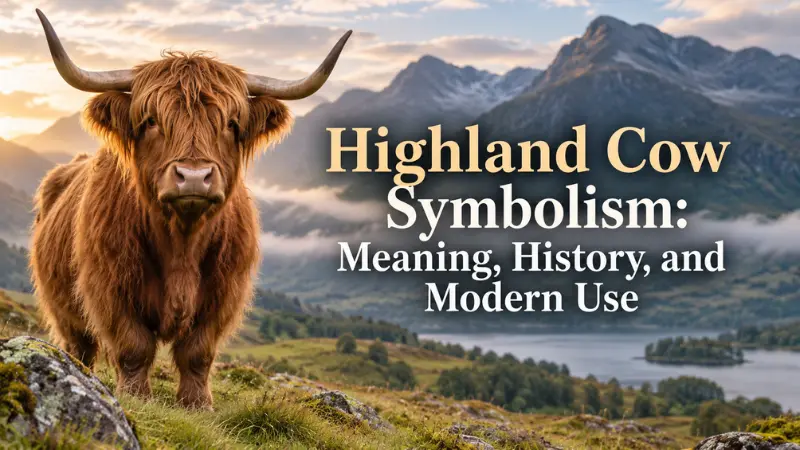
With sweeping horns, a long shaggy coat, and a calm expression, Highland cattle have one of the most recognizable appearances of any farm animal. Highland cow symbolism today commonly centers on resilience, quiet strength, protection, Scottish heritage, and a grounded connection to rural life.
Those meanings are not part of one ancient symbolic system. Rather, they developed from the breed’s real history in Scotland, its ability to live in difficult environments, its maternal behavior, and the way artists and modern culture portray the animal.
In the United States, Highland cows now appear far beyond cattle farms. Their faces show up in wall art, rustic interiors, clothing, gifts, social media posts, and tattoos. That modern popularity has added ideas such as comfort, individuality, simplicity, and self-reliance to the animal’s symbolism.
Quick Answer
Highland cow symbolism most often represents resilience, calm strength, protection, independence, and rural authenticity in modern American culture. Its deeper associations come from the breed’s Scottish origins, survival in harsh landscapes, protective maternal traits, and long connection with Highland farming life.
TL;DR
- Highland cows commonly symbolize resilience and steady strength.
- Their Scottish origins connect them with heritage and cultural pride.
- Protective cows can represent motherhood, family, and guardianship.
- Their rugged appearance suggests independence and self-sufficiency.
- American decor often uses them to express rustic warmth.
- Their symbolism is modern rather than a fixed ancient tradition.
What Makes a Highland Cow So Visually Distinctive?
Highland cattle originated in western Scotland and are known for long, flowing hair, a broad face, and large curved horns. Although reddish-brown animals dominate popular images, the breed also occurs in black, yellow, white, dun, brindle, and other recognized colors. (Highland Cattle Society)
The thick coat is more than decoration. It helped the breed cope with cold, wet, windy environments where exposed grazing conditions could be demanding. That physical adaptation strongly shapes the symbolism people attach to the animal.
The horns also affect how people read its appearance. They create an impression of strength and defense, while the shaggy hair softens the animal visually. This mixture of toughness and gentleness explains why Highland cows can represent both protection and warmth.
Technically, a cow is an adult female bovine. People often use “Highland cow” more loosely, however, when talking about Highland cattle in art, gifts, and popular culture.
What Highland Cows Commonly Mean in the United States
American interpretations usually focus on characteristics that are easy to recognize from the breed itself.
A Highland cow may symbolize someone who remains steady under pressure, protects the people they care about, and does not need to appear aggressive to be strong. It can also express appreciation for farming, country living, Scotland, family heritage, or a simpler pace of life.
Common American associations include:
| Context | Meaning in the USA | Common Associations | Notes |
| Home decor | Comfort and rustic simplicity | Farmhouses, country homes, warmth | Often playful rather than traditional |
| Tattoos | Resilience and individuality | Strength, independence, endurance | Meaning depends on the wearer |
| Scottish heritage | Cultural connection | Ancestry, Highlands, pride | Usually cultural, not religious |
| Family imagery | Protection and care | Motherhood, loyalty, security | Influenced by maternal behavior |
| Nature imagery | Rugged self-reliance | Open land, endurance, adaptability | Linked to the breed’s environment |
These meanings overlap, but context matters. A Highland cow picture in a kitchen may simply create a cozy rural mood, while the same animal in a tattoo may represent surviving a difficult period of life.
Why Resilience Is Its Strongest Symbolic Meaning
Resilience is probably the most grounded meaning attached to Highland cattle.
The breed developed in areas known for cold temperatures, strong winds, heavy rainfall, rough vegetation, and difficult upland terrain. Highland cattle became valued for their ability to remain productive in conditions that were challenging for less hardy livestock. Breed organizations continue to emphasize hardiness and adaptability as defining characteristics. (breeds.okstate.edu)
That history makes the animal an intuitive symbol for enduring hardship.
A person may therefore use a Highland cow image to communicate:
- surviving difficult circumstances
- adapting without losing one’s identity
- staying dependable during uncertainty
- remaining patient through long challenges
- finding strength in difficult surroundings
This symbolism differs from dramatic ideas of victory or conquest. The Highland cow represents endurance that is steady rather than flashy.
It survives because it is suited to its environment, not because it dominates everything around it.
Quiet Strength Without Aggression
Highland cows look formidable because of their size and horns, yet the breed is also widely described as calm or even-tempered when properly handled. VisitScotland similarly describes the animals as generally calm while reminding visitors that they remain large livestock that deserve space and caution. (breeds.okstate.edu)
That contrast creates one of the animal’s most appealing modern meanings: strength without unnecessary aggression.
Someone drawn to this symbolism may identify with being capable but reserved. The message is not “I must prove that I am powerful.” It is closer to “I know what I can withstand.”
For this reason, Highland cow imagery can suit people who value patience, emotional control, and confidence that does not depend on constant attention.
The horns make the animal look capable of defending itself. Its relaxed stance, however, keeps that strength from feeling hostile.
Motherhood, Protection, and Family Bonds
Female Highland cattle are known for attentive maternal behavior, and American breed standards specifically describe cows as strong mothers that should remain attentive to their young. (AHCA)
That gives the Highland cow a natural connection with motherhood and family protection.
In symbolic art, a cow standing beside a calf may represent:
- parental devotion
- safety
- nurturing
- loyalty to family
- protective love
- guiding children while allowing independence
This imagery is especially appropriate for family artwork or tattoos honoring a mother, child, or close family bond.
The meaning is more specific when a calf appears. A lone Highland cow usually emphasizes endurance, heritage, or individuality, while a cow-and-calf scene more clearly suggests care and family connection.
Scottish Heritage and Cultural Identity
Highland cattle have become internationally recognizable symbols of Scotland. Scotland’s national tourism organization openly describes them as Scottish icons, and encounters with Highland cows are promoted as part of experiencing the country’s landscapes and rural culture. (VisitScotland)
Their cultural importance comes partly from geography. The breed developed in the Highlands and western islands, places closely associated with some of Scotland’s most recognizable landscapes and traditions.
For Americans with Scottish ancestry, a Highland cow can therefore function as an ancestry symbol alongside tartan, thistles, castles, Celtic-inspired art, or Highland scenery.
It can express attachment to:
Scottish family roots, Highland landscapes, rural ancestry, traditional farming, or Scottish cultural identity.
Still, the animal should not be treated as an official national emblem in the same sense as Scotland’s unicorn or thistle. Its status is better understood as a widely recognized cultural icon.
From Working Livestock to a Scottish Icon
The Highland cow’s symbolism began with practical value rather than mythology.
Cattle once played an important economic role in Highland communities. Livestock could represent food, trade, wealth, and survival in agricultural societies. VisitScotland’s material on clan history notes that cattle were an important form of wealth in the Highlands and could even become a source of conflict between groups. (VisitScotland)
The modern Highland breed was formally preserved through organized breeding in the nineteenth century. The Highland Cattle Society formed in 1884, and its first herd book followed in 1885. (Highland Cattle Society)
Over time, the animal’s appearance became almost as culturally important as its agricultural role. Its unusual coat and horns made it attractive to painters, photographers, tourists, and eventually commercial designers.
This transition explains why a farm animal can now carry meanings that go well beyond livestock production.
Highland Cow Symbolism in American Farmhouse Decor
In the United States, one of the most visible modern uses of Highland cow imagery is home decoration.
Large portraits of shaggy cattle appear in living rooms, kitchens, bathrooms, nurseries, offices, and farmhouse-style interiors. Major American retailers sell Highland cow wall art in styles ranging from realistic photography to humorous bathroom scenes. (Target)
In this setting, the animal usually communicates less about Scotland and more about atmosphere.
It can suggest:
Warmth. The thick coat and soft facial features create visual comfort.
Country living. Cattle imagery immediately connects a room with farms and open land.
Simplicity. The animal fits interiors designed to feel less formal and more relaxed.
Personality. Its unusual appearance adds humor and character that generic farm imagery may lack.
Nostalgia. Rural animals can evoke an imagined slower lifestyle separated from crowded cities and constant technology.
For many homeowners, the Highland cow is therefore an emotional design symbol rather than a historical one.
What a Highland Cow Tattoo Can Symbolize
A Highland cow tattoo has no single fixed meaning.
Many people choose it for resilience. The breed’s ability to survive exposed landscapes makes it a natural image for someone who has endured difficult circumstances without losing their identity.
Others may use it to represent Scottish ancestry or a memorable connection with Scotland.
A tattoo may also stand for independence. A solitary Highland cow surrounded by mountains can suggest a person comfortable following their own path.
Different designs change the message. A cow with wildflowers may emphasize gentleness or natural beauty. A cow and calf can symbolize parenthood. A dramatic horned portrait can highlight courage and self-protection.
Humorous Highland cow tattoos are also common in principle because the animal’s shaggy bangs and expressive face lend themselves easily to playful artwork.
The wearer’s intention matters more than any supposed universal definition.
Do Highland Cow Colors Change the Meaning?
Color can influence modern interpretation, but there is no traditional rule assigning a spiritual meaning to each Highland cattle color.
Reddish Highland cattle are the image most Americans recognize. Warm brown and red shades often make artwork feel earthy, welcoming, autumnal, or rustic.
Black Highland cattle may appear more dramatic. In art or tattoos, black can emphasize strength, seriousness, mystery, or visual contrast.
White or very pale cattle may suggest calmness, simplicity, winter landscapes, or purity in modern design.
Dun and yellow coats tend to create warmer, softer imagery.
These are largely color-psychology and design associations, not historic Highland cattle beliefs. The breed naturally comes in several colors, so it is inaccurate to claim that a black, red, or white Highland cow carried a universal spiritual message in traditional Scotland.
Why People Connect the Animal With Independence
The Highland cow often appears alone in photographs: standing on a hillside, facing wind, walking through rough grass, or looking directly toward the camera.
That visual language encourages an association with independence.
The real breed also contributes to this perception. Highland cattle are known for functioning in exposed environments and making use of rough grazing that may be less suitable for some other cattle. (breeds.okstate.edu)
In modern symbolism, that can translate into the idea of needing less approval, comfort, or protection from outside sources.
The meaning is not complete isolation. Cattle remain social herd animals. Rather, the Highland cow represents self-sufficiency within a community: the ability to stand firmly while still belonging to something larger.
That distinction makes it a useful symbol for mature independence rather than loneliness.
The Emotional Appeal of the Shaggy Face
Part of the Highland cow’s popularity comes from a visual contradiction.
The animal has huge horns, a heavy frame, and the body of rugged livestock. Yet its long bangs, soft coat, and often calm facial expression can make it look friendly or even comical.
That contrast allows people to project both security and tenderness onto the animal.
Psychologically, soft textures often make objects appear warmer and more approachable. The shaggy coat reinforces that effect in photographs and illustrations. Meanwhile, the horns prevent the animal from becoming visually fragile.
The result is an unusually balanced symbol: soft but not weak, strong but not threatening.
This helps explain why Highland cow imagery works equally well in children’s rooms, rustic homes, serious tattoos, and humorous gifts.
Rural Simplicity and the Desire for a Slower Life
Modern Americans frequently encounter the Highland cow far from an actual farm.
Its image may represent an idealized countryside where life seems quieter, more physical, and less dominated by screens, schedules, and crowded spaces.
That does not mean real farm life is simple. Farming requires labor, money, knowledge, planning, and constant responsibility.
Symbolically, however, rural imagery can stand for a different set of priorities: land, seasons, animals, family routines, practical work, and time spent outdoors.
The Highland cow fits that visual language particularly well because its appearance feels less industrial than many familiar cattle breeds.
For someone decorating a suburban apartment, the animal may not represent farming literally at all. It may represent the feeling of being grounded.
Connection With Nature and Land Stewardship
Another modern association comes from the breed’s use in land management.
Highland cattle can graze rough vegetation and are used in some conservation projects to control overgrowth and help maintain varied habitats. National Trust projects in Britain, for example, have used Highland cattle for conservation grazing because they can browse coarse vegetation and tolerate demanding outdoor conditions. (National Trust)
This gives the animal a contemporary connection with stewardship and working landscapes.
In environmental imagery, a Highland cow can therefore suggest a relationship between agriculture and land management rather than untouched wilderness.
That distinction matters. Highland cattle are domesticated animals, not wild creatures. Their connection with nature comes from centuries of farming and grazing within landscapes shaped by both people and animals.
As a symbol, they can represent living productively with difficult land instead of simply controlling it.
What Highland Cow Symbolism Does Not Traditionally Mean
Online symbolism can become unreliable when modern interpretations are presented as ancient facts.
There is no strong basis for claiming that Highland cows had one universal Celtic spiritual meaning, served as a sacred Highland animal, or represented a specific supernatural force across ancient Scotland.
Cattle more broadly appear in many religions, myths, and traditional societies. That does not automatically make every cattle tradition part of Highland cow symbolism.
Likewise, claims that seeing a Highland cow is automatically an omen of money, romance, pregnancy, or spiritual awakening should be treated as personal or modern interpretations rather than established cultural traditions.
The historically defensible meanings are more grounded: livelihood, agricultural value, Scottish place and identity, toughness, adaptation, and later cultural recognition.
Modern symbolic meanings such as resilience and protection make sense because they grow from those characteristics.
How the Meaning Has Changed Over Time
For earlier Highland communities, cattle mattered primarily because they were useful animals connected with survival and the agricultural economy.
During the nineteenth and twentieth centuries, organized breeding helped preserve the Highland as a distinctive Scottish breed. The cattle also reached North America. Records from the American Highland Cattle Association document imports in the late nineteenth and early twentieth centuries, with American ranchers particularly interested in hardiness. (AHCA)
As travel photography, tourism, advertising, and consumer design expanded, the Highland cow increasingly became an image of Scotland itself.
More recently, American farmhouse decor and social media have softened that image further. The animal can now be cute, humorous, cozy, stylish, or sentimental.
Its symbolic path has therefore moved through several stages:
working livestock → hardy heritage breed → Scottish cultural icon → global rural image → personal symbol of resilience and warmth.
The newer meanings have not replaced the older ones. They sit on top of the animal’s agricultural history.
FAQs
Is a Highland cow a symbol of good luck?
A Highland cow is not traditionally recognized as a universal Scottish good-luck symbol. People may personally use one as a positive sign of endurance, security, prosperity, or strength, but those interpretations should not be confused with established folklore.
What does a Highland cow tattoo mean?
A Highland cow tattoo commonly represents resilience, independence, calm strength, Scottish heritage, or protection. A cow with a calf can add themes of motherhood and family devotion.
What does a Highland cow symbolize spiritually?
There is no single traditional spiritual meaning specific to the Highland breed. In modern personal spirituality, people sometimes associate it with groundedness, perseverance, protection, and staying steady during difficult periods.
Is the Highland cow a Scottish symbol?
Yes, in a broad cultural sense. Highland cattle have become highly recognizable icons of Scotland because of their Scottish origins, distinctive appearance, and strong presence in tourism and rural imagery, although they are not an official national emblem. (VisitScotland)
What does a Highland cow represent in home decor?
In American interiors, Highland cow artwork usually communicates rustic warmth, country character, comfort, and a relaxed farmhouse atmosphere. Some designs also use the animal humorously because of its long bangs and expressive face.
Does a Highland cow symbolize strength?
Yes, especially enduring or quiet strength. Its reputation for hardiness in difficult climates makes resilience a more fitting interpretation than aggression or dominance.
What does a Highland cow and calf symbolize?
A cow and calf most naturally symbolize maternal protection, caregiving, family bonds, and security. Because Highland cows are known for strong maternal behavior, this interpretation has a clear connection to the actual breed.
Conclusion
The Highland cow is most convincingly understood as a symbol of resilience, steady strength, protection, independence, Scottish heritage, and connection with rural life. Its meaning comes less from ancient mythology than from the real qualities and history of an animal shaped by Scotland’s demanding landscapes.
Today, Highland cow symbolism continues to evolve as the breed appears in American tattoos, farmhouse interiors, artwork, clothing, gifts, and digital culture. What keeps the image meaningful is the same contrast that makes the animal so memorable: toughness without harshness, protection without aggression, and an unmistakable ability to remain itself in difficult surroundings.


