
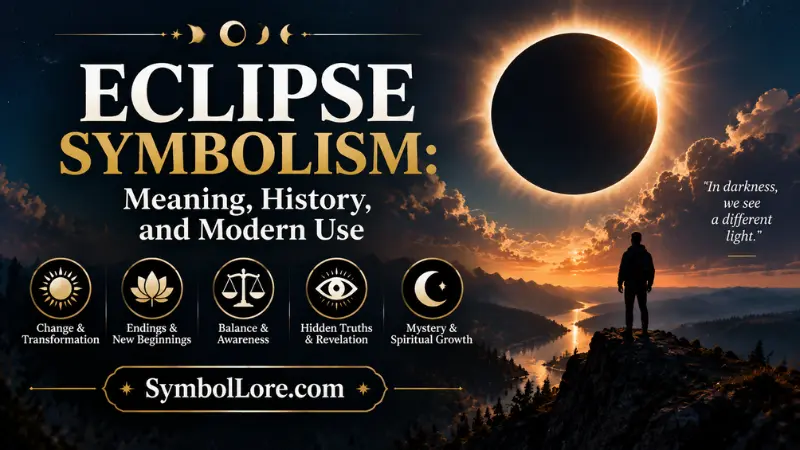
An eclipse is one of nature’s most striking visual events, occurring when one celestial body temporarily blocks another from view. The eclipse symbolism connected with these events often represents transformation, change, reflection, and moments when hidden aspects become visible. Across cultures, eclipses have inspired stories, beliefs, scientific curiosity, and artistic expression.
In modern American culture, eclipses are usually viewed through both scientific and symbolic perspectives. People gather to observe them, photograph them, create artwork around them, and use their imagery to represent personal transitions or important moments.
Although ancient societies sometimes interpreted eclipses as warnings or supernatural events, modern understanding focuses more on astronomy while still appreciating the emotional and cultural meanings attached to these rare occurrences.
Quick Answer
Eclipse symbolism commonly represents change, transformation, and new perspectives in modern American culture, especially during personal milestones, artistic expression, and moments of reflection. Historically, eclipses were also associated with spiritual beliefs, cosmic balance, and major turning points in many societies.
TL;DR
- Eclipses symbolize change, renewal, and transformation.
- Ancient cultures connected eclipses with myths and cosmic events.
- Americans often view eclipses through science and reflection.
- Lunar and solar eclipses carry different interpretations.
- Eclipse imagery appears in art, tattoos, and design.
What an Eclipse Represents and Why It Captures Attention
An eclipse occurs when one celestial object moves between another object and an observer, creating a temporary change in what people see in the sky. The two most familiar types are solar eclipses, when the Moon blocks the Sun, and lunar eclipses, when Earth’s shadow falls across the Moon.
The unusual nature of eclipses has made them symbols of interruption, transition, and renewal. Unlike ordinary changes in the sky, an eclipse creates a dramatic moment where light and darkness appear together.
This contrast is one reason people connect eclipses with personal experiences. Many interpret the event as a reminder that circumstances can shift and that temporary periods of uncertainty can lead to new understanding.
What It Commonly Means in the United States
In the United States, eclipses are generally understood as scientific events, but they also carry personal and cultural meanings. Many Americans associate eclipses with curiosity, discovery, and moments worth remembering.
Modern symbolic interpretations often include:
- transformation
- personal growth
- new beginnings
- awareness
- balance between opposites
A person watching a total solar eclipse may experience a sense of connection with nature and the larger universe. For some, the event becomes a meaningful memory tied to family gatherings, travel, education, or personal reflection.
| Context | Meaning in the USA | Common Associations | Notes |
| Personal growth | Transformation and change | New chapters, reflection | Often used metaphorically |
| Science events | Discovery and curiosity | Learning, exploration | Astronomy is central |
| Art and design | Contrast and balance | Light and shadow | Common visual theme |
| Tattoos | Personal transformation | Identity, life changes | Meaning varies by person |
| Social events | Shared experience | Community, celebration | Eclipse gatherings are popular |
Ancient Roots and Early Eclipse Symbolism
Before modern astronomy explained eclipses, many civilizations developed stories to understand these unusual events. The sudden disappearance of sunlight or changes in the Moon’s appearance created questions about the relationship between humans, nature, and the sky.
Ancient Chinese traditions included stories of celestial creatures consuming the Sun during eclipses. In some Mesopotamian cultures, eclipses were carefully observed because leaders and communities viewed them as significant signs connected with political or social events.
These interpretations reflected the limited scientific knowledge of earlier periods. Eclipses were not random mysteries but powerful natural events that encouraged people to create explanations based on their religious, cultural, and social frameworks.
Solar Eclipse Symbolism: Light Temporarily Hidden
A solar eclipse occurs when the Moon passes between Earth and the Sun, causing the Sun’s light to become partially or completely blocked.
Symbolically, solar eclipses are often connected with:
- hidden potential
- temporary obstacles
- transformation
- revealing what was unnoticed
The image of daylight becoming dark creates a strong metaphor. Something familiar changes briefly, reminding people that circumstances can shift quickly.
In modern storytelling and personal symbolism, solar eclipses are often used to represent moments when someone leaves an old identity behind and moves toward a new stage of life.
Lunar Eclipse Symbolism: Reflection and Inner Change
A lunar eclipse happens when Earth moves between the Sun and the Moon, casting a shadow across the Moon’s surface.
Because the Moon is often associated with emotions, intuition, and reflection in cultural symbolism, lunar eclipses are frequently connected with inner awareness.
Some common interpretations include:
- emotional understanding
- self-reflection
- accepting change
- releasing old patterns
These meanings are symbolic rather than scientific facts, but they explain why lunar eclipse imagery appears often in poetry, artwork, and personal storytelling.
Religious and Spiritual Interpretations of Eclipses
Eclipses have appeared in religious traditions around the world. Different communities have interpreted them in different ways, ranging from signs of change to reminders of cosmic order.
In some religious texts and traditions, unusual events in the sky are described as moments requiring reflection or attention. However, interpretations vary widely between faith communities.
Today, many religious and spiritual individuals view eclipses as opportunities for contemplation rather than as predictions of specific events. The meaning often depends on personal belief and cultural background.
Mythology and Folklore Connected With Eclipses
Myths about eclipses often involve struggles between forces of light and darkness. These stories helped explain natural events before scientific explanations became widely available.
Examples from different traditions include stories of:
- creatures chasing or consuming celestial bodies
- battles between cosmic forces
- temporary disruptions in universal order
These myths reveal how humans have always looked to the sky to understand important moments. Eclipse stories often reflect concerns about balance, survival, and the relationship between people and nature.
Emotional and Psychological Meaning of Eclipse Imagery
The visual contrast of an eclipse naturally creates emotional responses. A bright sky becoming dark or a familiar Moon changing appearance can encourage feelings of wonder and curiosity.
Psychologically, eclipse imagery is often used to represent transitions. People may connect it with experiences such as:
- moving to a new place
- changing careers
- ending one stage of life
- beginning another journey
The symbol works because it reflects a common human experience: change can feel uncertain, but it can also create opportunities for growth.
Eclipse Symbolism in American Culture and Public Life
Eclipses have become major public events in the United States. Communities organize viewing gatherings, schools use them as educational opportunities, and families travel to areas where the event is visible.
The cultural importance of eclipses in America often comes from shared experience. People who may have different backgrounds can participate in the same natural event at the same moment.
This collective experience gives eclipses a social meaning beyond astronomy. They become memories connected with community, learning, and appreciation for the natural world.
Eclipse Imagery in Tattoos, Fashion, and Identity
Eclipse designs are common in tattoos because the imagery allows for many personal interpretations. A person may choose an eclipse tattoo to represent change, resilience, balance, or an important life transition.
Common eclipse tattoo styles include:
- Sun and Moon combinations
- dark circles covering light sources
- celestial patterns
- minimalist astronomical designs
In fashion and artwork, eclipse imagery often communicates contrast and harmony. The combination of light and shadow creates a visual theme that fits modern design styles.
Eclipse Symbolism in Art, Literature, and Pop Culture
Artists and writers frequently use eclipses to represent moments when normal reality changes. Because eclipses create a temporary interruption in the natural order, they work well as symbols in stories involving transformation.
In literature and film, eclipses may appear during:
- major turning points
- emotional discoveries
- dramatic changes
- moments of mystery
However, fictional uses often exaggerate eclipse meanings. In real life, eclipses do not predict personal events or guarantee specific outcomes.
Common Misunderstandings About Eclipse Symbolism
One common misunderstanding is treating eclipse symbolism as a universal rule. Meanings differ across cultures, religions, and personal experiences.
Another misconception is that eclipses have proven supernatural effects on human behavior. Scientific research does not support claims that eclipses directly control emotions, decisions, or events.
The symbolic value of an eclipse comes from human interpretation, storytelling, and cultural traditions rather than from evidence that the event changes human lives.
How Eclipse Meaning Has Changed Over Time
Human understanding of eclipses has changed significantly. Earlier societies often explained them through mythology and religious beliefs, while modern science explains them through astronomy.
However, scientific understanding did not remove symbolic interest. Instead, it changed the way many people interpret eclipses.
Today, eclipses can represent both knowledge and imagination. They remind people of scientific discovery while also providing a visual language for discussing change and personal experiences.
Modern Uses of Eclipse Symbolism
Today, eclipse imagery appears in many forms, including:
- jewelry designs
- home decorations
- photography
- digital artwork
- tattoos
- educational materials
The symbol remains popular because it combines scientific reality with emotional meaning. A person can appreciate an eclipse as an astronomical event while also seeing it as a reminder of transformation or perspective.
Digital culture has also expanded eclipse imagery, with photographs and artwork shared widely during major celestial events. These images allow people to participate in a shared global experience.
FAQs
What does an eclipse symbolize spiritually?
An eclipse may symbolize reflection, transformation, and awareness in some spiritual traditions. The meaning depends on individual beliefs and cultural background rather than a single universal interpretation.
What does an eclipse tattoo mean?
An eclipse tattoo can represent personal change, balance between opposing forces, or an important life transition. Many people choose the design because it reflects their own experiences.
Are eclipses considered good or bad symbols?
Eclipses have been interpreted in both positive and negative ways throughout history. Modern interpretations often focus on change, curiosity, and reflection rather than predicting good or bad events.
What is the difference between solar and lunar eclipse symbolism?
Solar eclipse symbolism often focuses on hidden light, transformation, and external change. Lunar eclipse symbolism is more commonly connected with reflection, emotions, and internal awareness.
Why did ancient cultures fear eclipses?
Many ancient societies lacked scientific explanations for eclipses, so they created stories to explain sudden changes in the sky. These interpretations often reflected concerns about order, power, and nature.
Do eclipses have symbolic meaning in American culture today?
Yes, many Americans view eclipses as meaningful experiences connected with science, community, personal reflection, and appreciation for nature.
Conclusion
Eclipses have inspired human imagination because they combine a real astronomical event with powerful visual contrast. They represent moments when something familiar changes temporarily, creating opportunities for reflection and new perspectives.
Modern eclipse symbolism connects ideas of transformation, balance, and discovery with personal and cultural experiences. While interpretations differ across traditions, the eclipse remains a meaningful image because it reflects one of life’s most common experiences: change.


[…] endurance, independence, and adaptation. Its ability to survive on steep cliffs has made it a natural symbol of overcoming obstacles and […]