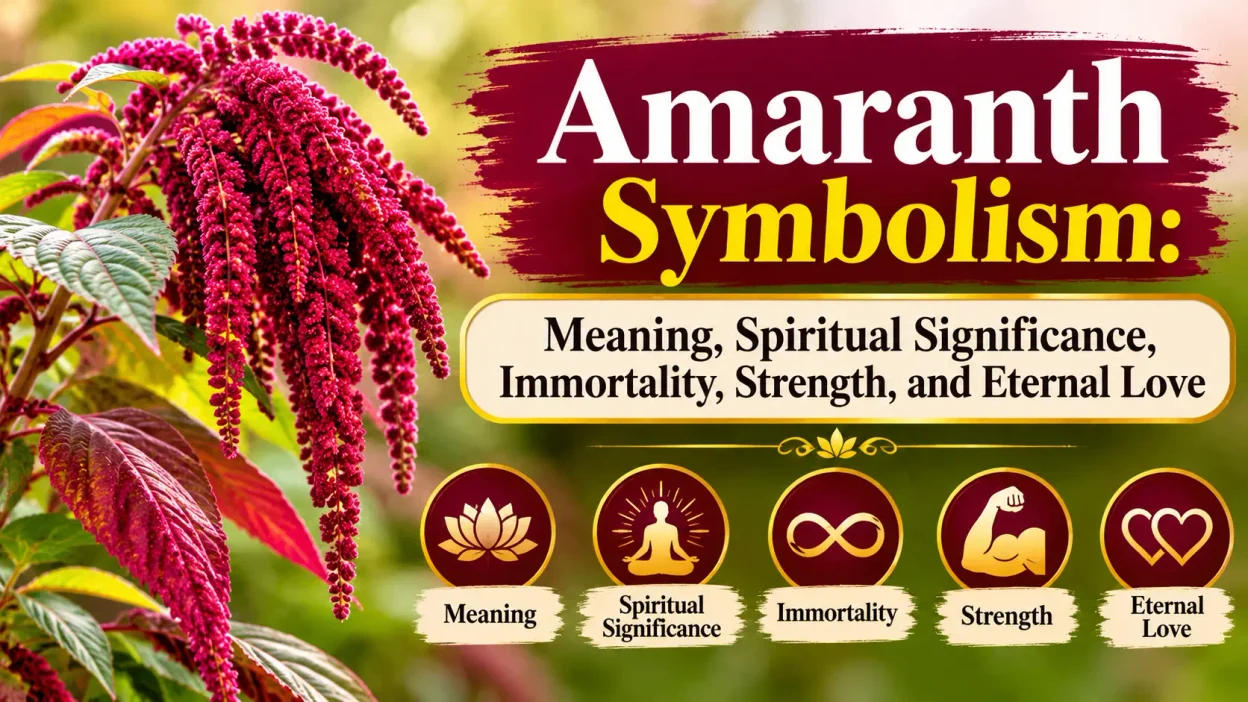
Amaranth is a remarkable flowering plant known for its vivid colors, unusual flower clusters, and ability to thrive in challenging conditions. Its beauty and natural resilience have made it a meaningful symbol of endurance, immortality, remembrance, and lasting affection. Unlike flowers that quickly lose their appearance after being picked, certain amaranth varieties retain much of their color when dried, strengthening their association with permanence and things that endure through time.
The word amaranth is connected to the Greek word amarantos, meaning “unfading” or “everlasting.” This association gives the flower a powerful symbolic connection with eternal love, undying memories, spiritual strength, and the continuation of life.
Amaranth symbolism also reflects resilience and the ability to flourish despite difficulties. Its colorful appearance and long history as both an ornamental plant and a food crop have given it different meanings across cultures.
Whether encountered in a garden, floral arrangement, historical artwork, or spiritual reflection, amaranth can represent the beauty of endurance and the importance of preserving what truly matters.
1. Amaranth Symbolizes Immortality and Eternity
One of the most recognized symbolic meanings of amaranth is immortality. Its name comes from the Greek amarantos, meaning unfading, which reflects the flower’s association with lasting beauty and permanence.
Some amaranth varieties retain their color and shape after drying, making them suitable for dried-flower arrangements. This characteristic has helped connect the plant with the idea that certain things can survive the passage of time.
Amaranth may symbolize:
- Immortality and eternal existence
- Lasting beauty
- The continuation of life
- Memories that never disappear
- Spiritual permanence
- Love that withstands time
In poetry and literature, amaranth can represent something precious that refuses to fade. It may stand for a relationship, a memory, or a personal value that remains meaningful even as circumstances change.
Its symbolism offers a reminder that not everything valuable is temporary. Some connections and experiences continue to influence us long after their original moments have passed.
2. Amaranth Symbolizes Endurance and Resilience
Amaranth is also a powerful symbol of resilience. Many species in the Amaranthus genus are adaptable plants that can grow under a range of environmental conditions.
Their ability to develop in challenging surroundings makes them fitting symbols of persistence and determination.
Amaranth can represent:
- Strength during difficult times
- The ability to recover from setbacks
- Emotional resilience
- Persistence and determination
- Adaptability
- Growth despite adversity
This meaning is especially relevant to people who have experienced significant challenges but continue moving forward.
Like a plant that keeps growing despite unfavorable conditions, a resilient person can find ways to adapt, rebuild, and develop new strength.
Amaranth reminds us that endurance does not mean avoiding hardship. It means continuing to grow even when circumstances are difficult.
3. Amaranth Represents Eternal Love and Devotion
Because of its connection with unfading beauty, amaranth is often interpreted as a symbol of eternal love and lasting devotion.
Its symbolism goes beyond temporary attraction. It suggests affection that remains meaningful through time, distance, and changing circumstances.
Amaranth may represent:
- Unconditional affection
- Long-lasting romantic love
- Loyalty and commitment
- Devotion between partners
- Emotional connection
- Memories of loved ones
In floral arrangements, amaranth can communicate a message of enduring affection. It may be especially meaningful for anniversaries, wedding celebrations, or gifts intended to express lasting commitment.
Its association with permanence also makes it suitable for representing family bonds and friendships that remain strong through different stages of life.
4. Amaranth Symbolizes Remembrance and Undying Memories
Amaranth’s association with unfading beauty gives it a natural connection with remembrance.
Flowers are often used to express emotions that are difficult to communicate through words. Some blooms represent affection, while others are associated with grief, gratitude, or celebration. Amaranth can bring these themes together by representing memories that remain alive in the heart.
Its symbolic meanings include:
- Remembering loved ones
- Preserving meaningful experiences
- Honoring lasting relationships
- Keeping memories alive
- Emotional continuity
- Respect for the past
Amaranth may be used in personal interpretations of remembrance because its appearance can remain attractive after drying.
It can therefore represent the idea that although people and circumstances change, meaningful memories can continue to shape our lives.
5. Amaranth Symbolizes Spiritual Strength and Inner Growth
From a spiritual perspective, amaranth is often interpreted as a symbol of inner strength, endurance, and the ability to maintain hope.
Its connection with eternity can also encourage reflection on values that extend beyond temporary experiences.
Some spiritual interpretations associate amaranth with:
Inner strength: The flower can represent the ability to remain steady during emotional or spiritual challenges.
Personal transformation: Its growth can serve as a reminder that difficult experiences may lead to development.
Eternal connection: Its unfading associations may represent enduring love, faith, and meaningful relationships.
Hope: Amaranth can symbolize the belief that difficult periods do not have to define the future.
Spiritual endurance: It may represent commitment to personal values even when circumstances become challenging.
These meanings are symbolic interpretations rather than universal religious teachings. The plant does not have one fixed spiritual meaning shared by every culture or tradition.
6. Amaranth Symbolizes Beauty That Does Not Fade
Amaranth has an unusual quality that contributes greatly to its symbolism: certain varieties maintain their color and visual appeal when dried.
This characteristic makes it a fitting representation of beauty that survives beyond its original moment.
Unlike a flower that quickly loses its appearance after being cut, some amaranth flowers can be preserved and enjoyed in dried arrangements.
Symbolically, this quality can represent:
- Lasting beauty
- Timeless elegance
- The value of meaningful experiences
- Preservation of memories
- Inner beauty
- Things that remain important with age
Amaranth encourages a broader understanding of beauty. It suggests that beauty does not always depend on youth, freshness, or temporary perfection. Sometimes, its greatest value comes from its ability to endure.
7. Amaranth Symbolizes Abundance and Prosperity
Amaranth also has a connection with abundance because several species are cultivated for their edible leaves and nutritious seeds.
Grain amaranth has been an important food crop in parts of the Americas for centuries. Its seeds are used in different traditional dishes, while its leaves are eaten as vegetables in many regions.
This practical value gives the plant an association with nourishment, survival, and the resources needed for a flourishing life.
Amaranth may therefore symbolize:
- Abundance and nourishment
- Prosperity and well-being
- Agricultural fertility
- Sustenance and survival
- Growth and productivity
- Gratitude for natural resources
In a personal context, amaranth can represent the hope for a life filled with meaningful opportunities, healthy relationships, and the resources needed to thrive.
Its connection with abundance is not limited to material wealth. It can also represent emotional richness, creativity, knowledge, and personal fulfillment.
8. Amaranth Symbolism in Greek Mythology and Ancient Literature
The name amaranth has an important connection with ancient Greek language and literary tradition.
The Greek word amarantos means “unfading” or “unwithering.” This idea became associated with the concept of something that could remain beautiful and enduring beyond ordinary limits.
In ancient Greek literary imagery, amaranth was associated with lasting beauty and immortality. Later writers and poets also used the flower as a symbol of eternal life, undying affection, and timeless qualities.
Its symbolism can be understood through several themes:
- Immortal beauty
- Eternal remembrance
- Unchanging affection
- Permanence beyond time
- The desire to overcome mortality
Amaranth is sometimes described in popular accounts as an immortal flower of the Greek gods. Such descriptions are best understood as literary or symbolic associations rather than a single universally established ancient myth involving the modern botanical plant.
Nevertheless, its linguistic connection with unfading beauty explains why amaranth has remained an enduring symbol in poetry and floral symbolism.
9. Amaranth Symbolism in Mesoamerican Cultures
Amaranth has a long history as a food crop in the Americas, particularly in Mesoamerican civilizations.
Different species of Amaranthus were cultivated for their nutritious seeds and leaves. The plant was an important part of traditional agriculture and food systems, including those of the Aztec civilization.
Amaranth seeds also had ceremonial and ritual uses in some historical Mesoamerican practices. These uses were not simply decorative; they were connected with cultural, religious, and community traditions.
The plant’s broader historical significance can be associated with:
- Nourishment and survival
- Agricultural abundance
- Cultural continuity
- Community traditions
- Religious and ceremonial practices
It is important not to assign one universal spiritual meaning to amaranth across all Indigenous peoples of the Americas. Historical uses varied between communities, regions, and periods.
Today, amaranth continues to be valued as a traditional food crop and as a connection to agricultural knowledge and cultural heritage.
10. Different Colors of Amaranth and Their Symbolic Meanings
Amaranth plants come in several colors, including red, burgundy, green, purple, and golden shades. Different varieties may have different flower and foliage colors.
Color symbolism adds another layer to the plant’s meaning. These associations are general interpretations rather than fixed meanings recognized by every culture.
| Amaranth color | Common symbolic associations |
|---|---|
| Red | Passion, courage, love, and vitality |
| Burgundy | Deep affection, dignity, and enduring commitment |
| Purple | Spirituality, wisdom, creativity, and mystery |
| Green | Growth, renewal, nature, and abundance |
| Golden | Prosperity, success, warmth, and achievement |
| Pink | Tenderness, affection, and gentle love |
Red Amaranth
Red amaranth is often associated with passion, energy, courage, and emotional strength. Its intense color can suggest a powerful connection that remains meaningful over time.
Purple Amaranth
Purple amaranth may represent wisdom, creativity, spirituality, and dignity. Its rich color can create an association with depth and personal transformation.
Green Amaranth
Green amaranth is commonly connected with nature, renewal, nourishment, and growth. It can symbolize the ability to develop and flourish.
Golden Amaranth
Golden shades may suggest success, prosperity, warmth, and abundance. This interpretation is especially fitting for celebrations and positive new beginnings.
11. Amaranth Symbolism in Love and Relationships
Amaranth is a meaningful flower for representing lasting affection and emotional commitment.
Its association with unfading beauty makes it suitable for relationships built on trust, loyalty, and shared experiences.
In love, amaranth may symbolize:
- Eternal affection
- Loyalty and devotion
- Long-term commitment
- Emotional resilience
- Memories shared between partners
- Love that survives difficult periods
For married couples, amaranth can represent a relationship that continues to grow and remain meaningful over time.
For friendships, it may symbolize loyalty and appreciation. It can also serve as a reminder that meaningful relationships are strengthened through patience, care, and consistency.
Unlike flowers that are commonly associated with the excitement of new romance, amaranth is particularly suited to expressing the lasting nature of affection.
12. Amaranth Symbolism in Dreams
Dreaming about amaranth may invite reflection on endurance, personal growth, remembrance, and relationships that remain important.
However, there is no established biblical or universal dream interpretation that assigns one fixed meaning to seeing amaranth.
The details of a dream and the emotions involved can influence its personal significance.
| Amaranth dream | Possible symbolic interpretation |
|---|---|
| Seeing blooming amaranth | Growth, hope, and lasting beauty |
| Receiving amaranth as a gift | Appreciation, devotion, or lasting affection |
| Planting amaranth | Building something meaningful for the future |
| Seeing dried amaranth | Remembrance, preservation, or enduring memories |
| Red amaranth | Passion, courage, or emotional strength |
| Purple amaranth | Reflection, creativity, or spiritual exploration |
| Withered amaranth | Change, disappointment, or concern about something important |
| A field of amaranth | Abundance, growth, and possibilities |
These interpretations are possibilities for personal reflection, not predictions of future events.
A dream about amaranth may simply reflect personal memories, emotions, or an interest in the plant’s unusual appearance.
13. Amaranth as a Symbol in Art, Literature, and Poetry
Amaranth has appeared in literary and artistic imagery because of its association with unfading beauty and immortality.
Writers can use the flower to express ideas that are difficult to communicate through ordinary descriptions.
In poetry, amaranth may represent:
- Love that survives time
- Memories that remain alive
- Beauty beyond physical change
- Immortality and eternity
- Hope that survives hardship
- The preservation of meaningful experiences
Its name and symbolic history make it particularly suitable for romantic and philosophical writing.
An author might use amaranth to describe a relationship that remains meaningful after separation or a memory that continues to influence someone long after an important event.
In visual art, its distinctive flower clusters and rich colors can also suggest abundance, persistence, and natural beauty.
14. Amaranth in Tattoos and Personal Symbolism
An amaranth tattoo can carry a deeply personal message connected with endurance, lasting love, remembrance, or personal strength.
Because the flower has several symbolic associations, its meaning can be adapted to different life experiences.
Common amaranth tattoo meanings include:
- Immortality: Representing the desire for something meaningful to endure.
- Resilience: Honoring the ability to survive difficult experiences.
- Eternal love: Expressing affection that remains strong over time.
- Remembrance: Keeping the memory of a loved one close.
- Spiritual growth: Representing personal development and deeper understanding.
- Abundance: Celebrating growth, opportunity, and fulfillment.
Some people may choose red amaranth to represent courage or passion, while purple varieties can suggest creativity and spiritual reflection.
A small amaranth tattoo may express a quiet personal reminder, while a larger floral design can celebrate the plant’s distinctive appearance and rich symbolic history.
15. Amaranth Botanical Facts: Understanding the Plant Behind the Symbolism
Understanding amaranth’s botanical identity helps explain why its symbolism can vary.
Amaranth is not just one flower. The name generally refers to plants in the genus Amaranthus, which includes many species grown for ornamental purposes, edible leaves, or grain.
One important distinction is between Amaranthus species and globe amaranth, scientifically known as Gomphrena globosa. Although globe amaranth belongs to the same botanical family, Amaranthaceae, it is a different genus.
| Feature | Description |
|---|---|
| Common name | Amaranth |
| Botanical genus | Amaranthus |
| Plant family | Amaranthaceae |
| Common uses | Ornamental flowers, edible leaves, and grain |
| Flower appearance | Often arranged in dense clusters or hanging tassels |
| Common colors | Red, burgundy, green, purple, and golden shades |
| Notable characteristic | Some varieties retain color well when dried |
Several ornamental amaranths are known for their dramatic hanging flower clusters, while other species are cultivated primarily for their leaves or seeds.
This diversity is one reason amaranth has both decorative and practical importance.
Frequently Asked Questions About Amaranth Symbolism
1. What does amaranth symbolize?
Amaranth commonly symbolizes immortality, endurance, eternal love, remembrance, resilience, and lasting beauty. Its name is associated with the idea of something unfading or everlasting.
2. What is the spiritual meaning of amaranth?
In personal spiritual interpretations, amaranth can represent inner strength, spiritual endurance, renewal, hope, and lasting connections. Its symbolism varies across traditions and individual beliefs.
3. Why is amaranth called the flower of immortality?
The name comes from the Greek word amarantos, meaning “unfading” or “everlasting.” This linguistic connection, along with the ability of certain varieties to retain their color when dried, helped establish its association with immortality.
4. Does amaranth symbolize eternal love?
Yes. Amaranth is often interpreted as a symbol of eternal love, loyalty, and lasting devotion. Its association with unfading beauty makes it suitable for representing relationships that remain meaningful over time.
5. What does red amaranth symbolize?
Red amaranth is commonly associated with passion, courage, vitality, love, and emotional strength. Its vivid color makes it a natural symbol of powerful feelings and determination.
6. What does purple amaranth symbolize?
Purple amaranth may represent spirituality, wisdom, dignity, creativity, and mystery. Its rich color gives it an association with deeper reflection and personal growth.
7. What does amaranth symbolize in Greek mythology?
Amaranth is connected with the Greek concept of something unfading or everlasting. In ancient and later literary imagery, it became associated with immortality, eternal beauty, and lasting qualities.
8. What does amaranth mean in dreams?
Dreaming about amaranth may personally suggest endurance, remembrance, love, hope, or personal development. Dream symbolism is subjective, and there is no universally accepted interpretation.
9. Is amaranth a symbol of good luck?
Amaranth may be interpreted as a symbol of abundance, prosperity, and positive growth in some modern floral traditions. However, it is not universally recognized as a traditional good-luck symbol.
10. Is amaranth the same as globe amaranth?
No. Amaranth generally refers to plants in the genus Amaranthus, while globe amaranth is Gomphrena globosa. Both belong to the Amaranthaceae family but are botanically different genera.
Conclusion: The Deeper Meaning of Amaranth Symbolism
Amaranth is a flower and plant with a rich symbolic history. Its connection with the Greek idea of unfading beauty makes it a powerful representation of immortality, eternal love, remembrance, and lasting devotion. Its natural adaptability also gives it a meaningful association with resilience, endurance, and the ability to grow through challenging circumstances.
Across literary traditions, cultural history, and modern floral interpretations, amaranth continues to represent things that remain valuable despite the passage of time. Whether it symbolizes a lasting relationship, an important memory, personal strength, or the hope of a prosperous future, its message centers on permanence and growth.
Ultimately, amaranth reminds us that some of life’s most meaningful qualities do not easily fade. Love, courage, memories, and inner strength can continue to shape our lives long after individual moments have passed.