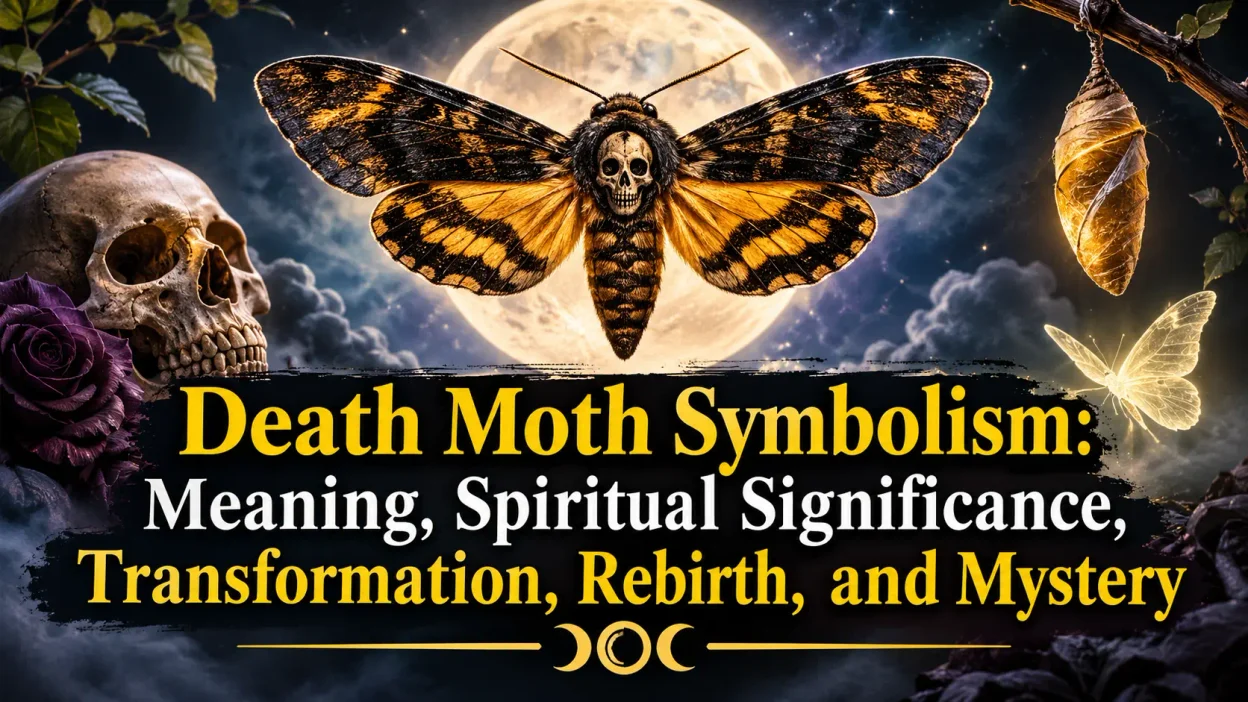
The death moth is one of the most mysterious and recognizable insects in symbolic imagery. Often associated with darkness, mortality, transformation, and the unknown, this unusual moth has captured human imagination through its distinctive appearance and dramatic markings. Its connection with death may seem frightening at first, but its symbolism is not limited to endings or misfortune. It can also represent rebirth, personal transformation, spiritual awareness, and the acceptance of life’s natural cycles.
The name “death moth” commonly refers to the death’s-head hawkmoth, a group of large moths belonging to the genus Acherontia. These moths are especially famous for the skull-like marking on their thorax, which gives them an eerie appearance and has contributed to their association with death and mystery.
Death moth symbolism explores the relationship between endings and beginnings. Just as a caterpillar transforms into a moth, people also experience periods of change that require them to leave old identities behind and embrace something new.
Whether appearing in folklore, dreams, tattoos, artwork, or a real-life encounter, the death moth can carry powerful symbolic meanings connected to mortality, courage, transformation, and the mysteries of existence.
1. Death Moths Symbolize Death and Mortality
One of the most recognizable meanings of the death moth is mortality. Its skull-like marking naturally reminds people of human skulls, which have long been used as symbols of death, impermanence, and the passage of time.
The moth’s appearance has contributed to its association with mortality in European folklore and popular culture.
However, death moth symbolism does not necessarily suggest physical death or an approaching tragedy. In a broader symbolic sense, it can represent the awareness that life is temporary and that every stage eventually comes to an end.
The death moth may symbolize:
- Human mortality
- The temporary nature of life
- Acceptance of life’s cycles
- The ending of an important chapter
- Awareness of personal limitations
- Reflection on what truly matters
Its appearance can encourage people to consider how they spend their time and what they want to leave behind.
Rather than representing a prediction of death, the moth can serve as a reminder to appreciate life while recognizing that change and endings are unavoidable parts of existence.
2. Death Moth Symbolism Represents Transformation and Change
Transformation is one of the most meaningful interpretations of moth symbolism.
Like butterflies, moths undergo complete metamorphosis. They begin as eggs, develop into caterpillars, enter a pupal stage, and eventually emerge as winged adults.
This dramatic change makes moths natural symbols of personal development and transformation.
The death moth can represent:
- Major life transitions
- Leaving the past behind
- Personal reinvention
- Emotional development
- Changes in identity
- The courage to embrace uncertainty
Its association with death adds another layer to this meaning. Symbolically, an old version of yourself may need to disappear before a new identity can develop.
For example, leaving a difficult relationship, changing careers, overcoming a painful experience, or developing a new perspective may feel like the end of one life chapter and the beginning of another.
The death moth reminds us that transformation can be uncomfortable, but it can also create opportunities for growth.
3. Death Moths Symbolize Rebirth and New Beginnings
Although the death moth is associated with mortality, it can also represent rebirth and renewal.
The moth’s life cycle demonstrates that transformation is not simply about losing something. It is also about becoming something different.
This makes the death moth a symbol of new beginnings that emerge after difficult endings.
Its symbolism may include:
- Starting over after hardship
- Emotional recovery
- Rebuilding confidence
- Discovering a new purpose
- Releasing outdated beliefs
- Finding hope after loss
The skull-like marking creates a visual connection with death, while the moth’s wings suggest movement, freedom, and the continuation of life.
Together, these features create a powerful symbolic contrast: an ending can become the beginning of something new.
In personal interpretations, the death moth may be meaningful during periods of recovery, self-discovery, and significant life changes.
4. Death Moths Represent Mystery and the Unknown
Moths are often associated with darkness because many species are active at night. The death moth’s unusual appearance strengthens this connection with mystery and the unknown.
Its skull-like pattern, large wings, and nocturnal behavior have helped make it a memorable figure in stories and artistic representations.
Death moth symbolism can therefore represent:
- Hidden truths
- Unanswered questions
- The mysteries of existence
- Uncertainty about the future
- The subconscious mind
- Curiosity about the unseen
The moth can serve as a symbol for situations in which people do not have all the answers.
It may also represent the willingness to explore unfamiliar experiences rather than allowing fear to prevent personal discovery.
Its symbolism encourages reflection on the unknown without assuming that everything mysterious must be dangerous.
5. Death Moths Symbolize Fear and Courage
The skull-like marking of the death moth can create an immediate association with fear. Its unusual appearance may remind people of danger, darkness, or the things they prefer not to confront.
However, this symbolism can also represent courage.
Fear is a natural response to uncertainty, change, and mortality. The death moth can symbolize the process of facing these fears instead of allowing them to control every decision.
It may represent:
- Confronting personal fears
- Accepting uncomfortable truths
- Emotional bravery
- Strength during uncertainty
- Facing change with confidence
- Developing resilience
For someone going through a difficult period, the death moth can serve as a reminder that courage does not mean having no fear. It means continuing forward despite uncertainty.
Its striking appearance also challenges the idea that something associated with darkness must be entirely negative.
6. Death Moth Spiritual Meaning
From a spiritual perspective, the death moth is often interpreted as a symbol of transformation, mortality, renewal, and reflection.
Its unusual markings may encourage people to think about the relationship between life and death, while its metamorphosis provides a natural image of personal change.
Some modern spiritual interpretations associate the death moth with:
Spiritual transformation: The moth may represent a period of inner change or the development of a new perspective.
Acceptance of mortality: Its skull-like marking can encourage reflection on the temporary nature of human life.
Release and renewal: It may symbolize letting go of old habits, painful memories, or limiting beliefs.
Hidden wisdom: Its nocturnal associations can represent curiosity about deeper truths and unexplored aspects of life.
Resilience: Its transformation from caterpillar to adult moth can symbolize the ability to adapt and continue growing.
These meanings are personal and vary across spiritual traditions. There is no universal religious teaching that assigns one fixed spiritual message to the death moth.
Importantly, seeing a death moth should not automatically be interpreted as a supernatural warning or prediction of death.
7. Death Moths and the Symbolism of the Skull
The death moth’s most distinctive feature is the skull-like marking on its thorax. This pattern is a major reason for its association with death and mystery.
The skull has a long history in human symbolism. It can represent mortality, danger, remembrance, and the temporary nature of physical existence.
When combined with the moth’s life cycle, the skull marking creates several symbolic possibilities:
- Death and rebirth
- The relationship between endings and beginnings
- Acceptance of mortality
- Transformation through difficult experiences
- Awareness of life’s fragility
In some artistic interpretations, the skull-like marking is not viewed as a symbol of destruction but as a reminder to live consciously.
The contrast between the skull and the moth’s wings creates an image of life continuing through change.
8. Death Moth Symbolism in Different Cultures and Folklore
The death’s-head hawkmoth has attracted attention in different regions because of its striking appearance and unusual behavior.
Its cultural associations are not identical everywhere, and many popular stories about the moth developed through folklore rather than established religious teachings.
European Folklore
In parts of Europe, the death’s-head hawkmoth became associated with death, bad luck, and supernatural mystery.
Its skull-like marking contributed to beliefs that encountering one could be an ominous sign. Such associations were influenced by historical fears of unusual animals and insects.
These beliefs are examples of folklore, not evidence that the moth predicts death or misfortune.
African and Asian Associations
The death’s-head hawkmoth occurs in parts of Africa, Europe, and Asia, depending on the species.
Its appearance and behavior may inspire different local interpretations, but there is no single universal African or Asian spiritual meaning for the insect.
It is important to distinguish documented cultural traditions from modern symbolic interpretations that may be applied to the moth.
Modern Gothic and Popular Culture
In modern art, fashion, horror imagery, and gothic aesthetics, the death moth often represents darkness, mortality, mystery, and transformation.
Its distinctive skull marking makes it particularly suitable for visual themes involving life, death, and the supernatural.
It has also appeared in film and literary imagery, where it can create an atmosphere of suspense or symbolize a character’s confrontation with mortality.
9. Death Moth Symbolism in Dreams
Dreaming about a death moth may reflect thoughts about change, uncertainty, fear, or the end of an important chapter.
The meaning of such a dream depends on its setting, the moth’s behavior, and the emotions experienced by the dreamer.
Some possible interpretations include:
| Death moth dream | Possible symbolic meaning |
|---|---|
| Seeing a death moth | Awareness of change, mystery, or mortality |
| A death moth flying toward you | Confronting an important issue or unexpected change |
| A death moth resting peacefully | Reflection, acceptance, or inner transformation |
| A death moth inside your home | Personal concerns, private changes, or uncertainty |
| A death moth following you | An unresolved fear or issue that needs attention |
| A dead death moth | The end of a difficult chapter or changing perspective |
| Holding a death moth | Accepting change or becoming comfortable with uncertainty |
| Several death moths | Multiple transitions or overwhelming concerns |
These interpretations are subjective rather than universal rules.
A dream about a death moth does not necessarily indicate danger, illness, or a future death. It may simply reflect personal emotions, memories, or concerns about change.
10. What Does It Mean to See a Death Moth in Real Life?
Encountering a death moth can be surprising because of its large size and unusual skull-like marking.
Some people attach personal spiritual meaning to such an encounter, especially when it happens during a period of significant change.
Possible symbolic interpretations include:
- A reminder of transformation: You may be entering a new stage of life.
- Acceptance of change: An encounter can inspire reflection on endings and beginnings.
- Awareness of mortality: It may encourage appreciation of the present.
- Courage during uncertainty: Its appearance can serve as a personal reminder to face difficult situations.
- Letting go: It may represent the desire to release something that no longer supports personal growth.
These interpretations are matters of personal belief, not scientifically established messages.
From a natural perspective, the moth may simply be resting, searching for food, or moving through its environment. Its presence does not mean that something bad will happen.
11. Death Moth Symbolism in Love and Relationships
Although the death moth is not traditionally a common romantic flower or animal symbol, it can carry meaningful interpretations in relationships.
Its association with transformation and endings makes it particularly relevant to relationships that involve emotional growth, difficult changes, or the process of letting go.
In love, the death moth may symbolize:
- Transformation through relationships
- Accepting the end of a connection
- Emotional healing after heartbreak
- Love that changes a person’s life
- Facing difficult truths
- Releasing unhealthy attachments
For some people, the death moth represents the idea that love can change us permanently, even when a relationship does not last forever.
It can also symbolize the end of an unhealthy relationship and the beginning of a more independent stage of life.
Its meaning is not necessarily negative. Sometimes, letting go is an important part of emotional renewal.
12. Death Moth Tattoo Meaning and Symbolism
Death moth tattoos are popular among people who appreciate gothic imagery, unusual insects, and symbolic designs connected with life and mortality.
The skull-like marking creates a dramatic visual statement, while the moth’s life cycle adds meanings related to change and rebirth.
A death moth tattoo may represent:
- Mortality: A reminder that life is temporary and valuable.
- Transformation: A personal journey of change and self-discovery.
- Rebirth: Starting again after a difficult experience.
- Resilience: Surviving emotional or personal challenges.
- Mystery: Interest in the unknown and unexplored parts of life.
- Individuality: Appreciation for unusual beauty and personal expression.
- Acceptance: Making peace with life’s uncertainties.
Popular Death Moth Tattoo Designs
| Tattoo design | Common symbolic interpretation |
|---|---|
| Realistic death moth | Acceptance of mortality and natural beauty |
| Death moth with a skull | Life, death, and impermanence |
| Death moth with a moon | Mystery, nighttime, and transformation |
| Death moth with flowers | Life continuing through change |
| Black-and-gray death moth | Mystery, remembrance, and gothic aesthetics |
| Death moth with a candle | Awareness, hope, and the passage of time |
The personal meaning of a tattoo ultimately depends on the individual. A death moth can commemorate a difficult chapter, honor someone who has passed away, or represent a commitment to personal transformation.
13. Death Moth Symbolism in Art and Literature
The death’s-head hawkmoth has a distinctive visual identity that makes it particularly effective in art and literature.
Its skull-like marking can create an atmosphere of suspense, while its association with metamorphosis introduces themes of transformation and renewal.
Writers and artists may use the death moth to communicate:
- The inevitability of death
- The mystery of human existence
- Fear of the unknown
- The contrast between beauty and darkness
- The transformation of identity
- The connection between life and death
One famous example is The Silence of the Lambs, where a death’s-head hawkmoth pupa is used as an important visual motif. The insect contributes to the film’s themes of transformation, identity, and disturbing psychological change.
In this context, the moth is not merely decorative. It reinforces the idea of transformation in a darker and more unsettling way.
14. Death Moth vs. Butterfly Symbolism
Death moths and butterflies both undergo complete metamorphosis, making them natural symbols of transformation. However, their cultural and visual associations are often different.
| Symbolic theme | Death moth | Butterfly |
|---|---|---|
| Transformation | Change through darkness and uncertainty | Personal growth and renewal |
| Death | Mortality and impermanence | Change and the continuation of life |
| Mystery | The unknown and hidden truths | Wonder and freedom |
| Rebirth | Emerging after difficult transitions | New beginnings and hope |
| Appearance | Often associated with gothic imagery | Commonly associated with beauty and light |
| Spiritual meaning | Reflection, transformation, and acceptance | Growth, joy, and spiritual renewal |
These differences are general symbolic associations, not strict rules. Both insects can represent transformation, and their meanings can overlap.
15. Death’s-Head Hawkmoth: Facts Behind the Symbolism
Understanding the real insect helps separate its natural behavior from the stories and beliefs surrounding it.
The name death moth most commonly refers to three closely related species in the genus Acherontia: Acherontia atropos, Acherontia styx, and Acherontia lachesis.
They are large hawkmoths recognized by the skull-like pattern on the thorax.
| Feature | Description |
|---|---|
| Common name | Death’s-head hawkmoth |
| Genus | Acherontia |
| Famous feature | Skull-like marking on the thorax |
| Family | Sphingidae |
| Activity | Primarily nocturnal |
| Diet | Adults of these species are known for feeding on honey from honeybee colonies |
| Main symbolic associations | Mortality, mystery, transformation, and rebirth |
An especially unusual feature is that death’s-head hawkmoths can produce squeaking or chirping sounds. This behavior has added to their reputation as mysterious insects.
They are also known for entering honeybee colonies and feeding on honey. Their ability to move among bees without being immediately attacked is associated with chemical and behavioral adaptations.
Despite their frightening appearance, these moths are not supernatural creatures or symbols of unavoidable misfortune. They are fascinating insects with distinctive biological characteristics.
Frequently Asked Questions About Death Moth Symbolism
1. What does a death moth symbolize?
A death moth commonly symbolizes mortality, transformation, mystery, rebirth, courage, and the acceptance of change. Its skull-like marking creates a connection with death, while its metamorphosis represents renewal.
2. What is the spiritual meaning of a death moth?
In modern spiritual interpretations, a death moth may represent personal transformation, the release of old habits, inner strength, and awareness of life’s temporary nature. These meanings vary according to personal beliefs.
3. Is seeing a death moth a bad omen?
No. Although some European folklore associated the death’s-head hawkmoth with death and misfortune, there is no scientific evidence that seeing one predicts something bad. Its presence is a natural event.
4. Does a death moth symbolize death or rebirth?
It can symbolize both. Its skull-like marking is associated with mortality, while its life cycle represents transformation and renewal. Together, these meanings highlight the relationship between endings and beginnings.
5. What does a death moth tattoo mean?
A death moth tattoo may represent mortality, transformation, resilience, mystery, personal growth, and acceptance. Some people also choose it to remember a loved one or mark an important life transition.
6. What does a death moth in a dream mean?
A death moth in a dream may reflect uncertainty, personal change, fear, or the end of a particular life chapter. Dream meanings are subjective and should not be treated as predictions.
7. Why does the death moth have a skull on its back?
The death’s-head hawkmoth has a naturally occurring pattern on its thorax that resembles a human skull. The marking is a physical feature of the insect, not an actual skull or supernatural sign.
8. Does a death moth represent spiritual transformation?
It can represent spiritual transformation in modern symbolic interpretations. Its metamorphosis provides an image of leaving an old stage behind and developing a new perspective.
9. What is the difference between a death moth and a regular moth?
The term death moth usually refers to a death’s-head hawkmoth in the genus Acherontia. It is especially recognizable for its large body and skull-like thoracic marking, which distinguish it from many other moths.
10. Are death moths dangerous to humans?
Death’s-head hawkmoths are not generally considered dangerous to humans. Their frightening appearance and unusual behavior have contributed to their reputation, but they are fascinating nocturnal insects rather than supernatural threats.
Conclusion: The Deeper Meaning of Death Moth Symbolism
Death moth symbolism brings together themes of mortality, transformation, mystery, courage, and rebirth. Its skull-like marking represents the temporary nature of life, while its remarkable life cycle offers a powerful image of personal change and renewal.
Although folklore has sometimes portrayed the death moth as an omen of misfortune, its symbolic meaning can be much more positive and reflective. It can represent the courage to face uncertainty, the strength to move beyond painful experiences, and the possibility of becoming something new after an ending.
Ultimately, the death moth reminds us that life is made up of transitions. Some chapters must close before others can begin, and even the most mysterious changes can lead to growth. Its deeper message is not simply about death, but about understanding life, accepting transformation, and finding meaning in the moments between endings and beginnings.