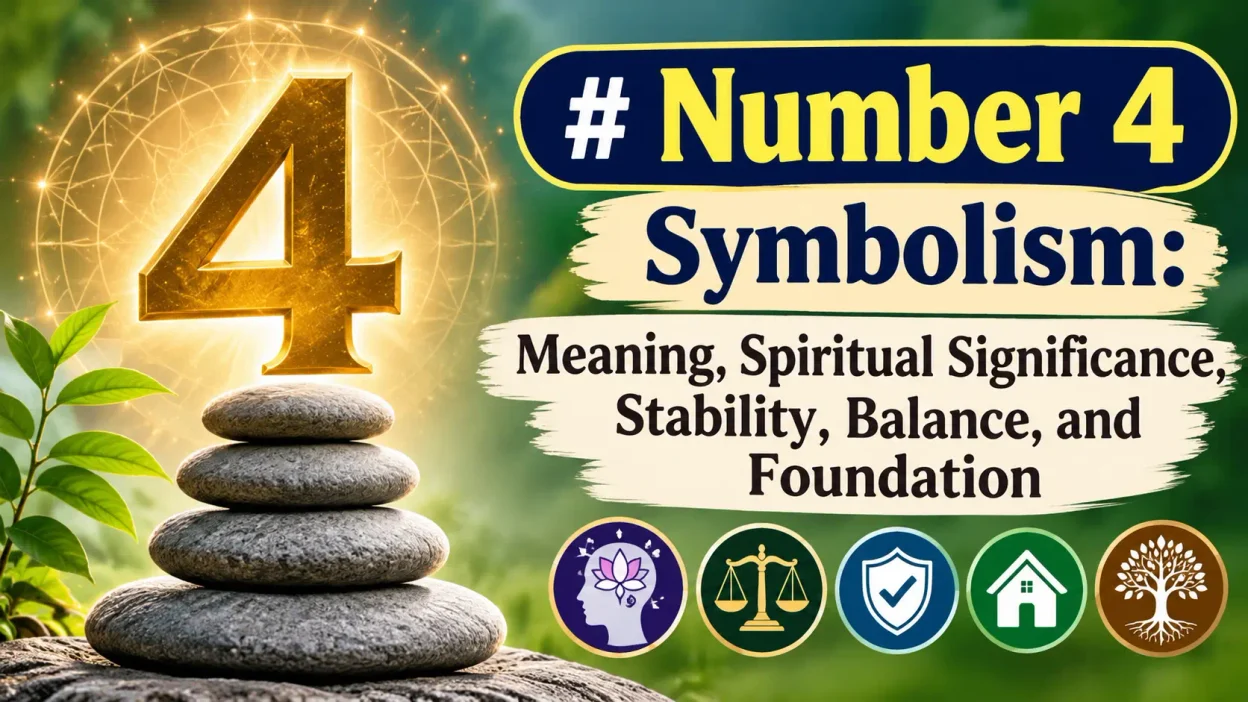
The number 4 is widely associated with stability, structure, balance, discipline, and a strong foundation. Its symbolism appears in mathematics, nature, architecture, religion, philosophy, and cultural traditions. From the four seasons and four cardinal directions to the four corners of a square, this number often represents order and completeness in the physical world.
Unlike numbers that are frequently associated with mystery or change, the number 4 is commonly connected with practical effort, responsibility, and reliability. It represents the structures that support everyday life and the steady work required to build something lasting.
In numerology and modern spiritual interpretations, number 4 is often viewed as a reminder to remain grounded, develop patience, and create a secure foundation for the future. However, its meaning varies across cultures, belief systems, and historical traditions.
What Does the Number 4 Symbolize?
The number 4 commonly symbolizes stability, balance, organization, hard work, security, and practicality. Its association with four-sided shapes and the basic divisions of the natural world makes it a powerful representation of structure and order.
Here are the most common symbolic meanings of number 4:
- Stability: Represents a strong foundation and dependable support.
- Balance: Reflects harmony between different parts of life.
- Structure: Symbolizes organization, planning, and clear boundaries.
- Hard work: Represents discipline, persistence, and consistent effort.
- Security: Suggests protection, reliability, and a sense of belonging.
- Practicality: Encourages realistic thinking and responsible decisions.
- Completeness: Connects with natural systems organized into groups of four.
- Patience: Represents the steady progress required to achieve long-term goals.
Overall, the number 4 is a symbol of building something meaningful through careful planning and consistent action.
Spiritual Meaning of Number 4
Spiritually, the number 4 is often interpreted as a symbol of grounding, balance, discipline, and stability. It can represent the importance of creating a strong foundation before moving toward personal or spiritual growth.
In modern spiritual interpretations, seeing the number 4 repeatedly may be viewed as a reminder to slow down, organize priorities, and pay attention to areas of life that need greater stability.
Its spiritual associations include:
- Grounding: Staying connected to reality and maintaining emotional balance.
- Inner strength: Developing resilience during challenging circumstances.
- Protection: Creating a safe and supportive environment.
- Discipline: Building positive habits through consistent effort.
- Harmony: Bringing different aspects of life into balance.
- Personal growth: Developing gradually instead of expecting immediate results.
Some people interpret repeated appearances of number 4 as meaningful spiritual signs. These interpretations are matters of personal belief rather than scientifically established messages or predictions.
Number 4 in Numerology
In numerology, the number 4 is commonly associated with practicality, responsibility, organization, discipline, and determination.
People who identify with the number 4 in numerological interpretations are often described as hardworking, dependable, realistic, and methodical. They are believed to value security and prefer making careful plans rather than taking unnecessary risks.
Positive Traits of Number 4
The number 4 is traditionally associated with several positive qualities:
- Reliability and dependability.
- Strong organizational skills.
- Patience and persistence.
- Practical problem-solving.
- Loyalty and responsibility.
- Attention to detail.
- Commitment to long-term goals.
These characteristics make number 4 a symbol of steady progress and lasting achievement.
Negative Associations of Number 4
Numerology also recognizes possible challenges associated with the number 4. Its strong connection with structure and order can sometimes be interpreted as excessive rigidity.
Potential negative associations include:
- Stubbornness.
- Resistance to change.
- Overworking.
- Excessive caution.
- Perfectionism.
- Difficulty expressing emotions.
- Becoming too focused on rules and routines.
In this context, the number 4 can serve as a reminder that stability is valuable, but flexibility is equally important.
Number 4 Symbolism in Nature
Nature provides several familiar examples of the number 4. These patterns have helped connect the number with order, balance, and the organization of the natural world.
1. Four Seasons
The four seasons—spring, summer, autumn, and winter—represent the recurring cycles of nature.
Each season brings a different stage of the natural cycle:
- Spring symbolizes renewal and new growth.
- Summer represents energy, abundance, and activity.
- Autumn reflects change, harvest, and transition.
- Winter represents rest, reflection, and dormancy.
Together, the seasons can symbolize the complete cycle of life and the importance of change within a stable natural pattern.
2. Four Cardinal Directions
The four cardinal directions—north, south, east, and west—provide a basic system for understanding geographical orientation.
Symbolically, they can represent direction, guidance, exploration, and the relationship between people and their surroundings.
In some spiritual and Indigenous traditions, directions also have sacred meanings. However, these meanings differ among individual cultures and communities and should not be treated as universal.
3. Four Elements
In ancient Greek philosophy, the natural world was commonly described through four classical elements:
- Earth: Stability and physical substance.
- Water: Emotion and fluidity.
- Air: Thought and movement.
- Fire: Energy and transformation.
These elements became important in historical philosophical and symbolic systems. They are not the same as the modern scientific periodic table or contemporary understanding of matter.
4. Four-Legged Animals
Many familiar animals, including dogs, horses, deer, and elephants, have four legs. This physical structure can be interpreted symbolically as a representation of balance, support, strength, and stability.
The association is especially noticeable in furniture and architecture, where four supporting legs often provide a dependable base.
Number 4 Symbolism in Different Cultures
The number 4 has different meanings across cultural and religious traditions. While it represents order and completeness in many symbolic systems, it is also associated with misfortune in certain cultures.
1. Number 4 in Chinese Culture
In Chinese culture, the number 4 is often associated with bad luck because its pronunciation, sì, is similar to the word for death, sǐ, in Mandarin.
This sound similarity has contributed to tetraphobia, or fear and avoidance of the number 4.
In some Chinese-speaking communities, buildings may omit the fourth floor from elevator labels, and people may avoid choosing addresses, phone numbers, or other combinations containing 4.
However, these practices vary by region and individual preference. The number does not have the same negative meaning in every Chinese cultural setting.
2. Number 4 in Japanese Culture
The number 4 can also carry negative associations in Japan because one common pronunciation, shi, is the same pronunciation used for the word death.
As a result, some people avoid number 4 in hospitals, hotels, gift arrangements, and other settings where unlucky associations are considered undesirable.
Japanese also has another pronunciation for 4, yon, which helps explain why the number is not universally avoided.
3. Number 4 in Ancient Greek Philosophy
The number 4 had an important place in ancient Greek philosophical thought.
The Pythagoreans viewed numbers as fundamental to understanding the structure and harmony of the universe. The number 4 was associated with the four elements and with mathematical relationships that helped explain order.
The tetractys, a triangular arrangement of ten points organized into four rows, was especially important in Pythagorean tradition. It represented mathematical harmony and the relationship between numbers.
4. Number 4 in Native American Traditions
The number 4 holds spiritual and cultural significance in some Indigenous North American traditions. It may be connected with the four directions, seasonal cycles, sacred relationships, or aspects of community and ceremonial life.
However, Indigenous cultures are diverse, and there is no single universal interpretation of number 4. Its meaning differs among Nations, communities, and specific ceremonial traditions.
5. Number 4 in Celtic Symbolism
The number 4 appears in some modern interpretations of Celtic symbolism through patterns involving four directions, seasonal divisions, and natural cycles.
The four major seasonal festivals often discussed in Celtic and neo-pagan traditions are Samhain, Imbolc, Beltane, and Lughnasadh. These festivals mark important points in the traditional seasonal calendar.
Their symbolism is connected with agricultural rhythms, seasonal transitions, and the relationship between human communities and nature.
Number 4 Symbolism in Religion
The number 4 appears in several religious traditions, particularly in symbolic descriptions of creation, direction, and the organization of the world.
Number 4 in Christianity
In Christian symbolism, the number 4 is associated with creation, the physical world, and the spread of the Gospel.
Several biblical patterns involve groups of four:
- Four Gospels: Matthew, Mark, Luke, and John.
- Four living creatures in the visions of Ezekiel and Revelation.
- Four corners of the earth, used as an expression of the world’s extent.
- Four winds, appearing in biblical imagery.
The four Gospels are especially important because they present accounts of the life, teachings, death, and resurrection of Jesus Christ.
In Christian art and tradition, the four Gospel writers are also associated with symbolic creatures: Matthew with an angel or human figure, Mark with a lion, Luke with an ox, and John with an eagle.
These associations are commonly connected with the four living creatures in biblical visions and later Christian interpretation.
Number 4 in Hinduism
The number 4 appears in several important Hindu concepts and traditions.
Examples include:
- Four Vedas: Rigveda, Samaveda, Yajurveda, and Atharvaveda.
- Four stages of life in the traditional ashrama system.
- Four goals of human life, known as the purusharthas.
- Four directions represented in different forms of religious art and cosmology.
The four purusharthas are dharma (duty and righteous living), artha (material prosperity), kama (desire and enjoyment), and moksha (liberation).
Together, these concepts provide a framework for understanding different dimensions of human life and spiritual development.
Number 4 in Buddhism
The number 4 is particularly significant in Buddhism because of the Four Noble Truths, which form the foundation of the Buddha’s teaching.
They explain:
- The truth of suffering (dukkha).
- The truth of the origin of suffering.
- The truth of the cessation of suffering.
- The truth of the path leading to the cessation of suffering.
The Fourth Noble Truth introduces the Noble Eightfold Path, which provides guidance for ethical conduct, mental discipline, and wisdom.
In this tradition, the number 4 is closely connected with understanding human suffering and the possibility of liberation.
Angel Number 4 Meaning
In modern angel-number interpretations, the number 4 is associated with stability, protection, discipline, and support.
People who follow angel-number beliefs may interpret repeated appearances of 4 as encouragement to build strong foundations and remain committed to their goals.
Common interpretations include:
- Stay consistent: Continue working toward your goals even when progress feels slow.
- Create stability: Pay attention to finances, relationships, and personal responsibilities.
- Trust the process: Meaningful achievements often require time and patience.
- Build healthy habits: Small, repeated actions can create lasting improvements.
- Remain grounded: Make practical decisions instead of acting only on temporary emotions.
These meanings belong to contemporary spiritual belief systems. There is no scientific evidence that repeated numbers are messages from angels or supernatural beings.
Number 4 Symbolism in Love and Relationships
In love and relationships, the number 4 is often interpreted as a symbol of commitment, loyalty, trust, and emotional security.
A healthy relationship requires more than attraction. It also depends on communication, shared responsibility, patience, and mutual respect. These qualities align with the traditional symbolic associations of number 4.
In modern numerology, its relationship meanings may include:
- Building a stable partnership.
- Developing trust through consistent actions.
- Maintaining loyalty and commitment.
- Creating a secure home environment.
- Working through challenges patiently.
- Establishing healthy boundaries.
The number 4 can also serve as a reminder that strong relationships need ongoing attention. Lasting connections are built through everyday choices rather than promises alone.
Number 4 Symbolism in Career and Success
The number 4 is frequently connected with professional discipline, planning, organization, and long-term achievement.
Its symbolic meaning emphasizes the importance of creating a reliable structure for success instead of depending entirely on luck or sudden opportunities.
In career-related interpretations, number 4 may represent:
- Setting realistic professional goals.
- Developing useful skills through practice.
- Managing time and resources responsibly.
- Building a dependable reputation.
- Following through on commitments.
- Creating long-term financial stability.
It is especially relevant as a metaphor for careers that require consistency, technical ability, organization, and careful attention to detail.
Number 4 Symbolism in Everyday Life
The number 4 appears in many ordinary objects and systems, reinforcing its association with structure and organization.
| Example | Symbolic Association |
|---|---|
| Four corners of a square | Order and stability |
| Four legs of a table | Support and balance |
| Four wheels of a car | Movement and dependable structure |
| Four cardinal directions | Orientation and guidance |
| Four seasons | Cycles and renewal |
| Four points of a compass | Direction and exploration |
| Four walls of a room | Shelter and security |
These examples demonstrate how the number 4 is connected with familiar structures that make daily life organized and predictable.
Is the Number 4 Lucky or Unlucky?
The number 4 can be considered lucky or unlucky depending on cultural background and personal beliefs.
In many Western numerological interpretations, it represents stability, discipline, reliability, and practical success. These qualities make it a positive symbol of security and achievement.
In some East Asian cultural contexts, particularly Chinese and Japanese traditions, the number may be avoided because of its phonetic association with death.
Therefore, the number 4 does not have one universal relationship with luck. Its interpretation depends on language, culture, tradition, and individual perspective.
Frequently Asked Questions About Number 4 Symbolism
1. What does the number 4 symbolize?
The number 4 commonly symbolizes stability, balance, structure, hard work, security, and practicality. It is often associated with strong foundations and the importance of consistent effort.
2. What is the spiritual meaning of number 4?
Spiritually, number 4 is often interpreted as a symbol of grounding, discipline, protection, and personal stability. Modern spiritual beliefs may also associate it with encouragement to remain focused and build a secure foundation.
3. Is number 4 a lucky number?
The number 4 is considered positive in some numerological traditions because of its association with stability and reliability. However, it is considered unlucky in certain Chinese- and Japanese-speaking communities because of its association with the word for death.
4. What does angel number 4 mean?
In angel-number interpretations, 4 is associated with stability, determination, protection, and practical effort. Some people view it as encouragement to stay disciplined and continue working toward long-term goals.
5. Why is the number 4 important in Christianity?
The number 4 appears in Christian symbolism through the four Gospels, four living creatures in biblical visions, and references to the four corners of the earth and four winds.
6. What does number 4 mean in numerology?
In numerology, number 4 represents organization, discipline, responsibility, patience, and practical thinking. It is commonly associated with people who value structure and long-term security.
7. Why is the number 4 unlucky in Chinese culture?
In Mandarin, the pronunciation of 4 (sì) sounds similar to the word for death (sǐ). This similarity has created negative associations and encouraged some people to avoid the number in addresses, buildings, and other settings.
8. What does number 4 symbolize in love?
In love, number 4 is commonly associated with commitment, loyalty, trust, stability, and building a lasting partnership. It emphasizes the importance of consistent care and mutual responsibility.
9. What are the four elements associated with number 4?
In ancient Greek philosophy, the four classical elements are earth, water, air, and fire. They represented different qualities of the natural world in historical philosophical systems.
10. What does number 4 represent in nature?
In nature-related symbolism, number 4 is associated with the four seasons, four cardinal directions, and recurring cycles. These patterns make it a symbol of order, balance, and natural organization.
Conclusion: The Deeper Meaning of Number 4
Number 4 symbolism centers on stability, balance, discipline, structure, and the strength of a solid foundation. Its presence in natural cycles, religious teachings, mathematical patterns, and everyday objects has made it an enduring symbol of organization and dependable support.
In numerology and modern spiritual interpretations, the number encourages patience, responsibility, and consistent effort. Religious traditions also give it meaning through important groups of four, including the Four Noble Truths in Buddhism, the four Vedas in Hinduism, and the four Gospels in Christianity.
However, the number does not carry the same meaning everywhere. While it is associated with reliability and strength in some traditions, it has negative associations in certain East Asian cultures.
Ultimately, number 4 offers a powerful symbolic reminder that lasting progress requires balance, careful planning, and a strong foundation. Whether viewed through culture, religion, numerology, or everyday life, it represents the value of building something meaningful one step at a time.