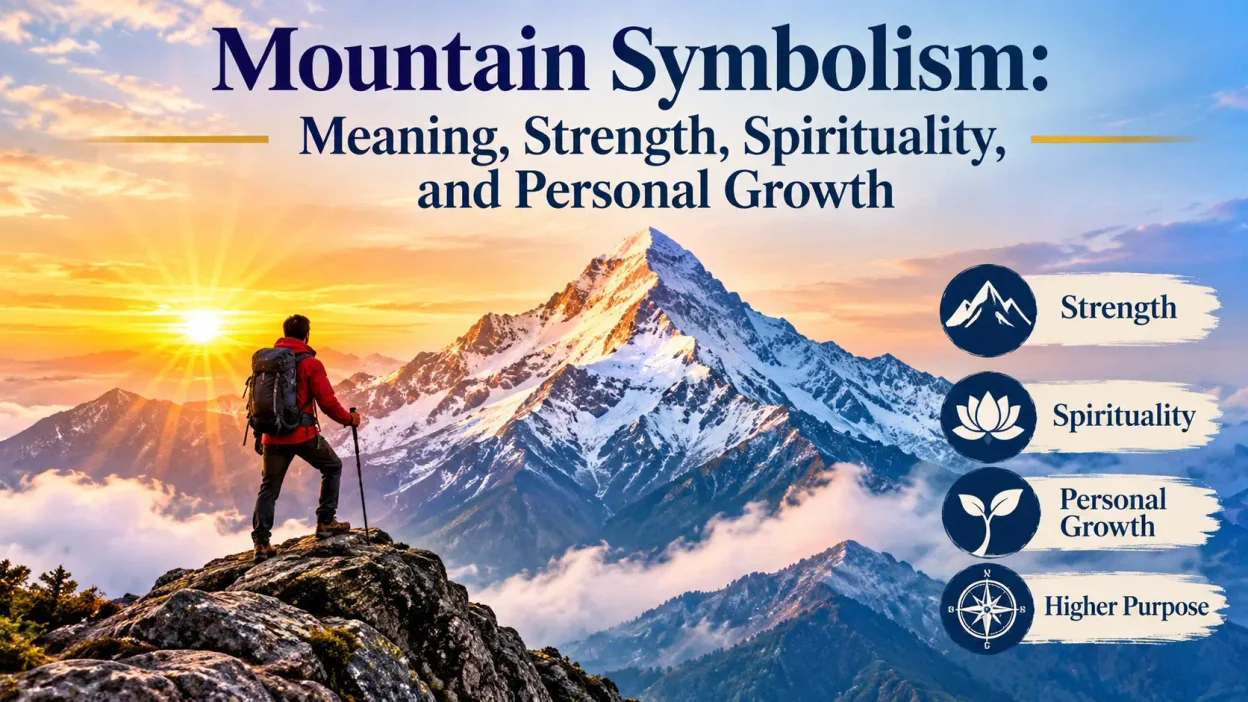
Mountain symbolism is deeply connected to strength, stability, endurance, ambition, spiritual growth, and the challenges that shape human life. Rising above the surrounding landscape, mountains have inspired people for thousands of years. Their enormous size, ancient formations, and seemingly unshakable presence make them powerful symbols of resilience, wisdom, and the ability to overcome obstacles.
Across different cultures and religious traditions, mountains have been viewed as sacred places, homes of deities, destinations for spiritual journeys, and symbols of connection between heaven and earth. Their towering peaks can represent ambition and achievement, while their difficult paths reflect the struggles people experience while pursuing meaningful goals.
Mountains also remind us that personal growth takes time. Reaching a summit requires patience, preparation, determination, and the willingness to continue despite uncertainty. In this sense, a mountain is more than a natural formation. It can represent the journey toward becoming stronger, wiser, and more confident.
Whether you see a mountain in nature, encounter one in a dream, or explore its meaning in religious stories and literature, its symbolism offers valuable lessons about perseverance, perspective, and the human desire to rise above limitations.
What Do Mountains Symbolize?
Mountains commonly symbolize strength, stability, endurance, ambition, spiritual connection, wisdom, and personal transformation. Their impressive height and long-lasting geological presence make them natural representations of qualities that develop over time.
Some of the most recognized meanings of mountain symbolism include:
- Strength: Mountains represent physical and emotional strength because they withstand powerful natural forces over long periods.
- Stability: Their solid foundations symbolize security, reliability, and a strong sense of identity.
- Endurance: Their ancient formations represent patience, persistence, and the ability to survive difficult conditions.
- Ambition: Climbing toward a summit symbolizes pursuing goals and reaching important achievements.
- Spiritual growth: Mountains are often associated with sacred spaces, meditation, revelation, and closeness to the divine.
- Wisdom: Their height and distance from ordinary surroundings can represent broader understanding and perspective.
- Obstacles: A steep mountain can symbolize challenges that require courage and determination.
- Freedom: Open mountain landscapes can represent independence, exploration, and escape from everyday limitations.
- Transformation: Reaching a summit can symbolize personal development and the completion of an important journey.
The exact meaning depends on the mountain’s appearance, cultural context, and the experience of the person interpreting it.
Spiritual Meaning of Mountains
Spiritually, mountains are often interpreted as symbols of enlightenment, inner strength, faith, reflection, and a deeper connection with existence. Their height and separation from busy human settlements have made them important settings for spiritual practices in many traditions.
1. Spiritual Awakening and Enlightenment
Mountains are frequently associated with spiritual awakening because they provide a natural setting for solitude, reflection, and meditation.
Their elevated peaks can symbolize moving beyond ordinary concerns and developing a broader understanding of life.
In spiritual interpretations, climbing a mountain may represent the journey toward greater awareness, self-discovery, and enlightenment.
2. Strength and Resilience
Mountains endure powerful winds, storms, changing temperatures, and geological pressure. Their ability to remain part of the landscape for millions of years makes them powerful symbols of resilience.
Spiritually, a mountain may remind you to remain strong during difficult circumstances and trust your ability to overcome challenges.
It represents the idea that strength is not always about avoiding hardship. Sometimes, it is about continuing despite it.
3. Stability and Grounding
Mountains are associated with solid foundations and permanence. Their enormous size creates an impression of security and reliability.
Symbolically, they may encourage you to remain grounded, protect your values, and create a stable foundation for your future.
This meaning can be especially relevant during periods of uncertainty or personal change.
4. Ambition and Achievement
The summit of a mountain often represents a goal that requires effort and determination to reach.
Its symbolism can encourage you to pursue your ambitions, remain disciplined, and recognize that meaningful achievements rarely happen without preparation.
A mountain reminds us that every difficult climb begins with a single step.
5. Solitude and Self-Discovery
Mountain landscapes often provide quiet environments away from crowded cities and everyday distractions.
For this reason, mountains can symbolize solitude, introspection, and the opportunity to understand yourself more deeply.
Spending time in mountainous surroundings may encourage reflection on your priorities, relationships, and personal direction.
6. Connection Between Earth and Heaven
Because mountains rise high above the surrounding land, many religious and spiritual traditions have viewed them as places where the earthly and divine worlds meet.
This association makes mountains symbols of transcendence, revelation, sacredness, and spiritual connection.
7. Patience and Perseverance
Climbing a mountain is rarely an immediate process. It involves preparation, careful decisions, physical effort, and patience.
Spiritually, this journey can represent the gradual development of wisdom and character.
A mountain may remind you that progress is not always measured by speed. Sometimes, continuing forward is the greatest achievement.
Mountain Symbolism in Different Cultures
Mountains have significant cultural and religious meanings around the world. Some are considered sacred homes of deities, while others represent national identity, spiritual revelation, or the relationship between humanity and nature.
Mountain Symbolism in Ancient Greek Culture
In ancient Greek mythology, Mount Olympus was regarded as the home of the Olympian gods.
The mountain represented divine authority, power, and the separation between the world of gods and the world of ordinary humans.
Its association with Zeus and other Olympian deities made it one of the most recognizable sacred mountains in Western mythology.
In this context, mountain symbolism includes:
- Divine power and authority
- Sacred space
- Immortality and the gods
- Spiritual elevation
- The boundary between mortal and divine worlds
Mountain Symbolism in Hinduism
Mountains hold profound religious significance in Hindu traditions.
Mount Kailash, located in the Tibetan region, is regarded as sacred and is traditionally associated with Lord Shiva. It is also important in Buddhism, Jainism, and the Bon tradition.
Mount Meru appears in Hindu, Buddhist, and Jain cosmological traditions as a sacred cosmic mountain representing the center of the universe.
In Hindu symbolism, mountains can represent:
- Divine presence
- Spiritual stability
- Cosmic order
- Meditation and ascetic practice
- The relationship between earthly and sacred realms
Mountain Symbolism in Buddhism
Mountains are important in Buddhist traditions because they can represent meditation, spiritual discipline, wisdom, and the pursuit of enlightenment.
Sacred mountains are associated with pilgrimage and contemplation in several Buddhist communities.
Mount Meru, in particular, appears in Buddhist cosmological traditions as a central feature of the universe.
Mountain imagery can also represent the stability and stillness needed for meditation and spiritual development.
Mountain Symbolism in Chinese Culture
Mountains have a long history of importance in Chinese philosophy, landscape painting, poetry, and religious traditions.
In Daoist traditions, mountains have often been associated with spiritual cultivation, immortals, solitude, and harmony with nature.
Their towering forms also appear in traditional Chinese landscape art as symbols of permanence, balance, and the relationship between humanity and the natural world.
Mountain Symbolism in Japanese Culture
Mountains are deeply connected with Japanese religious and cultural traditions.
Mount Fuji is one of Japan’s most recognizable natural landmarks and has been regarded as a sacred mountain in different religious traditions, particularly in Shinto and Buddhist contexts.
Mountain worship, known as sangaku shinkō, has influenced Japanese spiritual practices for centuries.
Mountains may represent:
- Purification and spiritual discipline
- Nature’s power
- Sacredness and reverence
- Pilgrimage and personal devotion
- Harmony between humans and the natural world
Mountain Symbolism in Indigenous Cultures
Mountains hold distinct meanings in many Indigenous cultures around the world. Some are regarded as ancestral places, sacred landscapes, sources of life, or locations connected with traditional stories and responsibilities.
For example, Uluru in Australia is a deeply significant cultural landscape for the Anangu Traditional Owners. It is connected with ancestral stories, law, identity, and ongoing cultural responsibilities.
The meanings of sacred mountains differ between communities and should not be reduced to a single universal Indigenous belief.
Mountain Symbolism in Native American Traditions
Many Native American nations have important relationships with particular mountains, which may be associated with creation stories, ancestral connections, sacred geography, and cultural identity.
For example, the San Francisco Peaks in Arizona are sacred to several Indigenous peoples, including the Hopi and Navajo (Diné), although their specific beliefs and relationships with the landscape differ.
Mountains should therefore be understood within the traditions of the individual nations and communities connected to them.
Mountain Symbolism in the Bible
Mountains appear throughout the Bible and are frequently associated with God’s presence, revelation, faith, strength, refuge, and spiritual transformation.
They are often settings for important encounters between God and human beings.
1. Mount Sinai: Revelation and Divine Law
Mount Sinai is one of the most significant mountains in the Bible.
According to Exodus 19–20, Moses ascended Mount Sinai, where God gave him the Ten Commandments.
The mountain represents:
- Divine revelation
- God’s authority
- Covenant and obedience
- Spiritual responsibility
- The importance of faith
Mount Sinai demonstrates how mountains can serve as places of profound spiritual encounters.
2. Mount Ararat: Hope and New Beginnings
Genesis 8:4 states that Noah’s ark came to rest on the mountains of Ararat after the flood.
In Christian interpretation, this event can symbolize survival, hope, restoration, and the beginning of a renewed world.
The mountain becomes a place associated with the transition from destruction toward a new chapter.
3. Mount Zion: God’s Presence and Security
Mount Zion holds an important place in biblical literature.
It is associated with Jerusalem, God’s dwelling place, worship, and the spiritual identity of God’s people.
Psalm 125:1 compares those who trust in the Lord to Mount Zion, which cannot be moved but remains forever.
This passage makes the mountain a symbol of faith, stability, and spiritual security.
4. The Mount of Olives: Prayer and Reflection
The Mount of Olives appears in several important events in the life of Jesus.
It is associated with prayer, teaching, and the events leading to his arrest.
In Luke 22:39–46, Jesus goes to the Mount of Olives to pray before his arrest.
The mountain can therefore be understood as a setting for spiritual reflection, devotion, and facing difficult circumstances.
5. The Sermon on the Mount: Spiritual Teaching
In Matthew 5–7, Jesus delivers the Sermon on the Mount.
The mountain becomes the setting for important teachings about humility, mercy, righteousness, forgiveness, prayer, and faithful living.
It is often interpreted as a symbol of spiritual instruction and moral guidance.
6. Faith That Moves Mountains
In Matthew 17:20, Jesus uses the image of faith moving mountains to describe the power of genuine faith.
The mountain represents an apparently impossible obstacle, while faith represents the ability to trust in God’s power.
This passage has made the phrase “moving mountains” a familiar expression for overcoming enormous challenges.
Mountain Symbolism in Dreams
Dreaming about mountains can have several symbolic interpretations depending on their appearance, your actions, and the emotions you experience.
A mountain may represent ambition, personal challenges, emotional strength, or a desire for greater understanding.
Dream interpretation is subjective and should not be treated as a scientific prediction or a guaranteed spiritual message.
Dreaming of Climbing a Mountain
Climbing a mountain may symbolize ambition, determination, and progress toward an important goal.
It can reflect the challenges you are currently facing and your willingness to keep moving forward.
If you reach the summit, the dream may represent confidence, achievement, or a sense of accomplishment.
Dreaming of Standing on a Mountain Peak
Standing on a mountain peak may symbolize success, a broader perspective, and the completion of an important personal journey.
It can also represent a desire for independence or a need to look at a situation from a different viewpoint.
Dreaming of a Snow-Covered Mountain
A snow-covered mountain may represent peace, isolation, emotional distance, or clarity.
Its appearance can suggest a need for quiet reflection or a period of emotional stillness.
Depending on the dream’s atmosphere, it may also symbolize purity and renewal.
Dreaming of a Rocky Mountain
A rocky mountain may represent obstacles, responsibilities, or difficult experiences.
It could reflect a situation that requires patience, practical thinking, and emotional resilience.
Dreaming of Falling from a Mountain
Falling from a mountain may symbolize fear of failure, loss of confidence, or anxiety about losing something you have worked hard to achieve.
It may reflect concerns about responsibilities or uncertainty about your future.
Dreaming of a Green Mountain
A green mountain may symbolize growth, vitality, renewal, and emotional balance.
It can represent a period of development in which you are becoming more confident and connected with your surroundings.
Dreaming of a Mountain You Cannot Climb
A mountain that seems impossible to climb may represent frustration, self-doubt, or a goal that currently feels out of reach.
It may encourage you to break a large challenge into smaller, more manageable steps.
Different Types of Mountains and Their Symbolic Meanings
Mountains have different shapes, sizes, colors, and geological characteristics. These differences can inspire different symbolic interpretations.
| Mountain Type | Symbolic Meaning |
|---|---|
| Snow-covered mountain | Purity, peace, isolation, and clarity |
| Green mountain | Growth, abundance, renewal, and vitality |
| Rocky mountain | Endurance, obstacles, and resilience |
| Volcanic mountain | Passion, transformation, power, and hidden energy |
| High mountain peak | Ambition, achievement, and spiritual elevation |
| Misty mountain | Mystery, uncertainty, and introspection |
| Ancient mountain | Wisdom, permanence, and endurance |
| Mountain range | Community, interconnectedness, and collective strength |
Snow-Covered Mountain Symbolism
Snow-covered mountains often represent purity, stillness, peace, and isolation.
Their white peaks create an impression of distance and quietness, making them useful symbols of reflection and emotional clarity.
They may also represent challenges that require patience and careful preparation.
Green Mountain Symbolism
Green mountains symbolize growth, abundance, vitality, and renewal.
Their vegetation suggests life and the ability of nature to flourish in changing conditions.
They can represent a period of personal development, prosperity, and a stronger connection with nature.
Rocky Mountain Symbolism
Rocky mountains are associated with strength, endurance, resilience, and difficult journeys.
Their rugged surfaces can symbolize obstacles that require courage and determination.
They remind us that progress does not always happen along a smooth path.
Volcanic Mountain Symbolism
Volcanic mountains can symbolize powerful emotions, transformation, creation, destruction, and hidden energy.
Their geological activity represents forces that may remain unseen for long periods before producing dramatic change.
In personal symbolism, a volcano can represent suppressed feelings, creative energy, or the need to manage intense emotions carefully.
Misty Mountain Symbolism
Misty mountains represent mystery, uncertainty, imagination, and spiritual reflection.
When a mountain disappears into clouds or fog, its summit becomes difficult to see.
This can symbolize the uncertainty of the future and the importance of continuing forward even when the destination is not completely clear.
Mountain Symbolism in Literature and Art
Mountains are powerful literary and artistic symbols because they provide a natural setting for stories about ambition, struggle, isolation, and transformation.
Writers and artists frequently use mountains to communicate ideas that go beyond their physical appearance.
1. Mountains as Obstacles
A mountain can represent a major difficulty standing between a character and an important goal.
In this sense, climbing becomes a metaphor for overcoming fear, uncertainty, and personal limitations.
2. Mountains as Freedom
Wide mountain landscapes can represent independence, escape, and freedom from social expectations.
A character traveling into the mountains may be seeking a simpler life or a deeper connection with nature.
3. Mountains as Wisdom
Because mountains are often imagined as ancient and permanent, they can represent accumulated knowledge, experience, and perspective.
In literature, a mountain setting may provide an opportunity for reflection or an encounter with a wise figure.
4. Mountains as Isolation
Remote mountain environments can symbolize loneliness, separation, and emotional distance.
Their vastness may emphasize the smallness of human concerns or the difficulty of connecting with others.
5. Mountains as Transformation
Reaching the summit often represents a major turning point.
A character who completes a difficult climb may emerge with greater confidence, maturity, or understanding.
Mountain Symbolism in Personal Growth
Mountains offer a particularly useful metaphor for personal development because reaching a summit requires more than physical effort.
The journey involves preparation, patience, courage, and the ability to adapt when conditions change.
Mountain symbolism can teach several important lessons:
- Set meaningful goals: Decide what you want to achieve and understand why it matters.
- Accept challenges: Difficult experiences can help you develop new strengths.
- Remain patient: Progress may be slow, but consistent effort creates results.
- Prepare carefully: Successful journeys require planning, awareness, and practical decisions.
- Appreciate the journey: Personal growth is not only about reaching a final destination.
- Recognize your progress: Every step forward represents effort worth acknowledging.
The mountain reminds us that achievement is not simply about standing at the top. It is also about who we become while making the climb.
Mountain Symbolism in Love and Relationships
In relationships, mountains can symbolize stability, loyalty, endurance, and the challenges that people overcome together.
A mountain’s strong foundation makes it a natural representation of commitment and reliability.
Its difficult paths can also represent the effort required to maintain a meaningful relationship.
Mountain symbolism in love may include:
- Loyalty: Remaining committed through difficult circumstances.
- Stability: Building a relationship on trust and mutual respect.
- Endurance: Continuing to support one another during challenging periods.
- Shared ambition: Working toward common goals and dreams.
- Emotional strength: Facing disagreements with patience and understanding.
- Growth: Developing together through shared experiences.
A mountain can also represent emotional distance when it appears as a barrier between two people. In this interpretation, it may suggest that communication and effort are needed to overcome separation.
Mountain Symbolism: Positive and Negative Meanings
Mountains carry both positive and challenging symbolic associations.
| Positive Meanings | Negative Meanings |
|---|---|
| Strength | Obstacles |
| Stability | Isolation |
| Wisdom | Emotional distance |
| Ambition | Pressure and responsibility |
| Spiritual growth | Uncertainty |
| Freedom | Loneliness |
| Endurance | Exhaustion |
| Achievement | Fear of failure |
Their positive meanings focus on resilience, achievement, and spiritual development. Their more challenging meanings reflect the difficulties, limitations, and emotional struggles that people may encounter along life’s journey.
What Can Mountains Teach Us?
Mountain symbolism offers practical lessons that can help us approach everyday challenges with greater confidence.
Be patient with progress. Important achievements often require time, preparation, and consistent effort.
Build a strong foundation. Stability comes from developing reliable habits, values, and relationships.
Accept difficult experiences. Challenges can reveal strengths that you may not have recognized before.
Keep your perspective. Looking at a problem from a broader viewpoint can help you make better decisions.
Respect your limits. Strength does not mean ignoring exhaustion or refusing to ask for help.
Appreciate the journey. Reaching a goal matters, but the experiences and lessons along the way are equally valuable.
Frequently Asked Questions About Mountain Symbolism
1. What do mountains symbolize spiritually?
Mountains commonly symbolize spiritual growth, enlightenment, strength, stability, divine connection, and inner wisdom. Their elevated peaks often represent the journey toward greater awareness and understanding.
2. What is the biblical meaning of mountains?
In the Bible, mountains are associated with divine revelation, God’s presence, faith, refuge, and spiritual authority. Mount Sinai, Mount Zion, and the Mount of Olives are important examples.
3. What does climbing a mountain symbolize?
Climbing a mountain symbolizes ambition, determination, personal growth, and overcoming obstacles. It represents the effort required to reach meaningful goals.
4. What does a mountain symbolize in dreams?
Mountains in dreams may represent personal challenges, ambition, emotional strength, stability, or spiritual development. Their meaning depends on the dream’s setting and your feelings.
5. What does a mountain peak symbolize?
A mountain peak often symbolizes achievement, success, wisdom, perspective, and reaching an important goal. It can also represent spiritual elevation or personal fulfillment.
6. What does a snow-covered mountain symbolize?
A snow-covered mountain can symbolize purity, peace, solitude, emotional clarity, and reflection. Its meaning may also involve difficult conditions that require patience and preparation.
7. What does a green mountain symbolize?
A green mountain commonly represents growth, abundance, renewal, vitality, and harmony with nature. It can suggest a period of positive development.
8. What do mountains symbolize in love?
Mountains in love symbolize loyalty, stability, commitment, endurance, and shared challenges. They can represent relationships that grow stronger through patience and mutual support.
9. Why are mountains considered sacred in many cultures?
Mountains are often regarded as sacred because of their height, isolation, natural beauty, and association with the sky. Different religious traditions connect particular mountains with deities, revelation, meditation, and pilgrimage.
10. What does a mountain symbolize in literature?
In literature, mountains often symbolize obstacles, ambition, freedom, isolation, wisdom, and transformation. A difficult climb can represent a character’s struggle toward personal growth or achievement.
11. What does a mountain symbolize in Japanese culture?
Mountains have important spiritual and cultural associations in Japan. Mount Fuji, for example, is a sacred landscape connected with Shinto and Buddhist traditions and represents natural power, reverence, and pilgrimage.
12. Are mountains symbols of strength?
Yes. Mountains are widely used as symbols of strength because of their enormous size, solid appearance, and ability to endure changing natural conditions. They can represent emotional resilience, stability, and perseverance.
Conclusion: The Deeper Meaning of Mountain Symbolism
Mountain symbolism represents strength, endurance, stability, ambition, spiritual growth, and the courage to overcome challenges. Their towering peaks inspire people to pursue meaningful goals, while their ancient foundations remind us of the importance of patience and resilience.
Across cultures and religious traditions, mountains have been regarded as sacred places, centers of spiritual reflection, and symbols of divine power. In the Bible, they are associated with revelation, faith, refuge, and important encounters with God. In Greek mythology, Mount Olympus represents the home of the gods, while Mount Fuji holds deep spiritual and cultural significance in Japan.
In dreams, mountains may reflect personal ambitions, difficult circumstances, emotional stability, or the desire to gain a broader perspective. In relationships, they can symbolize loyalty and the strength required to overcome challenges together.
Ultimately, mountains remind us that every meaningful journey involves effort, uncertainty, and growth. Their symbolism teaches us to remain grounded while reaching higher, to face obstacles with courage, and to appreciate every step that brings us closer to our goals.