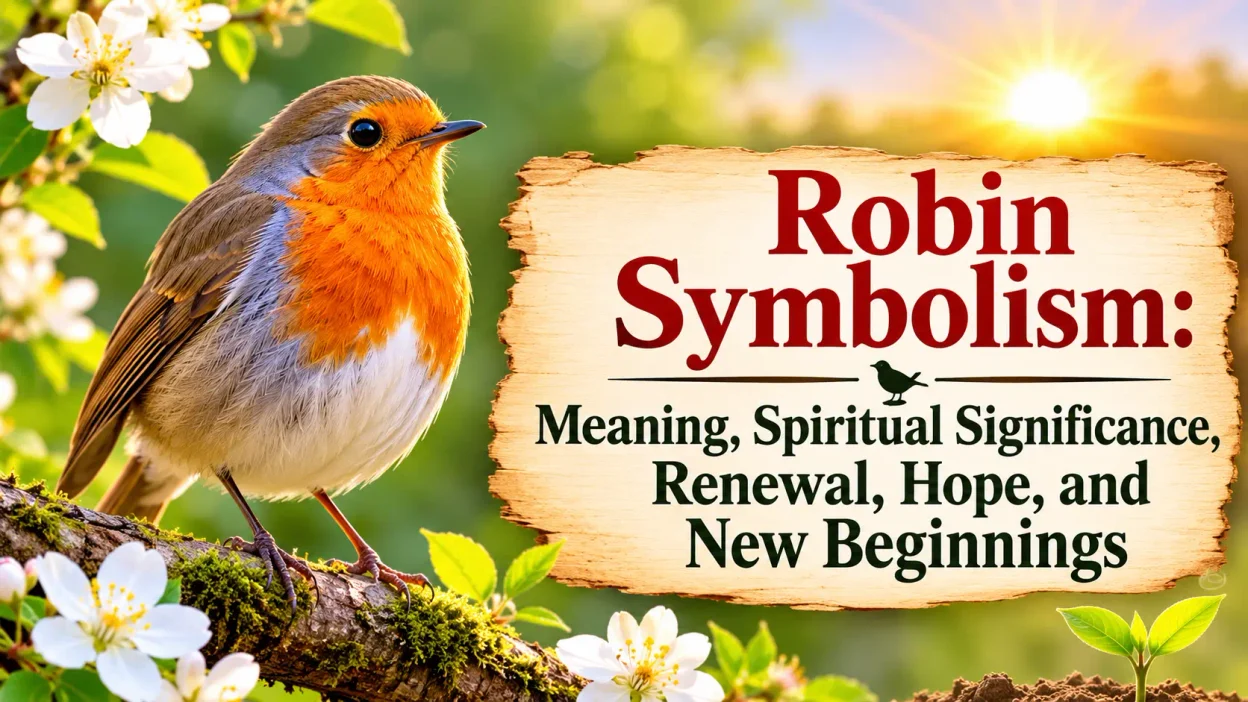
Robins are often associated with hope, renewal, happiness, and the arrival of new beginnings. Their cheerful songs, distinctive red or orange breasts, and appearance during changing seasons have made them meaningful symbols in folklore, literature, spirituality, and everyday life.
Seeing a robin can feel like a small reminder that difficult periods do not last forever. For many people, this familiar bird represents fresh opportunities, emotional healing, love, and the possibility of starting again.
Quick Answer: Robin symbolism is commonly connected with hope, renewal, happiness, new beginnings, protection, and spiritual growth. In some traditions, robins are also associated with loved ones who have passed away, making them meaningful symbols of remembrance and comfort.
TL;DR: What Do Robins Symbolize?
- Hope: Robins represent optimism and encouragement during difficult times.
- New beginnings: Their seasonal associations make them symbols of fresh starts and transformation.
- Renewal: They can represent recovery, personal growth, and the return of happiness.
- Love and warmth: Their appearance and familiar songs can symbolize affection, comfort, and connection.
- Spiritual messages: Some people interpret robin sightings as meaningful reminders of guidance or reassurance.
- Remembrance: In certain modern spiritual beliefs and folk traditions, robins are associated with deceased loved ones.
- Happiness: Their cheerful songs often symbolize joy, positivity, and appreciation for everyday life.
1. General Symbolism of Robins
Robins are small birds with powerful symbolic associations. Their familiar appearance in gardens, parks, forests, and neighborhoods has made them recognizable symbols of hope and renewal.
The most common meanings associated with robins include:
- Hope and optimism: A reminder that better days can come after difficult experiences.
- Renewal and transformation: The opportunity to grow, change, and begin again.
- Happiness and joy: An invitation to appreciate simple pleasures.
- Love and affection: Warmth, companionship, and emotional connection.
- Protection and comfort: A feeling of reassurance during uncertain times.
- Resilience: The ability to adapt and continue despite challenges.
- Spiritual connection: A symbolic reminder of faith, guidance, or remembrance.
These meanings vary across cultures and personal beliefs. A robin does not have one universal spiritual message, but its familiar presence often inspires positive interpretations.
2. Robin Spiritual Meaning
Spiritually, robins are frequently associated with renewal, hope, and the ability to move forward. Their appearance may encourage you to recognize new opportunities and remain open to positive changes.
Some people interpret a robin sighting as a reminder to trust their journey, release emotional burdens, and welcome a fresh chapter.
Common spiritual interpretations include:
A fresh beginning: A robin may symbolize the end of one chapter and the beginning of another.
Emotional healing: Its presence can serve as a reminder to give yourself time to recover from disappointment, grief, or difficult experiences.
Trust and faith: Robins may represent the importance of remaining hopeful when the future feels uncertain.
Personal transformation: Their symbolism can encourage you to embrace change rather than resist it.
Connection with nature: Seeing a robin may remind you to slow down and become more aware of the natural world.
These interpretations are spiritual beliefs rather than scientifically established messages.
3. Robin Symbolism in Different Cultures
Robins have different symbolic associations depending on the bird species and cultural tradition. Two especially familiar birds are the American robin and the European robin. They belong to different bird families, even though both are commonly called robins.
American robin symbolism
American Robin
Orange and black birdperching on branch photo – Free Animal Image on Unsplash
The American robin is widely recognized by its orange-red breast and cheerful song. In North American popular culture, it is often associated with spring, warmer weather, and the return of life after winter.
Its common symbolic meanings include:
- Spring and renewal
- Hope and optimism
- Happiness and warmth
- Growth and fresh opportunities
- Resilience and adaptability
Although American robins can be seen throughout the year in many areas, their seasonal movements and increased visibility in spring have strengthened their association with new beginnings.
European robin symbolism
European Robin
A close up of a Robin Redbreast in some woodland in the southwest of England (UK).
The European robin is a small bird with an orange-red face and breast. It has a particularly strong presence in European folklore, seasonal traditions, and Christmas imagery.
In Britain and other parts of Europe, robins are familiar garden birds and are often associated with winter, companionship, and comfort.
Their symbolic meanings may include:
- Warmth during cold seasons
- Hope in difficult circumstances
- Protection and companionship
- Christmas and generosity
- Remembrance and affection
The European robin’s association with Christmas is especially visible in British seasonal cards and decorations.
4. Robin Symbolism in Love and Relationships
Robins can symbolize love, tenderness, loyalty, and emotional warmth. Their familiar presence around homes and gardens makes them comforting symbols of companionship.
In romantic relationships, a robin may represent:
- Sincere affection
- Faithfulness and commitment
- Emotional closeness
- A new beginning in love
- Hope after heartbreak
- The importance of nurturing a relationship
Seeing a robin during a difficult period in a relationship might personally remind you to approach problems with patience and understanding.
A robin can also symbolize the beginning of a new romantic chapter. For someone recovering from heartbreak, it may represent the possibility of loving again without carrying the weight of past disappointments.
5. Robin Symbolism and Deceased Loved Ones
One of the most meaningful modern interpretations of robin symbolism connects the bird with deceased loved ones.
In some British and North American folk beliefs, seeing a robin is considered a comforting reminder of someone who has passed away. People may interpret an unexpected visit from a robin as a symbolic message of love, remembrance, or reassurance.
Common interpretations include:
- A reminder of someone you miss
- Comfort during grief
- The continuation of love through memories
- A feeling of emotional closeness
- Hope during a period of loss
This association is particularly familiar in British folklore and modern popular culture.
However, there is no scientific evidence that robins carry messages from deceased people. The meaning is personal and may provide comfort to someone experiencing grief.
6. Robin Symbolism in Christianity and the Bible
Robins do not have an explicitly established symbolic meaning in the Bible. They are not identified as specific messengers or assigned a particular spiritual role in Christian scripture.
Nevertheless, some Christians connect robins with broader biblical themes.
Hope and renewal: A robin’s association with spring can remind believers of spiritual renewal and the promise of new life.
God’s care for creation: Birds can bring to mind Matthew 6:26, where Jesus uses birds as an illustration of God’s provision and care.
Faith during difficult times: A robin’s ability to remain active through changing seasons may serve as a personal reminder of perseverance and trust.
New life: Some people associate the robin’s seasonal symbolism with resurrection and the hope of renewal.
There is also a popular Christian legend connecting the robin’s red breast with compassion during the crucifixion of Jesus. In different versions, the bird attempts to remove a thorn or comfort Jesus, staining its breast red. This is a later folk legend, not a story found in the Bible.
7. Robin Symbolism in Dreams
Dreaming about a robin may symbolize hope, happiness, emotional healing, or a desire for a fresh start. The bird’s behavior and the atmosphere of the dream can influence its personal interpretation.
Dreaming of a robin flying
A flying robin may represent freedom, personal growth, and the desire to move beyond past limitations. It can suggest that you are ready to explore new possibilities.
Dreaming of a robin singing
A singing robin may symbolize happiness, communication, and positive emotional changes. It can also represent a desire to express your feelings more openly.
Dreaming of a robin in your house
A robin entering your home may represent comfort, family connection, or a desire for emotional security. Some people interpret it as a symbolic reminder of love and protection.
Dreaming of a baby robin
A baby robin may symbolize innocence, vulnerability, new opportunities, and the beginning of personal development. It can also reflect a new responsibility or relationship that needs care.
Dreaming of a robin building a nest
A robin building a nest may represent family, stability, preparation, and the desire to create a secure environment.
Dreaming of an injured robin
An injured robin may reflect emotional vulnerability, disappointment, or concern about someone you care about. It may encourage you to pay attention to your emotional needs.
Dreaming of a dead robin
A dead robin may symbolize the end of a chapter, lost hope, or a significant emotional transition. It does not predict death or misfortune. The dream may simply reflect feelings of sadness or change.
8. What Does It Mean When a Robin Visits You?
A robin visiting your garden, window, balcony, or outdoor space can feel special, especially when it appears repeatedly.
From a symbolic perspective, a robin visit may represent:
- A reminder to remain hopeful
- A new opportunity approaching
- Emotional renewal
- A connection with nature
- Comfort during a difficult period
- The importance of appreciating the present
Some spiritual interpretations describe a robin visit as a sign of encouragement or reassurance. Others associate it with remembrance and the presence of loved ones in memory.
There are also ordinary explanations for robin visits. Birds may be attracted to gardens because of food, insects, shelter, nesting opportunities, or familiar feeding locations.
Both the natural explanation and personal symbolic meaning can coexist.
9. Robin Symbolism by Color
Robins are best known for their orange-red breasts, but their other colors can also inspire symbolic interpretations.
Ultimate Guide to the American Robin | Song, Diet & Behavior
8
| Color | Possible symbolic meaning |
|---|---|
| Red or orange breast | Love, warmth, courage, and vitality |
| Brown feathers | Stability, grounding, and connection with nature |
| Gray tones | Balance, patience, and reflection |
| White or unusually pale feathers | Purity, uniqueness, and spiritual renewal |
These color associations are interpretive rather than fixed meanings shared by all cultures.
10. Robin Symbolism in Winter and Spring
Robins have a strong connection with changing seasons, although their seasonal behavior differs by species and location.
Robin symbolism in winter
European robins are particularly familiar in winter gardens and Christmas imagery. Their presence against a cold or snowy background can symbolize warmth, companionship, hope, and perseverance.
A robin in winter may represent the ability to find beauty and comfort even when circumstances are difficult.
Robin symbolism in spring
American robins are especially associated with spring in North American culture. Their appearance and singing are often viewed as signs of seasonal renewal.
Spring robin symbolism includes:
- Fresh beginnings
- Growth and opportunity
- Happiness and optimism
- Fertility and new life
- Recovery after difficult times
Together, winter and spring associations make robins powerful symbols of hope through changing circumstances.
11. Robin Symbolism in Literature and Art
Robins often appear in poetry, children’s stories, paintings, seasonal decorations, and popular literature.
Writers and artists use them to communicate emotional themes without explaining them directly.
Common literary meanings include:
Hope: A robin appearing after a period of sadness may suggest that happiness is returning.
Innocence: Its small size and gentle appearance can represent childhood, simplicity, and vulnerability.
Freedom: A robin flying across an open sky may symbolize independence and possibility.
Remembrance: A robin may represent memories of someone who is absent or deeply missed.
Renewal: Its association with spring can help communicate transformation and the beginning of a new chapter.
In visual art, a robin perched on a branch can create a sense of peacefulness, while a robin in a snowy landscape can suggest warmth and resilience.
12. Robin Symbolism in Tattoos
A robin tattoo can carry personal meaning connected with hope, remembrance, love, and transformation.
People may choose this bird to represent an important moment or relationship in their lives.
Popular robin tattoo meanings include:
- Hope: Staying positive through difficult circumstances.
- Remembrance: Honoring someone who has passed away.
- New beginnings: Celebrating a fresh chapter.
- Love: Expressing affection and emotional connection.
- Resilience: Finding strength during challenging periods.
- Freedom: Embracing independence and personal growth.
A robin tattoo can be designed as a small bird on a branch, a flying robin, or a detailed illustration with flowers and leaves.
Adding a date, name, or meaningful phrase can make the design more personal.
13. Robin Symbolism in Different Situations
The meaning of a robin can change depending on where you encounter it and what it is doing.
| Situation | Possible symbolic meaning |
|---|---|
| Robin at your window | Hope, reflection, or remembrance |
| Robin in your garden | Happiness, renewal, and connection with nature |
| Robin singing | Joy, communication, and optimism |
| Robin flying overhead | Freedom and new opportunities |
| Robin building a nest | Family, security, and preparation |
| Robin sitting near you | Comfort, companionship, and reassurance |
| Robin appearing repeatedly | A personal reminder of hope or change |
| Robin in winter | Resilience and warmth during difficult times |
These interpretations are symbolic possibilities, not predictions of future events.
14. Positive and Negative Meanings of Robin Symbolism
Robin symbolism is primarily positive, but its meaning can also reflect difficult emotions and transitions.
| Positive meanings | Challenging interpretations |
|---|---|
| Hope and optimism | The struggle to remain hopeful |
| New beginnings | Fear of change |
| Love and affection | Missing someone |
| Healing and renewal | Unresolved emotional pain |
| Happiness and joy | Longing for happier times |
| Protection and comfort | A desire for security |
| Transformation | Leaving the past behind |
A robin may therefore represent not only happiness but also the journey toward finding it again.
15. What Can We Learn From Robin Symbolism?
Robins offer several meaningful lessons about life, growth, and emotional resilience.
Every season brings change. Just as nature moves through different seasons, our lives also experience periods of difficulty, growth, and renewal.
Hope can appear in small ways. A familiar bird singing in a garden can remind us that happiness does not always require major achievements.
New beginnings are possible. The robin’s association with spring encourages us to remain open to fresh opportunities.
Remembering loved ones can bring comfort. Symbolic connections with familiar birds can help people preserve meaningful memories.
Resilience matters. Robins adapt to different environments, reminding us that flexibility can help us navigate life’s challenges.
Frequently Asked Questions About Robin Symbolism
1. What does a robin symbolize spiritually?
Spiritually, robins commonly symbolize hope, renewal, happiness, transformation, and emotional healing. Some people also associate them with guidance, reassurance, and remembrance.
2. Is seeing a robin a sign from a deceased loved one?
In some folk traditions and modern spiritual beliefs, a robin sighting is interpreted as a comforting reminder of someone who has passed away. However, this is a personal belief rather than a scientifically established connection.
3. What does a robin symbolize in the Bible?
The robin does not have a specific symbolic meaning in biblical scripture. Some Christians associate it with God’s care for creation, hope, renewal, and spiritual perseverance.
4. What does it mean when a robin visits your window?
A robin visiting your window may symbolize hope, comfort, reflection, or remembrance. In practical terms, it may simply be attracted to food, shelter, or a familiar outdoor environment.
5. What does a robin symbolize in love?
Robins can symbolize affection, loyalty, emotional warmth, and lasting companionship. They may also represent hope for a new romantic beginning.
6. What does a robin symbolize in dreams?
A robin in a dream may represent happiness, emotional renewal, freedom, and new opportunities. Its behavior and the emotions experienced in the dream can influence its interpretation.
7. Are robins a symbol of good luck?
Some people consider robins symbols of good luck because of their associations with hope, happiness, and positive change. This is a cultural and personal interpretation rather than a guarantee of good fortune.
8. What does a robin symbolize at Christmas?
In British Christmas traditions, robins are associated with warmth, companionship, generosity, and seasonal cheer. Their appearance on Christmas cards and decorations has made them familiar symbols of the holiday season.
Conclusion
Robin symbolism represents hope, renewal, happiness, love, resilience, and new beginnings. From their cheerful songs to their familiar presence in gardens and seasonal traditions, robins have become meaningful reminders of life’s ability to change and grow.
Whether you see a robin as a symbol of spring, a reminder of someone you love, or an encouragement during a difficult period, its message can be deeply personal. Ultimately, the robin reminds us to remain hopeful, appreciate small moments of happiness, and welcome the possibility of a fresh beginning.