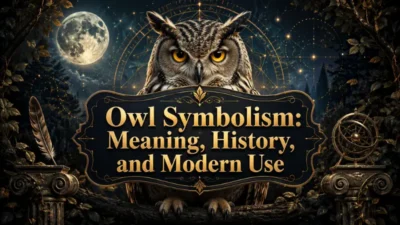

Symbolism in The Raven transforms a simple nighttime visit from a bird into a psychological study of grief, memory, and despair. Edgar Allan Poe’s speaker is mourning Lenore when a raven enters his room, settles above the door, and repeatedly answers his questions with one word: “Nevermore.”
The poem matters because its objects do more than create a dark atmosphere. The bird, the chamber, the December night, the bust of Pallas, and even the changing lamplight reflect what is happening inside the speaker’s mind.
Rather than helping him accept loss, each symbol becomes part of a cycle in which he searches for comfort, expects the worst, and then uses the raven’s answer to confirm his fears.
Quick Answer
Symbolism in The Raven commonly represents unresolved grief, permanent loss, and the mind’s tendency to torment itself with painful memories. The raven, “Nevermore,” Lenore, midnight, and the bust of Pallas also symbolize the conflict between emotional despair and rational thought.
TL;DR
- The raven represents grief that refuses to disappear.
- “Nevermore” turns uncertainty into permanent emotional defeat.
- Lenore symbolizes idealized love made stronger by absence.
- Midnight and December mark endings, isolation, and transition.
- Pallas represents reason losing control over emotion.
- The chamber reflects the speaker’s trapped mental state.
What Happens in “The Raven”?
The poem begins with an unnamed speaker reading late at night in an attempt to distract himself from the death of Lenore. A tapping sound interrupts him, first at the chamber door and then at the window.
When he opens the window, a raven enters and sits on a bust of Pallas above the door. The speaker is briefly amused by the bird, but his curiosity soon becomes emotional dependence. He begins asking questions about his sorrow, his future, and whether he will see Lenore again.
The raven gives the same answer each time: “Nevermore.” Although the speaker realizes that the bird may have learned only one word, he continues asking questions whose answers he knows will hurt him. By the end, the raven remains above the door while its shadow appears to cover the speaker’s soul.
The Raven as a Symbol of Unending Grief
The raven is the poem’s central symbol. It represents grief that has entered the speaker’s private life and refuses to leave.
At first, the bird is physically separate from him. It is simply an unexpected visitor. As the poem continues, however, the speaker gives it greater emotional authority. He imagines that it may be a prophet, a supernatural messenger, or an agent sent from the underworld.
The bird does not create his grief. Lenore’s death occurred before it arrived. Instead, the raven gives that grief a visible form. Its dark body, still posture, and repeated answer allow the speaker to treat his own fearful thoughts as messages coming from outside himself.
Poe later explained that he intended the bird to represent mournful remembrance that does not end. That description fits the final scene: the raven remains in place, just as the speaker’s memory of Lenore remains fixed in his mind.
Why the Raven Is More Than a Symbol of Death
The raven is often described simply as a symbol of death, but that interpretation is incomplete. Lenore is already dead, and the bird does not appear to kill anyone or predict a new physical death.
Its more specific meaning is the emotional permanence of death. It represents what remains with the living person after someone has been lost: memory, longing, unanswered questions, and the fear that happiness will never return.
The bird may also represent an indifferent reality. It does not comfort the speaker, explain Lenore’s death, or respond differently when his questions become desperate. It continues giving the same answer regardless of his emotional needs.
This makes the raven frightening not because it attacks him, but because it cannot be persuaded. The speaker wants an exception to loss, while the bird represents a finality that will not change.
“Nevermore” as a Symbol of Finality
“Nevermore” begins as a strange but almost amusing response. The speaker assumes the raven learned the word from a previous owner who experienced repeated misfortune.
Its symbolic weight grows because the speaker keeps changing the question while the answer stays the same. The word eventually means that Lenore will not return, sorrow will not disappear, spiritual comfort may not come, and reunion after death may be impossible.
The raven does not provide detailed information. The speaker supplies the meaning himself. Each question is shaped so that “Nevermore” becomes the most painful possible response.
The word therefore symbolizes both finality and self-inflicted torment. The speaker knowingly asks a one-word bird questions about love, death, heaven, and eternity. He turns a limited sound into a complete judgment on his life.
Lenore as a Symbol of Idealized Love
Lenore never appears directly. Readers know her only through the speaker’s praise and grief.
Because she is absent, she cannot speak, change, disappoint him, or become more complicated. She exists as an idealized memory: beautiful, pure, distant, and permanently unreachable.
Lenore symbolizes a love that has become inseparable from loss. The speaker does not remember ordinary moments or describe a detailed relationship. Instead, he presents her in elevated language that separates her from everyday life.
This idealization intensifies his sorrow. He is not only mourning a person; he is mourning an image of perfect happiness that can no longer be tested against reality. Lenore becomes the standard against which his empty present is measured.
Midnight and December as Symbols of Ending
The poem takes place at midnight in December. Both details place the speaker near an ending.
Midnight separates one day from the next. It is a threshold rather than a stable period, making it an appropriate setting for uncertainty between memory and reality, life and death, and reason and imagination.
December is the final month of the year and, in much of the United States and Europe, a season associated with long nights, cold weather, bare landscapes, and reduced activity. In the poem, it strengthens the sense that warmth and growth have withdrawn.
The dying fire also casts separate shadows across the floor. Together, the late hour, winter month, and fading embers create an environment in which the speaker sees life as something receding rather than beginning again.
The Chamber as a Symbol of Isolation
Nearly the entire poem takes place inside the speaker’s chamber. This enclosed room symbolizes both physical solitude and psychological confinement.
The room appears to contain books, curtains, a lamp, a door, a window, and the bust of Pallas. It should be a place of study and safety, yet it becomes a mental prison once the speaker begins interpreting everything through his grief.
He initially tries to use books as a distraction. That effort fails because intellectual activity cannot provide the emotional relief he wants. The more he questions the raven, the less connected he becomes to anything outside the room.
The chamber can therefore be read as a representation of his mind. The outside world is almost absent, while memories, fears, and imagined messages fill the limited space around him.
The Door and Window as Psychological Boundaries
The door and window separate the speaker’s controlled interior world from the darkness outside.
When the tapping first comes from the door, he imagines a human visitor. Opening it reveals only darkness. He whispers Lenore’s name, and the only reply is an echo of his own voice.
That moment prepares readers for his interaction with the raven. Once again, the speaker sends a thought outward and receives something that seems like an answer but originates partly from himself.
The window provides a second entrance. Unlike the empty doorway, it allows the raven to cross into the chamber. Symbolically, this suggests that the speaker’s defenses have failed. The fear and uncertainty he associates with the night are no longer outside; they have entered his private mental space.
The Bust of Pallas as a Symbol of Reason
The raven chooses to sit on a bust of Pallas Athena, the classical goddess associated with wisdom and strategic thought. Its position is one of the poem’s clearest symbolic arrangements.
The bust represents knowledge, reason, and disciplined judgment. The speaker is also a reader surrounded by books, so the object fits his identity as an educated person.
The dark bird sitting above Pallas suggests that grief and irrational fear have gained control over reason. The bust remains present, but it does not help the speaker interpret the situation calmly.
This does not mean that reason disappears completely. The speaker briefly offers a sensible explanation: the raven probably learned one repeated word. His failure occurs when he abandons that explanation and treats the bird as an authority on his spiritual future.
Darkness, Lamplight, and Shadow
Darkness in the poem represents uncertainty, death, and the limits of what the speaker can know. When he looks beyond the door, he cannot find evidence of Lenore, an afterlife, or a supernatural visitor. He finds only darkness and silence.
Lamplight appears to offer clarity, but its effect becomes disturbing. Near the end, the lamp throws the raven’s shadow across the floor. Instead of exposing the bird as ordinary, the light enlarges its symbolic presence.
The final shadow suggests that grief has spread beyond a single memory. It now shapes the speaker’s entire understanding of himself.
The poem closes without movement or release. The raven remains, the shadow remains, and the speaker imagines his soul trapped beneath it. Light has revealed his condition, but it has not freed him from it.
Biblical and Mythological References
Poe uses biblical and classical references to expand the speaker’s private sorrow into questions about medicine, fate, the underworld, and eternal life.
| Reference | Original Association | Meaning in the Poem |
| Pallas | Wisdom and rational judgment | Reason overshadowed by grief |
| Plutonian shore | Pluto and the classical underworld | Death, darkness, and the unknown |
| Nepenthe | A legendary drink that removes sorrow | The speaker’s desire to forget |
| Balm in Gilead | Biblical image of healing | Hope for emotional or spiritual relief |
| Aidenn | A poetic form of Eden | Paradise and reunion after death |
These references reveal how far the speaker’s questions have grown. He begins by wondering who is tapping at his door but eventually asks whether sorrow can be cured and whether Lenore exists in paradise.
The raven’s unchanging reply blocks every possible source of relief. Knowledge, medicine, religion, and mythology are all pulled into the speaker’s despair.
Sound and Repetition as Symbols of Mental Entrapment
The poem’s sound patterns are not merely decorative. Repeated rhymes, internal echoes, and the recurring refrain imitate a mind circling around the same painful thought.
Many lines contain words that answer or mirror one another. This creates a sense of movement, but the poem repeatedly returns to similar sounds and endings. The speaker appears to move through different questions while emotionally remaining in the same place.
“Nevermore” becomes especially forceful because the reader learns to expect it. Each return feels less like new information and more like a locked door.
The structure reflects rumination: the repeated mental review of distressing memories without reaching a solution. The speaker keeps approaching his grief from different angles, yet every path leads back to permanent loss.
A Quick Guide to the Poem’s Main Symbols
| Symbol | Main Meaning | Effect on the Speaker | Wider Theme |
| The raven | Persistent grief and remembrance | Gives sorrow a visible form | Loss does not obey reason |
| “Nevermore” | Finality and hopelessness | Confirms his worst expectations | Language can intensify pain |
| Lenore | Idealized lost love | Keeps the past more attractive than life | Memory can preserve and distort |
| Midnight | A boundary between states | Increases uncertainty and fear | Transition and instability |
| December | Ending, coldness, and decline | Makes renewal feel distant | Emotional winter |
| Pallas | Wisdom and reason | Becomes overshadowed by the raven | Emotion defeats judgment |
The symbols work together rather than separately. The setting creates vulnerability, Lenore provides the source of grief, the raven gives grief a body, and “Nevermore” gives it a permanent voice.
The Psychological Meaning of the Poem
The speaker’s behavior resembles a cycle of grief, rumination, and confirmation bias.
He searches for signs connected to Lenore, then interprets uncertain events in ways that support his most painful beliefs. Even after concluding that the bird knows only one word, he asks whether he will recover, whether spiritual relief exists, and whether he will meet Lenore in heaven.
These are not neutral questions. They invite “Nevermore” as an answer.
The raven can therefore be read as a projection screen for the speaker’s mind. Because the bird says almost nothing, the speaker fills the silence with his own fears.
The poem does not reduce grief to weakness or irrationality. It shows how grief can alter perception. A person may recognize the logical explanation for an event while still responding as though the event carries a personal message.
Historical Context and Poe’s Intended Effect
“The Raven” first appeared in New York’s Evening Mirror on January 29, 1845, shortly before its scheduled appearance in The American Review. It quickly attracted attention and became closely associated with Poe’s public reputation.
In his 1846 essay “The Philosophy of Composition,” Poe presented the poem as a carefully constructed work. He described choosing a repeated refrain, selecting “Nevermore” for its sound, and using a raven because a speaking bird could repeat the word while matching the poem’s somber tone.
This account supports the idea that the poem’s details were selected to create a unified emotional effect. The bird, setting, language, and subject all direct readers toward melancholy and irreversible loss.
The poem also reflects nineteenth-century mourning culture, when death was a visible part of family and public life. Mourning clothing, memorial objects, formal customs, and artistic representations helped people express continuing attachment to the dead.
Meaning in Modern American Culture
In the United States, “The Raven” is commonly encountered in literature classes, Halloween readings, theatrical performances, illustrations, parody, and gothic design. Its winter night, talking black bird, and memorable refrain make it easy to adapt visually and dramatically.
The poem has also become part of Baltimore’s public identity because Poe lived in the city and was buried there. When Baltimore’s NFL franchise was named in 1996, “Ravens” was selected through a public process as a tribute to the poem and its author.
Modern adaptations sometimes emphasize horror, but the poem’s emotional center is bereavement rather than physical danger. The raven is unsettling because it gives shape to a familiar fear: that a painful loss may permanently change the person left behind.
That emotional clarity helps explain why the poem remains recognizable in American culture. Readers do not need to believe that the bird is supernatural to understand the speaker’s need for an answer.
Common Misunderstandings About the Symbols
One common mistake is assuming that the raven definitely comes from the supernatural world. The speaker imagines several supernatural possibilities, but the poem never confirms them. The bird may be ordinary, while the terrifying meaning comes from the speaker’s interpretation.
Another mistake is treating “Nevermore” as a prophecy that changes with every question. The raven repeats the same learned word. It is the speaker who changes the context and turns the word into a series of personal verdicts.
Lenore should not automatically be understood as a detailed portrait of a specific historical woman. Within the poem, she functions mainly as an absent and idealized figure. Trying to identify her too narrowly can distract from her literary role.
Finally, the ending does not prove that the speaker literally loses his soul. The shadow and trapped soul are symbolic images showing that grief has come to dominate his inner life.
FAQs
What does the raven symbolize in the poem?
The raven primarily symbolizes persistent grief and remembrance. It also represents the finality of death and the speaker’s inability to separate reality from his fearful interpretation of events.
Why does the raven keep saying “Nevermore”?
The speaker believes the bird probably learned the word from a former owner. Symbolically, its repetition allows every question to receive the same hopeless answer, showing how grief can make different fears feel like proof of one permanent conclusion.
What does Lenore symbolize?
Lenore symbolizes lost love, idealized memory, and an unreachable past. Because she never appears or speaks, the speaker can preserve her as a perfect figure rather than remember her as a complex person.
What does the bust of Pallas represent?
The bust represents wisdom, education, and rational thought. The raven’s position above it suggests that the speaker’s grief has gained authority over his judgment.
Is the raven actually supernatural?
The poem leaves the question unresolved. The speaker increasingly treats the bird as a supernatural messenger, but readers are also given a reasonable explanation: it may be an ordinary raven trained to repeat one word.
Is the poem mainly about death or grief?
Death creates the situation, but grief drives the action. The poem focuses on what happens when a mourning person cannot accept uncertainty and repeatedly searches for answers that reinforce despair.
Why is “The Raven” still important in American culture?
Its strong rhythm, memorable refrain, gothic setting, and clear emotional conflict make it suitable for reading, performance, education, parody, and visual art. Its connection with Baltimore has also given the poem a continuing place in American civic and sports culture.
Conclusion
Symbolism in The Raven shows how grief can move from being a painful feeling to becoming a person’s entire way of interpreting the world. The raven embodies persistent remembrance, “Nevermore” expresses finality, Lenore represents idealized loss, and Pallas reveals the weakening influence of reason.
The poem’s most disturbing possibility is not that a supernatural bird has entered the room. It is that the speaker already carries the answer he fears, and the raven merely gives him a voice through which to repeat it.
Poe leaves the bird sitting above the door because unresolved grief rarely ends with a single discovery. It remains present until the person mourning can stop treating every silence as another confirmation of loss.