Numbers play an important role throughout the Bible. From the seven days of creation to the twelve tribes of Israel and the forty days Jesus spent fasting in the wilderness, numbers appear in stories, prophecies, laws, visions, and religious teachings. Beyond their mathematical purpose, certain numbers carry symbolic significance that helps communicate spiritual ideas and biblical themes.
Number symbolism in the Bible is often associated with concepts such as creation, completeness, divine order, judgment, covenant, redemption, and spiritual transformation. Some numbers appear repeatedly in important biblical events, making them especially meaningful to readers and theologians.
However, biblical number symbolism requires careful interpretation. Not every number has a hidden spiritual message, and not every repeated number should be treated as a supernatural sign. The meaning of a number depends on its scriptural context, literary purpose, and theological tradition.
This guide explores the most significant biblical numbers, their meanings, and the passages that help explain their symbolism.
What Is Number Symbolism in the Bible?
Number symbolism in the Bible refers to the use of numbers to communicate ideas beyond simple quantity. In certain passages, numbers help emphasize spiritual themes, organize important events, or represent broader religious concepts.
For example:
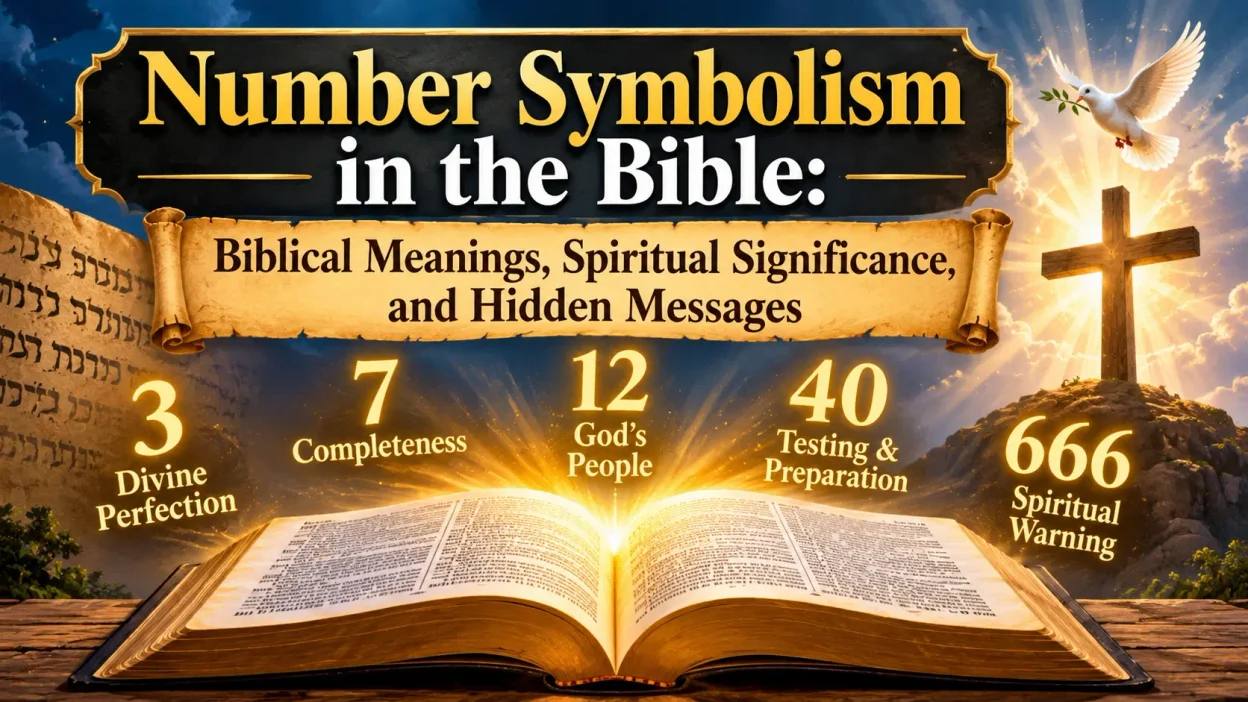
- 3 is frequently associated with divine significance and resurrection.
- 7 commonly represents completion or fullness.
- 12 is associated with God’s people and covenant organization.
- 40 often marks testing, preparation, or a significant period of transition.
- 10 can represent completeness in certain biblical structures and commandments.
These interpretations come from patterns in biblical texts rather than from a single universal code.
The Most Important Numbers in the Bible and Their Meanings
Number 1: Unity and the Oneness of God
The number one is associated with unity, uniqueness, and the oneness of God.
Deuteronomy 6:4 declares:
“Hear, O Israel: The LORD our God, the LORD is one.”
This verse, known as the Shema, is one of the central declarations of biblical faith. It emphasizes that God is unique and that Israel should worship Him alone.
In biblical interpretation, the number one can therefore represent:
- Divine unity.
- God’s uniqueness.
- Singular devotion.
- Spiritual oneness.
- The beginning or first position.
The number one also appears in teachings about unity among believers, including the idea of being one body in Christ.
Number 2: Witness, Agreement, and Partnership
The number two often appears in biblical passages involving testimony, agreement, and partnership.
Deuteronomy 19:15 establishes that a matter should be confirmed by two or three witnesses. This principle emphasizes the importance of reliable testimony in legal and community matters.
Other examples include:
- Noah’s animals entering the ark in pairs (Genesis 7:9).
- Jesus sending disciples out two by two (Mark 6:7).
- The two witnesses in Revelation 11:3.
Number two may therefore symbolize:
- Confirmation.
- Testimony.
- Agreement.
- Partnership.
- Shared responsibility.
Its meaning depends on the passage rather than representing one fixed spiritual message.
Number 3: Divine Significance and Resurrection
Three is one of the most recognizable numbers in Christian biblical symbolism.
It appears in several important events and teachings, particularly those associated with resurrection and divine significance.
Examples include:
- Jesus rising on the third day (1 Corinthians 15:4).
- Jonah spending three days and three nights in the fish (Jonah 1:17).
- Peter denying Jesus three times (Luke 22:54–62).
- Jesus praying three times in Gethsemane (Matthew 26:36–44).
In Christian theology, the Father, Son, and Holy Spirit are understood as the three persons of the Trinity, although the word “Trinity” itself is not directly used in the Bible.
Common symbolic associations of three include:
- Resurrection and new life.
- Divine significance.
- Spiritual completeness in certain passages.
- Restoration.
- Important turning points.
The number three is especially meaningful in Christian interpretations because of its connection with Jesus’ resurrection.
Number 4: Creation and the Earth
The number four is sometimes associated with the created world and the four directions of the earth.
Biblical examples include:
- The four rivers flowing from Eden (Genesis 2:10–14).
- The four winds mentioned in prophetic passages.
- The four living creatures in Ezekiel 1.
- The four living creatures surrounding God’s throne in Revelation 4:6–8.
These passages contribute to interpretations connecting four with creation, the world, and the totality of earthly existence.
Possible symbolic associations include:
- The natural world.
- Creation.
- Universality.
- The four directions.
- God’s authority over the earth.
However, these associations should be understood as interpretive patterns rather than a strict biblical formula.
Number 5: Grace and God’s Provision
Some Christian traditions associate the number five with grace, although this meaning is not explicitly defined as a universal biblical rule.
One passage often connected with this interpretation is the feeding of the five thousand.
In Matthew 14:13–21, Jesus feeds a large crowd using five loaves and two fish.
The event demonstrates God’s provision and Jesus’ compassion. The five loaves have inspired later symbolic interpretations involving grace, generosity, and divine abundance.
Other biblical references to five include:
- The five books of the Torah.
- David selecting five smooth stones before facing Goliath (1 Samuel 17:40).
- The five wise and five foolish virgins in Matthew 25:1–13.
The number five may therefore be associated with provision, responsibility, and grace in certain Christian interpretations.
Number 6: Humanity, Labor, and Imperfection
The number six is associated with humanity and human labor in several biblical interpretations.
Genesis 1 describes humanity being created on the sixth day.
Exodus 20:9 also commands people to work for six days before observing the Sabbath on the seventh day.
The number six is sometimes contrasted with seven, which often represents completion in biblical patterns.
Common interpretations include:
- Human life and responsibility.
- Labor and effort.
- The limitations of humanity.
- Incompleteness in contrast with seven.
In Revelation 13:18, the number 666 is described as the number of the beast. It has been interpreted in different historical and theological ways, including through ancient numerical systems and references to imperial power.
It is important not to assume that every appearance of six represents evil.
Number 7: Completion, Rest, and Spiritual Fullness
Seven is among the most important numbers in biblical symbolism.
Its association with completion comes especially from the creation account in Genesis.
According to Genesis 2:2–3, God completed His work of creation in six days and rested on the seventh day.
Other examples include:
- Seven days of creation (Genesis 1–2).
- Seven pairs of clean animals in Genesis 7:2, depending on translation and interpretation of the passage.
- Seven lamps on the golden lampstand (Exodus 25:31–37).
- Seven churches in Revelation 1:4.
- Seven seals in Revelation 5–8.
- Seven trumpets in Revelation 8–11.
Seven is commonly interpreted as representing:
- Completion.
- Wholeness.
- Rest.
- Fulfillment.
- Spiritual fullness.
The number appears frequently in Revelation, where it helps organize visions and communicate themes of divine authority and the completion of God’s purposes.
Number 8: New Beginnings and Renewal
The number eight is often associated with new beginnings in Christian symbolism.
This interpretation is influenced by its relationship to the seven-day creation cycle. Eight can be understood symbolically as the beginning of a new cycle after completion.
Biblical examples include:
- Circumcision taking place on the eighth day (Genesis 17:12; Leviticus 12:3).
- Eight people being preserved through the flood in 1 Peter 3:20.
- Jesus’ resurrection, sometimes described in Christian tradition through the symbolism of the “eighth day.”
The eighth-day interpretation is especially prominent in early Christian discussions of resurrection and new creation.
Possible symbolic meanings include:
- Renewal.
- New beginnings.
- Resurrection.
- New life.
- Spiritual transformation.
Number 9: Fruitfulness and Spiritual Growth
The number nine is sometimes connected with spiritual fruitfulness because Galatians 5:22–23 lists nine qualities known as the fruit of the Spirit.
These qualities are:
- Love.
- Joy.
- Peace.
- Patience.
- Kindness.
- Goodness.
- Faithfulness.
- Gentleness.
- Self-control.
This list has inspired Christian interpretations associating nine with spiritual development and the qualities produced by a life guided by the Holy Spirit.
However, the Bible does not explicitly establish nine as a universal symbol of spiritual maturity.
Number 10: Commandments, Responsibility, and Order
Ten is important in biblical history because of the Ten Commandments.
Exodus 20:1–17 records the commandments given to Israel through Moses. These instructions establish principles for worship, moral behavior, and relationships with others.
Other examples include:
- The ten plagues of Egypt (Exodus 7–12).
- The ten virgins in Matthew 25:1–13.
- The ten servants in the parable of the minas (Luke 19:11–27).
In some biblical interpretations, ten represents completeness, responsibility, law, or an organized whole.
Number 11: Transition and Incompleteness
Eleven is sometimes interpreted as a number of transition or incompleteness because it falls between ten and twelve, two numbers that have important biblical associations.
However, this interpretation is largely a later symbolic framework rather than an explicit biblical teaching.
Examples of the number eleven include:
- Eleven sons of Jacob remaining in Canaan before Joseph’s brothers traveled to Egypt (Genesis 42).
- Eleven disciples remaining after Judas’ betrayal, before Matthias was chosen (Acts 1:15–26).
The meaning of eleven should be interpreted within each passage rather than automatically assigned a spiritual message.
Number 12: God’s People, Government, and Covenant
Twelve is one of the most significant numbers in the Bible.
It is strongly connected with the organization of God’s people and the biblical covenant.
Important examples include:
- The twelve tribes of Israel (Genesis 49).
- The twelve apostles chosen by Jesus (Matthew 10:1–4).
- Twelve stones taken from the Jordan River (Joshua 4:1–9).
- Twelve gates and twelve foundations in the New Jerusalem (Revelation 21:12–14).
The number twelve is commonly associated with:
- God’s people.
- Covenant identity.
- Religious organization.
- Leadership.
- Divine order.
Its repeated use in both the Old and New Testaments makes it particularly important in biblical interpretation.
Number 13: Rebellion and Human Tradition
The number thirteen is sometimes associated with rebellion, disorder, or misfortune in popular Christian numerology.
However, the Bible does not establish thirteen as a universal symbol of evil or bad luck.
Some interpretations connect it with events involving rebellion or judgment, but these associations should not be treated as definite biblical doctrine.
The number thirteen can appear simply as a numerical detail without any special symbolic meaning.
Number 14: Generations and Messianic History
Fourteen has an important role in Matthew’s presentation of Jesus’ genealogy.
Matthew 1:17 organizes the genealogy into three groups of fourteen generations:
- From Abraham to David.
- From David to the Babylonian exile.
- From the exile to Christ.
This structure highlights Jesus’ place in Israel’s history and the Gospel’s presentation of Him as the promised Messiah.
The number fourteen is therefore significant in this particular literary and theological structure.
Number 40: Testing, Preparation, and Transformation
Forty is one of the most frequently discussed numbers in biblical symbolism.
It appears in stories involving judgment, testing, preparation, and important periods of spiritual change.
Examples include:
- Rain falling for forty days and forty nights during the flood (Genesis 7:12).
- Moses spending forty days and nights on Mount Sinai (Exodus 24:18).
- Israel wandering in the wilderness for forty years (Numbers 14:33–34).
- Jesus fasting for forty days in the wilderness (Matthew 4:1–2).
- Jesus appearing to His disciples over forty days after His resurrection (Acts 1:3).
The number forty is commonly associated with:
- Testing and trials.
- Preparation.
- Repentance.
- Spiritual growth.
- Transition.
- Judgment and renewal.
Its repeated use makes it a meaningful biblical pattern, although the exact significance varies between passages.
Number 50: Jubilee, Freedom, and Restoration
The number fifty is especially important in the Old Testament because of the Year of Jubilee.
Leviticus 25 describes a Jubilee year after seven cycles of seven years. The fiftieth year was associated with liberty, restoration, and the return of property under the law’s provisions.
Fifty is also associated with Pentecost, a Christian celebration connected with the coming of the Holy Spirit in Acts 2.
These passages inspire associations with:
- Freedom.
- Restoration.
- Release from debt or servitude under Jubilee law.
- Celebration.
- Spiritual empowerment.
Number 70: Leadership, Nations, and Fulfillment
Seventy appears in several important biblical events.
Examples include:
- Seventy elders appointed to assist Moses (Numbers 11:16–25).
- Seventy descendants of Jacob listed in Exodus 1:5 in the traditional Hebrew textual count.
- Jesus sending out seventy or seventy-two disciples, depending on the Bible translation, in Luke 10:1.
The number can be associated with leadership, collective responsibility, and the organization of God’s people.
Some later Jewish and Christian traditions also connect seventy with the nations of the world.
Number 100: Abundance and Blessing
The number one hundred can represent a large quantity, abundance, or a complete measure in certain biblical passages.
For example, Matthew 13:8 describes seed producing a hundredfold, sixtyfold, or thirtyfold.
In this parable, the hundredfold harvest illustrates remarkable fruitfulness.
The number is sometimes associated with:
- Abundance.
- Fruitfulness.
- Blessing.
- God’s provision.
- Spiritual growth.
Its meaning should still be understood through the passage in which it appears.
Number 666: The Number of the Beast
The number 666 appears in Revelation 13:18 and is described as the number of the beast.
The passage invites readers to calculate the number because it is associated with the number of a human being.
Throughout history, scholars have offered different interpretations, including connections to ancient systems in which letters represented numerical values. One widely discussed historical interpretation connects the number with Nero Caesar.
In Christian theology and popular culture, 666 is often associated with:
- Opposition to God.
- Evil and deception.
- Human political power.
- False worship.
- The beast’s authority in Revelation.
The passage is complex, and scholars do not agree on every detail. It should not be used to label ordinary people, products, dates, or events as evil without sound contextual evidence.
Biblical Number Symbolism: Quick Reference Table
| Number | Common Biblical Association | Important Reference |
|---|---|---|
| 1 | Unity and God’s oneness | Deuteronomy 6:4 |
| 2 | Witness and agreement | Deuteronomy 19:15 |
| 3 | Resurrection and divine significance | 1 Corinthians 15:4 |
| 4 | Creation and the earth | Genesis 2:10–14 |
| 5 | Grace and provision in later interpretation | Matthew 14:17–21 |
| 6 | Humanity and labor | Genesis 1:26–31 |
| 7 | Completion and rest | Genesis 2:2–3 |
| 8 | New beginnings and renewal | 1 Peter 3:20 |
| 9 | Fruitfulness of the Spirit | Galatians 5:22–23 |
| 10 | Commandments and responsibility | Exodus 20:1–17 |
| 12 | God’s people and covenant | Matthew 10:1–4 |
| 14 | Messianic genealogy | Matthew 1:17 |
| 40 | Testing and preparation | Matthew 4:1–2 |
| 50 | Jubilee and restoration | Leviticus 25 |
| 70 | Leadership and collective responsibility | Numbers 11:16–25 |
| 100 | Abundance and fruitfulness | Matthew 13:8 |
| 666 | The beast and opposition to God | Revelation 13:18 |
Why Are Numbers Important in the Bible?
Numbers help communicate biblical messages in several ways.
1. They Organize Biblical Events
Numbers often provide structure to important events, genealogies, laws, and religious practices. For example, the seven-day creation account establishes a pattern of work and rest.
2. They Reinforce Spiritual Themes
Repeated numbers can emphasize ideas such as completeness, covenant, judgment, and renewal.
3. They Connect Different Biblical Stories
The forty days of rain during the flood, Israel’s forty years in the wilderness, and Jesus’ forty days of fasting create thematic connections involving testing and preparation.
4. They Help Readers Understand Prophecy
Numbers play an important role in biblical prophetic literature, particularly Daniel and Revelation. Their use may communicate symbolic ideas, historical references, or structured visions.
5. They Reflect Biblical Culture and Literature
Ancient Hebrew and Greek writing used numbers in ways that sometimes differ from modern literary conventions. Understanding historical context can help readers interpret numerical patterns more accurately.
Is Biblical Number Symbolism the Same as Numerology?
No. Biblical number symbolism and numerology are related topics, but they are not identical.
Biblical number symbolism examines how numbers function in Scripture, including their literary, historical, theological, and symbolic roles.
Numerology generally attempts to assign spiritual or mystical significance to numbers and may use them to interpret personal experiences, personality, or future events.
For example, the Bible associates seven with creation and rest through Genesis 2:2–3. Modern numerology may assign additional meanings to the number seven that are not directly taught in that passage.
Christians differ in their views of numerology, but many caution against using repeated numbers to predict the future or replace biblical teaching.
How to Interpret Numbers in the Bible Correctly
Understanding biblical numbers requires more than memorizing symbolic meanings.
Consider these principles:
- Read the entire passage: Understand what happens before and after the number appears.
- Consider the historical context: Learn about the culture, traditions, and literary practices of the biblical period.
- Compare related passages: Look for repeated patterns across Scripture.
- Distinguish explicit teaching from interpretation: A biblical event may inspire a symbolic meaning without the Bible directly defining it.
- Avoid forcing hidden meanings: Not every number carries a special message.
- Focus on the central message: Numerical patterns should support the meaning of Scripture rather than replace it.
Frequently Asked Questions About Number Symbolism in the Bible
1. What is the most important number in the Bible?
Seven is often considered one of the most significant numbers in biblical symbolism because of its association with creation, rest, and completion. It appears throughout both the Old and New Testaments.
2. What does the number 7 mean in the Bible?
The number seven commonly symbolizes completion, fullness, and rest. Its importance is established through the seven-day creation account in Genesis 1–2.
3. What does the number 3 represent in the Bible?
Three is associated with important spiritual events, particularly Jesus’ resurrection on the third day. It also appears in several significant biblical stories.
4. What does the number 12 mean in biblical symbolism?
Twelve is associated with God’s people, covenant, and religious organization. Examples include the twelve tribes of Israel and the twelve apostles.
5. Why is the number 40 important in the Bible?
Forty frequently marks periods of testing, preparation, judgment, or transition. Examples include Israel’s forty years in the wilderness and Jesus’ forty days of fasting.
6. What does 666 mean in the Bible?
Revelation 13:18 identifies 666 as the number of the beast. It is commonly interpreted in connection with opposition to God, deception, and corrupt human authority.
7. Does the number 8 mean new beginnings in the Bible?
Many Christian traditions associate eight with renewal and new beginnings. This interpretation is connected with eighth-day circumcision, the eight survivors of the flood, and early Christian resurrection symbolism.
8. What does the number 5 mean in the Bible?
Some Christian interpreters associate five with grace and provision. The feeding of the five thousand using five loaves is one passage sometimes used to support this interpretation.
9. Does every number in the Bible have a spiritual meaning?
No. Many numbers simply describe quantities, ages, measurements, dates, or historical details. A symbolic interpretation should be supported by the passage and its context.
10. Is seeing repeated numbers a biblical sign from God?
The Bible does not teach that repeatedly seeing numbers on clocks, receipts, or everyday objects automatically delivers a personal message from God. Christians are generally encouraged to evaluate spiritual questions through Scripture, wisdom, and prayer rather than relying on number patterns alone.
11. What does the number 10 represent in the Bible?
Ten is important in biblical structures involving law, responsibility, and completeness. The Ten Commandments and the ten plagues of Egypt are major examples.
12. What does the number 50 symbolize in the Bible?
Fifty is connected with the Year of Jubilee in Leviticus 25, which emphasized liberty and restoration. It is also associated with Pentecost in Christian tradition.
Conclusion
Number symbolism in the Bible offers a fascinating way to understand the structure, themes, and spiritual messages of Scripture. Numbers such as three, seven, twelve, and forty appear in important biblical events and help communicate ideas about resurrection, completion, covenant, testing, and renewal.
From the seven days of creation to the twelve tribes of Israel and Jesus’ forty days in the wilderness, numerical patterns connect stories across the Bible and enrich their theological meaning.
However, biblical numbers should always be interpreted within their original context. Not every number contains a hidden message, and Scripture does not provide a universal code for predicting personal events through repeated numbers.
Ultimately, the greatest value of biblical number symbolism is not discovering secret messages but gaining a deeper understanding of God’s purposes, the teachings of Scripture, and the spiritual themes that connect the biblical story.