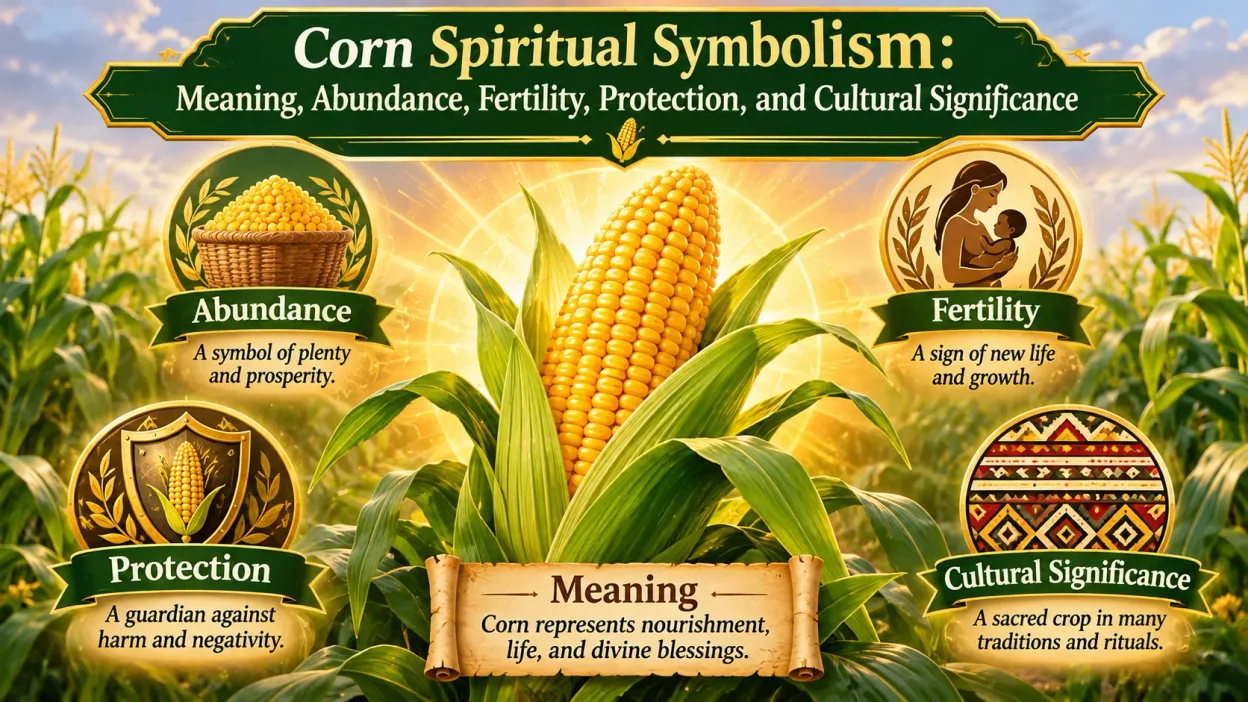
Corn is more than an important food crop. Throughout history, it has represented nourishment, prosperity, fertility, gratitude, community, and the relationship between human beings and the natural world. From ancient agricultural civilizations to modern spiritual practices, corn has carried deep symbolic meaning because of its ability to sustain families, support communities, and provide the foundation for entire cultures.
Corn spiritual symbolism is closely connected to abundance and life’s natural cycles. Its golden kernels can represent wealth and blessings, while its growth from a small seed into a tall, productive plant reflects patience, transformation, and the rewards of consistent effort. Corn also symbolizes gratitude because its harvest reminds people of the importance of appreciating nature’s gifts.
Different cultures have developed their own relationships with corn. In many Indigenous societies of the Americas, corn is especially significant as a sacred food, cultural symbol, and source of life. Its meaning varies across communities and traditions, making it important to understand its cultural background rather than assigning one universal interpretation.
What Does Corn Symbolize Spiritually?
Spiritually, corn commonly represents:
- Abundance: A plentiful harvest, prosperity, and the blessings of life.
- Fertility: Growth, reproduction, nourishment, and the creation of new life.
- Gratitude: Appreciation for food, nature, and the work that sustains communities.
- Protection: The preservation of life, family, and essential resources.
- Transformation: Growth through different stages of life.
- Patience: Understanding that meaningful results take time.
- Community: Cooperation, shared resources, and family connections.
- Renewal: The cycle of planting, growing, harvesting, and beginning again.
These meanings are symbolic interpretations. Specific spiritual associations differ between cultures, religious traditions, and individuals.
1. Corn Symbolizes Abundance and Prosperity
One of the strongest spiritual meanings of corn is abundance.
A single corn plant can produce many kernels, making it a natural representation of plentiful resources and the rewards of a successful harvest. For agricultural communities, corn has historically provided food, supported trade, and helped sustain families through changing seasons.
Spiritually, corn can represent:
- Financial opportunities.
- A plentiful home.
- Successful projects.
- Personal achievements.
- Gratitude for available resources.
- The ability to share blessings with others.
Seeing corn may inspire you to recognize the abundance already present in your life. It can also serve as a reminder that prosperity involves more than money. Health, relationships, nourishment, knowledge, and meaningful experiences are also forms of abundance.
2. Corn Represents Fertility and New Life
Corn has a powerful connection with fertility because of its seeds, growth, and ability to produce nourishment.
A kernel contains the potential for a new plant. Under suitable conditions, it develops roots, stems, leaves, and eventually produces another harvest.
This natural process makes corn a symbol of:
- Fertility and reproduction.
- Family growth.
- New opportunities.
- Creative potential.
- Fresh beginnings.
- The continuation of life.
In spiritual interpretations, corn may represent the beginning of something meaningful that needs time and attention to develop.
Its symbolism can apply to relationships, family aspirations, creative projects, and personal goals.
3. Corn Symbolizes Gratitude and Appreciation
Corn reminds people of the importance of appreciating the natural resources that support life.
Growing food requires fertile soil, water, sunlight, labor, and favorable conditions. A successful harvest is therefore the result of several interconnected elements.
Spiritually, corn can encourage gratitude for:
- Food and nourishment.
- Family and community.
- The natural environment.
- Hard work and dedication.
- Everyday opportunities.
- The people who support your life.
Corn’s association with harvest also makes it a meaningful symbol of appreciating the results of previous efforts.
4. Corn Represents Growth and Personal Transformation
The growth of corn provides a powerful metaphor for personal development.
A small seed does not immediately become a mature plant. It must pass through several stages, including germination, growth, flowering, pollination, and the development of kernels.
Similarly, personal transformation often happens gradually.
Corn can symbolize:
- Learning from difficult experiences.
- Developing confidence.
- Becoming emotionally stronger.
- Building new skills.
- Moving toward personal goals.
- Recognizing progress over time.
Its spiritual message is that growth requires patience, favorable conditions, and consistent effort.
5. Corn Symbolizes Protection and Sustenance
Because corn has provided nourishment for generations, it can represent security and the preservation of life.
For agricultural communities, storing and preserving harvested corn helped families prepare for seasons when fresh food was less available.
This practical role contributes to corn’s symbolic connection with protection.
In spiritual interpretations, corn may represent:
- Food security.
- Family stability.
- A protected home.
- Emotional support.
- Preparedness for difficult times.
- Caring for future generations.
Corn can remind us that genuine protection often involves providing care, maintaining relationships, and preparing responsibly for the future.
6. Corn Represents Community and Togetherness
Corn has played an important role in the development of communities throughout the Americas.
Its cultivation, preparation, storage, and distribution have often involved cooperation and shared knowledge.
As a result, corn can symbolize:
- Family unity.
- Cooperation.
- Shared traditions.
- Cultural identity.
- Hospitality.
- Collective responsibility.
In this interpretation, corn teaches that abundance becomes more meaningful when it supports the well-being of others.
Corn Symbolism in Different Cultures and Spiritual Traditions
Corn has a particularly important place in the histories and traditions of Indigenous peoples of the Americas. Its cultural and spiritual meanings are diverse and should not be reduced to one universal belief.
1. Native American Corn Symbolism
Corn is sacred or culturally important in many Indigenous communities across North America, although traditions vary significantly between nations.
Among the Hopi, Pueblo, and other Southwestern peoples, corn has deep connections with agriculture, ceremony, identity, and relationships with the land.
In several Pueblo traditions, corn is connected with life, nourishment, prayer, and community responsibilities.
Different colors of corn may also carry ceremonial or directional associations in particular traditions. However, these meanings are not identical across all Native American cultures.
Common themes include:
- Life and nourishment.
- Fertility and growth.
- Ancestral traditions.
- Gratitude for the harvest.
- Connection with the natural world.
2. Maya Corn Symbolism
Corn was central to ancient Maya civilization, providing nourishment and influencing mythology, agriculture, art, and religious life.
In the Popol Vuh, a foundational K’iche’ Maya narrative, humanity is created from maize after earlier attempts using other materials fail.
This story gives corn a profound connection with human origins and identity.
Maya corn symbolism can therefore be associated with:
- Creation and humanity.
- Life and nourishment.
- Renewal and regeneration.
- Ancestral identity.
- The relationship between people and the earth.
Corn continues to hold cultural significance for many Maya communities today.
3. Aztec Corn Symbolism
Corn was essential to the agricultural and religious life of the Aztec Empire.
The deity Centeotl was associated with maize, while Chicomecóatl was an important goddess connected with agriculture and nourishment.
Maize also played a role in ceremonial offerings and agricultural festivals.
In Aztec cultural contexts, corn can be connected with:
- Fertility and agricultural abundance.
- Divine nourishment.
- Seasonal cycles.
- Life and renewal.
- Community survival.
These historical associations reflect the central importance of maize in Aztec society.
4. Ancient Mexican Corn Traditions
Across different Indigenous cultures of Mexico, maize has been much more than a source of food.
It has shaped traditional farming practices, family life, cooking, festivals, and cultural identity.
The concept of milpa, a traditional agricultural system that often combines maize, beans, and squash, reflects relationships between crops, land, and community knowledge.
Corn symbolism in these traditions can express cooperation, balance, nourishment, and respect for the earth.
5. Corn in Christian Symbolism
Corn is not established as a universal or central Christian symbol in the same way that bread, wheat, grapes, or the vine appear in biblical imagery.
However, corn can be used in modern Christian reflection as a symbol of:
- God’s provision.
- Gratitude for daily food.
- The fruitfulness of the earth.
- The importance of sharing.
- Faith and patience.
These associations are inspired by broader biblical teachings about harvest, nourishment, generosity, and creation.
For example, Genesis 8:22 describes the continuing cycles of seedtime and harvest. Matthew 6:11 includes the prayer for daily bread, emphasizing dependence on God’s provision.
These passages concern agricultural life and nourishment broadly rather than specifically teaching that corn has a special biblical meaning.
Different Colors of Corn and Their Spiritual Meanings
Corn comes in several natural colors, and each can inspire different symbolic interpretations.
<PRIVATE_PERSON>### Yellow Corn: Happiness and Abundance
Yellow corn is often associated with sunlight, warmth, prosperity, and harvest.
Its golden appearance makes it a natural symbol of abundance, success, optimism, and gratitude.
White Corn: Purity and Peace
White corn may symbolize simplicity, peace, nourishment, and spiritual clarity in modern symbolic interpretations.
In particular Indigenous traditions, white corn may also have specific ceremonial or cultural meanings that should be understood within their own contexts.
Red Corn: Strength and Vitality
Red corn can symbolize strength, energy, courage, and vitality.
Its deep color may also inspire associations with life, passion, and resilience.
Blue Corn: Wisdom and Spiritual Connection
Blue corn is especially important in certain Indigenous foodways and traditions, including those of the American Southwest.
In modern symbolic interpretations, it may represent wisdom, connection with ancestral knowledge, and spiritual depth.
Its cultural meaning should not be separated from the communities that have cultivated and preserved it.
Black Corn: Mystery and Resilience
Black or dark-colored corn may symbolize mystery, endurance, protection, and transformation in contemporary interpretations.
These meanings are not universal traditional associations, and the cultural significance of dark maize varieties varies by region.
What Does It Mean Spiritually to See Corn?
Seeing corn may encourage reflection on growth, nourishment, gratitude, and prosperity.
The meaning can depend on where you encounter it and what it represents to you.
Seeing corn growing in a field: May symbolize potential, patience, progress, and the rewards of consistent effort.
Seeing ripe corn: Can represent achievement, abundance, and the completion of an important stage.
Seeing fresh corn: May inspire thoughts of nourishment, renewal, and new opportunities.
Seeing dried corn: Can represent preservation, preparation, wisdom, and learning from previous experiences.
Seeing a large amount of corn: May symbolize generosity, community, and a sense of plentiful resources.
These interpretations are personal and symbolic rather than guaranteed spiritual messages.
Corn Spiritual Meaning in Dreams
Dreams about corn can be interpreted through themes of growth, abundance, nourishment, and personal development.
The details of the dream and your emotions are important when considering its meaning.
Dreaming of Green Corn
Green corn may represent fresh opportunities, developing plans, and personal growth.
It can suggest that something in your life is still developing and requires patience.
Dreaming of Ripe Corn
Ripe corn may symbolize achievement, rewards, prosperity, or the results of previous efforts.
It can reflect a period when your hard work is beginning to produce meaningful outcomes.
Dreaming of Harvesting Corn
Harvesting corn may represent accomplishment, gratitude, and the recognition of personal progress.
It can also encourage you to appreciate what you have achieved.
Dreaming of Eating Corn
Eating corn may symbolize nourishment, comfort, family connections, and satisfaction.
Depending on the dream’s emotional atmosphere, it may reflect a desire for stability or a stronger sense of belonging.
Dreaming of Rotten Corn
Rotten corn may represent disappointment, neglected opportunities, wasted resources, or concerns about something that is not developing as expected.
It can encourage reflection on areas of life that may need attention.
Dreaming of Planting Corn
Planting corn may symbolize hope, preparation, new beginnings, and long-term goals.
It can remind you that the results of today’s actions may become visible in the future.
Dream interpretations are subjective and should not be treated as predictions of future events.
Corn as a Symbol of Harvest and Thanksgiving
Corn is strongly connected with harvest traditions because of its historical importance as a staple crop.
In North America, corn appears in many autumn decorations and harvest celebrations. It is often associated with gratitude, seasonal change, food, and community.
Corn also has an important place in Thanksgiving imagery, although the historical relationship between Indigenous peoples, European settlers, and Thanksgiving is more complex than simplified popular accounts sometimes suggest.
As a harvest symbol, corn can represent:
- Appreciation for nature’s resources.
- The value of agricultural labor.
- Generosity and sharing.
- Seasonal renewal.
- Family gatherings.
- The relationship between people and the land.
Corn Symbolism in Spiritual Growth
Corn offers several lessons that can be applied to personal and spiritual development.
Growth Requires the Right Environment
A seed needs suitable soil, water, and sunlight to develop. Similarly, people benefit from supportive relationships, healthy habits, and opportunities to learn.
Patience Creates Lasting Results
Corn takes time to grow and produce a harvest. Its life cycle reminds us not to expect every goal to be achieved immediately.
Abundance Comes With Responsibility
A successful harvest provides food and resources, but it also creates an opportunity to share with others.
Every Stage Has Value
Planting, growing, harvesting, and preserving are all necessary parts of the agricultural cycle. In the same way, difficult or uncertain periods can contribute to personal development.
Is Corn a Sign of Good Luck?
Corn is often considered a positive symbol because of its historical association with nourishment, prosperity, fertility, and successful harvests.
In modern spiritual interpretations, seeing corn may be taken as a reminder to welcome opportunities, appreciate your blessings, and remain patient with your goals.
However, corn is not a universal supernatural sign of good fortune. Its meaning depends on cultural context and personal interpretation.
FAQs About Corn Spiritual Symbolism
1. What does corn symbolize spiritually?
Corn commonly symbolizes abundance, prosperity, fertility, nourishment, gratitude, protection, growth, and community. Its meaning is strongly connected with its role as an essential food crop.
2. What does corn mean spiritually in a dream?
Dreaming of corn may represent growth, opportunities, nourishment, achievement, or abundance. The meaning depends on whether the corn is growing, ripe, harvested, eaten, or damaged.
3. Is corn a symbol of abundance?
Yes. Corn is widely used as a symbol of abundance because a successful harvest can produce substantial food and support entire communities.
4. What does yellow corn symbolize spiritually?
Yellow corn often represents prosperity, happiness, warmth, sunlight, gratitude, and harvest in modern symbolic interpretations.
5. What does corn symbolize in Native American culture?
Corn has different sacred and cultural meanings among Indigenous nations. It can be connected with life, nourishment, agriculture, fertility, ceremony, and ancestral traditions. There is no single interpretation shared by every Native American community.
6. What does corn symbolize in Mayan culture?
Corn is deeply connected with creation, human identity, nourishment, and renewal in Maya culture. The Popol Vuh describes the creation of human beings from maize.
7. What does corn symbolize in Christianity?
Corn can be used as a modern Christian symbol of provision, gratitude, harvest, and God’s care for creation. However, it is not a central biblical symbol with one officially established spiritual meaning.
8. What does harvesting corn symbolize?
Harvesting corn can symbolize achievement, rewards, gratitude, abundance, and the completion of a period of hard work.
9. Does corn symbolize fertility?
Yes. Corn’s seeds, growth, and ability to produce new plants make it a common symbol of fertility, reproduction, and the continuation of life.
10. What does dried corn symbolize?
Dried corn may represent preservation, preparation, resourcefulness, and the wisdom of planning for the future.
11. Is corn considered a sacred plant?
Corn is sacred in several Indigenous traditions, particularly among communities of the Americas. Its religious and cultural significance varies between peoples and should be understood in its specific context.
12. Is seeing corn a spiritual message?
Some people interpret seeing corn as a personal reminder of abundance, growth, and gratitude. However, there is no universal rule that seeing corn carries a supernatural message.
Conclusion
Corn spiritual symbolism reflects some of life’s most important themes: abundance, fertility, gratitude, protection, nourishment, and transformation. Its journey from a small seed to a mature plant offers a meaningful reminder that growth requires patience, care, and the right conditions.
Across Indigenous cultures of the Americas, corn has held profound importance as a source of food, cultural identity, and spiritual connection. Its role in Maya creation traditions and the agricultural and ceremonial life of many other communities demonstrates that corn is much more than an ordinary crop.
Whether you associate corn with prosperity, family, personal development, or gratitude, its symbolism encourages you to appreciate life’s resources, nurture meaningful relationships, and recognize the value of every stage of growth.