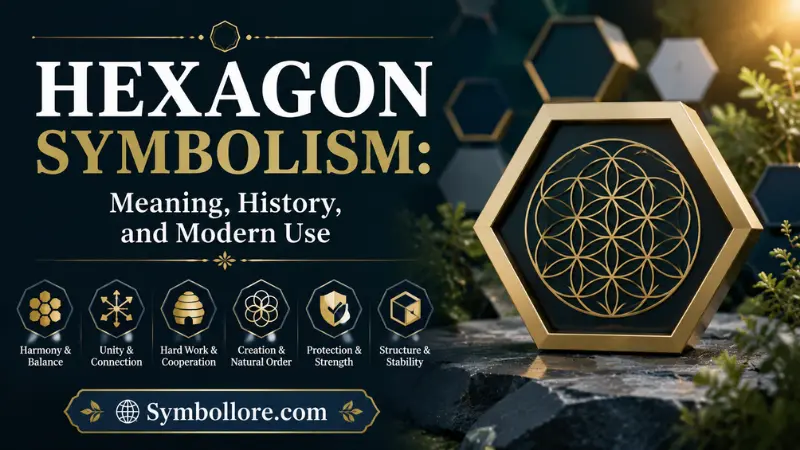
A hexagon is a six-sided shape found in honeycombs, snow crystals, mineral formations, architecture, technology, and decorative art. Hexagon symbolism commonly grows from these visible qualities, connecting the shape with balance, cooperation, strength, efficient organization, and the relationship between individual parts and a larger whole.
Americans encounter hexagons in science classrooms, bathroom tiles, quilts, jewelry, corporate logos, games, and environmental campaigns. The shape often appears modern and technical, yet people have studied its geometry for more than two thousand years.
No single culture created one permanent meaning for the hexagon. Its interpretation developed from mathematics, observations of nature, religious patterns, craft traditions, and modern design.
Quick Answer
In modern American culture, hexagon symbolism most often represents balance, cooperation, strength, and efficient organization, especially through its resemblance to a honeycomb. Historically, its sixfold symmetry has also connected it with mathematical order, natural structure, creation, and the harmonious arrangement of separate parts.
TL;DR
- Hexagons commonly represent balance, cooperation, strength, and efficiency.
- Honeycombs connect the shape with community and productive teamwork.
- Sixfold symmetry gives it associations with order and natural structure.
- Religious meanings usually belong to hexagrams, not plain hexagons.
- American design uses hexagons to suggest technology and modular organization.
- The shape has no universal mystical or negative meaning.
What a Hexagon Looks Like
A hexagon is any polygon with six straight sides and six corners. The word comes from Greek roots meaning “six” and “angle.”
Although people usually picture a regular hexagon, not every six-sided figure has equal measurements. A regular hexagon has six sides of equal length, six interior angles measuring 120 degrees each, and six lines of symmetry.
The shape can be divided into six equilateral triangles meeting at the center. Its side length also equals the radius of a circle drawn around it. These mathematical relationships make the regular hexagon appear unusually balanced and easy to construct with a compass.
Hexagons occur in several recognizable forms:
- A single outlined geometric figure
- Repeating honeycomb cells
- Three-dimensional hexagonal prisms
- Hexagonal tiles and quilt pieces
- Chemical ring diagrams
- Digital grids and network graphics
A lone hexagon often suggests stability or technology. A group of connected hexagons places more emphasis on community, systems, and interdependence.
What the Hexagon Commonly Means in the United States
The hexagon has several related meanings in contemporary American culture. Most come from its symmetry, its ability to repeat without gaps, or its association with bees.
| Context | Common U.S. Meaning | Familiar Examples | Important Detail |
| Honeycomb imagery | Cooperation and productivity | Bee logos, environmental campaigns | Meaning comes from colony behavior |
| Science and technology | Structure and innovation | Molecule graphics, software icons | Often creates a precise, modern appearance |
| Architecture | Stability and efficient use of space | Tiles, panels, modular rooms | Repetition matters as much as shape |
| Crafts | Connection and patience | Quilts, mosaics, beadwork | Small units create a complete design |
| Personal symbols | Balance and resilience | Tattoos, jewelry, artwork | Meaning depends on accompanying imagery |
| Spiritual design | Harmony and interconnectedness | Mandalas, geometric meditation art | Usually a modern or tradition-specific reading |
These interpretations overlap, but they are not interchangeable. A honeycomb tattoo may celebrate family cooperation, while a hexagonal logo may simply communicate engineering and organization.
Why Honeycombs Shape the Symbol’s Meaning
The honeycomb provides the strongest source of modern hexagonal meaning. Honeybees construct repeated cells for storing honey and pollen and raising young bees. Every cell supports the work of the colony rather than serving one bee alone.
That communal purpose gives the pattern associations with teamwork, shared responsibility, and organized labor. The cells are separate, yet their walls connect them physically. As a result, the pattern offers a clear visual metaphor for individuals contributing to a family, workplace, neighborhood, or society.
Geometry adds another layer. Equilateral triangles, squares, and regular hexagons can all cover a flat surface without leaving gaps. Among those regular shapes, the hexagon encloses more area for a given amount of boundary. This makes a honeycomb-like arrangement efficient in its use of material.
The cells also distribute contact across multiple sides. Designers have adapted honeycomb structures for lightweight panels, packaging, aerospace components, and protective materials.
Symbolically, the lesson is not simply “work harder.” The honeycomb represents coordinated effort: strength emerges when well-organized parts support one another.
Hexagons in the Natural World
Honeycombs are only one example of sixfold structure in nature. Hexagonal forms also appear in ice crystals, minerals, cooling rock, molecular diagrams, and even planetary weather.
Snow crystals develop sixfold symmetry because of the molecular structure of ice. Their branches may grow into elaborate patterns, but the underlying arrangement remains six-sided. This makes the snowflake a useful image of structured variation: countless forms can emerge from the same basic framework.
Basalt formations may break into polygonal columns as lava cools and contracts. Six-sided columns are common, although five- and seven-sided formations also occur. Their appearance connects the hexagon with endurance, geological time, and order produced by physical forces.
Chemists use hexagonal diagrams for molecules such as benzene, while carbon atoms form honeycomb-like arrangements in materials such as graphene. These scientific images have strengthened the shape’s connection with research, complexity, and microscopic structure.
Saturn provides a much larger example. A persistent six-sided jet stream surrounds the planet’s north pole. Its existence sometimes inspires mystical speculation, but it is a natural atmospheric phenomenon produced by moving fluids and planetary conditions.
Such examples help explain why people view the hexagon as a bridge between geometry and nature. They do not prove that nature assigns the shape a conscious message.
Mathematical Order and Early Historical Meaning
The hexagon does not have one identifiable symbolic starting point. People could observe six-sided patterns in flowers, crystals, and honeycombs long before written geometry.
Ancient Greek mathematicians studied the regular hexagon as part of a broader effort to understand ideal forms. Around 300 BCE, Euclid explained how to construct one inside a circle using a straightedge and compass. The relationship works neatly because the length of each side equals the circle’s radius.
Ancient writers also considered the efficiency of honeycomb cells. The Roman scholar Marcus Terentius Varro discussed why bees appeared to favor hexagons over other shapes. Mathematicians continued examining the problem for centuries before modern work formally established the efficiency of hexagonal partitions.
These developments encouraged three enduring associations:
- Order: Six equal sides create a predictable structure.
- Balance: Each part has an equivalent position around the center.
- Reason: The shape can be explained and constructed mathematically.
Historical artists and builders did not always use hexagons to express those exact ideas. Sometimes the form was chosen because it tiled a surface beautifully or fit a construction plan. Symbolic meaning often developed afterward through repeated cultural use.
The Hexagon in American Culture and Craft
In the United States, hexagons have a particularly visible history in quilting. Nineteenth-century makers pieced small six-sided scraps into patterns known as Honeycomb, Mosaic, and later Grandmother’s Flower Garden. Rings of colored hexagons resembled clusters of blossoms.
A finished quilt required many carefully joined pieces. Consequently, the pattern could reflect patience, domestic skill, resourcefulness, family continuity, and the transformation of small remnants into something useful.
Modern quilters continue to use the form, sometimes maintaining traditional floral layouts and sometimes creating abstract designs. The connected pieces make the hexagon a fitting emblem for memory: separate fabrics may represent different people, places, or stages of life.
Americans also recognize the shape through school science, beekeeping, hardware, games, and home renovation. A hexagonal nut suggests practical strength, while a honeycomb graphic may evoke pollinator protection or locally produced honey.
Environmental groups often use bee-and-cell imagery to represent ecological interdependence. The message is easy to understand: removing one part of a living system can affect everything connected to it.
Architecture, Technology, and Digital Design
Hexagons appeal to architects and product designers because they repeat cleanly while appearing more dynamic than squares. Hexagonal floor tiles became common in American homes and public buildings, particularly in bathrooms, kitchens, entryways, and transit spaces.
A repeating tile pattern suggests cleanliness, continuity, and controlled movement. Larger hexagonal panels can give a building a futuristic or nature-inspired appearance, depending on the material and color.
Technology companies frequently use the shape in logos, dashboards, diagrams, and backgrounds. It can resemble a molecular structure, bolt head, circuit network, or modular component. These associations communicate precision, connection, and engineered systems.
Hex grids also appear in strategy games because they allow movement in six neighboring directions without the awkward diagonal distances created by square grids. In this context, the form represents planning, territory, and interconnected choices.
Frequent use has made the hexagon visual shorthand for innovation. However, it can also feel impersonal when a design relies too heavily on dark colors, metallic textures, or rigid repetition.
Religious and Cross-Cultural Interpretations
Plain hexagons appear in the art and architecture of many cultures, but they rarely carry one universal religious message.
Islamic artists have used hexagonal tiles, stars, and interlocking geometric networks in mosques, palaces, manuscripts, and decorative objects. Repetition can create a sense of extension beyond the physical border of the artwork. Yet a single hexagon is not an official symbol of Islam, and its meaning depends on the complete design.
Some Christian interpretations associate the number six with the six days of creation described in Genesis. A hexagonal architectural feature may therefore receive a creation-related reading. Nevertheless, Christianity has no broadly established doctrine assigning one sacred meaning to every hexagon.
Modern sacred-geometry practices connect the shape with harmony, creation, and the organization of life. These ideas usually come from its symmetry and its presence in patterns such as the Flower of Life. They represent particular spiritual frameworks rather than scientifically verified properties of the shape.
Across cultures, the most defensible shared interpretation is organized multiplicity: several equal parts create one stable figure.
Why a Hexagon Is Not the Same as a Hexagram
A hexagon and a hexagram are different figures. A hexagon is a six-sided polygon, while a hexagram is a six-pointed star usually formed from two overlapping triangles. The star contains a hexagon at its center, which contributes to the confusion.
The Star of David, or Magen David, is a hexagram and a widely recognized symbol of Jewish identity. It should not be reduced to general statements about six-sided polygons.
Hindu traditions also use a hexagram called the Shatkona in some yantras. Its intersecting upward and downward triangles may represent complementary principles, commonly expressed as Shiva and Shakti or Purusha and Prakriti. This meaning belongs to the paired triangles, not automatically to every six-sided shape.
Likewise, the 64 hexagrams of the I Ching are figures composed of six broken or unbroken horizontal lines. They are called hexagrams because they contain six elements, not because they resemble geometric hexagons.
Distinguishing these symbols prevents religious traditions from being blended into a vague claim that all six-part figures mean the same thing.
Emotional and Psychological Associations
A regular hexagon can feel stable because it has a clear center and evenly distributed sides. Unlike a circle, it has firm edges; unlike a square, it offers more directions and visual movement.
Its emotional effect changes with presentation:
- A single solid hexagon can feel protective, technical, or self-contained.
- An open outline appears lighter, more modern, and less defensive.
- Connected cells suggest cooperation, community, or social networks.
- Irregular hexagons may communicate disruption or controlled imperfection.
- Bright colors make the form playful and energetic.
- Dark metallic colors create an industrial or futuristic mood.
People who identify with the shape may value organization, reliability, logical thinking, or collaborative work. That interpretation is metaphorical. Choosing hexagons does not reveal a scientifically measurable personality type.
Because the form looks both natural and engineered, it can express a desire to balance instinct with reason or individuality with belonging.
Hexagon Tattoos, Jewelry, and Personal Style
A hexagon tattoo often represents balance, resilience, connection, or the creation of order from complexity. Honeycomb tattoos add more specific themes such as family, teamwork, purposeful work, or loyalty to a community.
Different additions change the message. A bee emphasizes dedication and ecological awareness. Flowers introduce growth and beauty, while chemical structures may honor science, medicine, or a particular field of study. Broken or incomplete cells can represent personal change, loss, or a community that is still being built.
Couples, relatives, or friends sometimes choose matching cells that connect when placed together. In that use, each person remains an individual while belonging to a shared pattern.
Hexagonal jewelry usually feels clean, contemporary, and architectural. It can serve as a private reminder to maintain balance or recognize how one decision affects surrounding parts of life.
The shape also appears in clothing prints, eyewear, bags, and accessories. Repeating patterns look energetic, while a single metal outline feels understated and precise.
Common Misunderstandings and Distorted Meanings
One widespread mistake is claiming that the hexagon has always meant “divine perfection.” Historical cultures used six-sided forms for many reasons, including construction, decoration, mathematics, and available materials. Spiritual perfection is one possible interpretation, not a universal fact.
Another error involves treating every hexagon as a Star of David. The Jewish symbol is a specific six-pointed star with its own cultural and historical identity. A plain honeycomb cell does not automatically carry that meaning.
The word hex also causes confusion. In modern English, “hex” can mean a curse or spell, but that word has a different linguistic history from “hexagon.” The shape is not inherently connected with witchcraft, misfortune, or harmful magic.
Online posts sometimes present hexagonal storms, crystals, or honeycombs as proof of secret codes controlling nature. These patterns have scientific explanations involving molecular structure, physical stress, packing efficiency, or fluid motion.
A hexagon can certainly hold a spiritual meaning for an individual. The problem begins when a personal interpretation is presented as documented history or scientific evidence.
FAQS
What does a hexagon mean spiritually?
In contemporary spiritual art, a hexagon often represents harmony, interconnection, balance, and the relationship between individual parts and creation. These meanings come largely from symmetry and natural patterns rather than from one universal religious teaching.
What does a hexagon tattoo symbolize?
A hexagon tattoo commonly represents balance, strength, logical structure, or belonging to a larger community. Honeycomb designs may add themes of family, cooperation, productivity, and environmental responsibility.
Does a hexagon have a biblical meaning?
The Bible does not establish the hexagon as a standard sacred symbol. Some Christians associate its six sides with the six days of creation, but this is a later interpretive connection rather than a direct biblical definition.
Is a hexagon a symbol of good luck?
A hexagon is not a universal good-luck sign. Some people may treat it as fortunate because it suggests stability, productivity, and well-organized growth, especially when presented as a honeycomb.
Is a hexagon the same as the Star of David?
No. A hexagon is a six-sided polygon, while the Star of David is a six-pointed hexagram formed from two overlapping triangles. Although the star contains a central hexagon, the two symbols should not be treated as interchangeable.
Why do bees use hexagonal cells?
Hexagonal cells store substantial volume while using wax efficiently and fitting together without gaps. Their shared walls also create a stable, connected structure for honey, pollen, and developing bees.
Conclusion
The hexagon draws its meaning from a rare combination of natural occurrence and mathematical clarity. Honeycomb cells connect it with cooperation, snow crystals with structured variation, quilts with patient craftsmanship, and modern graphics with science and technology.
In contemporary American culture, hexagon symbolism most reliably represents balance, efficient organization, shared strength, and the way separate parts can support a complete system. Its most grounded message is simple: structure becomes stronger when every piece connects with the others.


