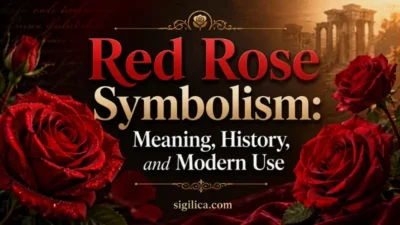

Rose symbolism centers on love, beauty, remembrance, and emotional commitment, but the flower carries more than one message. In the United States, roses appear at romantic celebrations, weddings, funerals, public ceremonies, gardens, and personal milestones, so their meaning changes with color, condition, and setting.
A fresh red rose offered on Valentine’s Day usually communicates desire or devotion. A white rose in a bridal bouquet suggests sincerity, purity, or a new beginning. The same flower placed at a grave may express grief, respect, or the continuing bond between the living and the dead. Understanding the rose therefore requires attention not only to the flower itself, but also to who gives it, when it appears, and what surrounds it.
Quick Answer
Rose symbolism most commonly represents romantic love, beauty, and devotion in modern American culture, especially in gifts, weddings, and Valentine’s Day traditions. Historically, roses have also represented sacred love, secrecy, mortality, political identity, and the tension between pleasure and pain.
TL;DR
- Red roses usually communicate romantic love and desire.
- White roses often suggest purity, remembrance, or new beginnings.
- Thorns add meanings of pain, defense, and sacrifice.
- Christian art connects roses with Mary, virtue, and martyrdom.
- American culture uses roses in romance, mourning, and civic identity.
- Color meanings guide interpretation but never form a universal code.
What a Rose Looks Like and Why Its Form Matters
A rose is recognizable by its layered petals, rounded bloom, fragrance, and often-prickled stems. Wild roses may have simple open flowers with only a few petals, while cultivated varieties can form dense cups, spirals, rosettes, or high-centered blooms. Roses also appear as shrubs, climbers, miniature plants, and cut flowers.
The flower’s structure helps explain its symbolic range. Soft petals and fragrance suggest attraction, tenderness, luxury, and intimacy. Prickles introduce danger, difficulty, and self-protection. A tightly closed bud can imply youth, promise, secrecy, or feelings not yet revealed, while a fully opened rose suggests maturity, fulfillment, or emotional openness.
What Roses Commonly Mean in the United States
For most Americans, the rose first signals love. That association is strongest when the flower is red, given by a romantic partner, or presented on Valentine’s Day, an anniversary, or a proposal. Yet roses also express admiration, gratitude, apology, sympathy, congratulations, and remembrance.
Roses also symbolize beauty that is not effortless. Their blooms are delicate, but their stems protect them. This contrast allows the flower to represent a person who is loving yet guarded, elegant yet resilient, or attractive without being defenseless.
Ancient Roots in Greece and Rome
Ancient Mediterranean traditions helped establish the rose as a flower of love, beauty, pleasure, and desire. Greek myth associated it closely with Aphrodite, while Roman culture connected it with Venus, Aphrodite’s counterpart. Roses appeared in art, ritual, gardens, fragrance, banquets, and stories about erotic love and divine beauty.
Roman uses added other meanings. Rose petals could mark celebration and luxury, but the flower also appeared in memorial practices. This combination of pleasure and mortality became important later: the rose could celebrate life while reminding viewers that beauty fades.
The association with Aphrodite and Venus still shapes modern interpretation. Contemporary red roses do not need a mythological explanation to feel romantic, but their cultural force rests partly on centuries of linking the flower with attraction, sensuality, and beloved figures.
Christian Meanings of Purity, Charity, and Sacrifice
As Christianity developed in Europe, the rose gained religious meanings that sometimes transformed its earlier associations. Medieval and Renaissance artists connected roses with the Virgin Mary. White roses could represent purity and innocence, while red roses could suggest charity, divine love, martyrdom, or the future suffering of Christ. Museum collections still preserve works in which Mary holds or stands within roses that carry these meanings.
The flower’s thorns also supported Christian interpretation. A beautiful bloom growing from a prickled stem could represent virtue in a fallen world, love joined with suffering, or spiritual beauty surviving hardship. In some devotional contexts, the rose garden became an image of paradise, prayer, or Mary’s protection.
Modern Americans may encounter these meanings in Catholic art, church windows, rosaries, devotional jewelry, religious tattoos, cemetery sculpture, and Marian imagery. Even when viewers do not know the full iconographic tradition, white and red roses in sacred settings often feel more solemn than romantic.
Why the Rose Can Represent Secrecy
The expression “sub rosa,” meaning privately or confidentially, literally refers to something happening “under the rose.” The phrase developed from older European traditions that treated the flower as a sign that conversation should remain secret. Later stories connected this custom with classical gods of love and silence, while carved roses appeared in spaces associated with confidential speech.
This meaning differs from the rose’s public romantic image. A rose can announce affection, but it can also hide it. A closed bud, a rose sealed in a letter, or a flower placed in a secret meeting scene may imply private knowledge, unspoken desire, or a promise not to reveal what has been shared.
In modern design, this secretive meaning appears in mystery fiction, private-club imagery, perfume branding, gothic art, and tattoos about concealed identity. Context determines whether the rose means love openly declared or feelings carefully protected.
Victorian Flower Language and Its Limits
Nineteenth-century flower-language books encouraged people to treat flowers as messages. Roses became especially important because different colors, stages, and combinations could be assigned separate meanings. The practice was fashionable, but it was never governed by one reliable dictionary. Different books often gave the same flower different definitions. Smithsonian Gardens notes that even white roses received conflicting interpretations in flower-language guides published only a few years apart.
This history explains why modern color charts feel traditional even when their rules are inconsistent. Red for love and white for purity became broadly recognizable, but many finer distinctions came from commercial convention, etiquette books, or local custom rather than a universal symbolic system.
A flower’s meaning should therefore be read as a social suggestion, not a fixed translation. The sender’s relationship to the recipient usually matters more than an online chart.
What Different Rose Colors Usually Communicate
Color strongly affects interpretation in the United States, although occasion and relationship remain decisive.
| Rose color or style | Common U.S. meaning | Typical context | Important note |
| Red | Romantic love, desire, devotion | Valentine’s Day, anniversaries, proposals | Can also suggest courage or sacrifice |
| White | Purity, sincerity, remembrance | Weddings, funerals, religious events | Meaning shifts sharply by setting |
| Pink | Admiration, affection, gratitude | Birthdays, thanks, gentle romance | Usually less intense than red |
| Yellow | Friendship, warmth, cheer | Congratulations, recovery, friendship | Older jealousy meanings are less common |
| Orange or coral | Enthusiasm, attraction, energy | New romance, celebration, achievement | Often feels bolder than pink |
| Very dark or “black” | Grief, rebellion, transformation | Tattoos, gothic design, memorial art | Usually symbolic, not a literal black bloom |
Mixed bouquets soften rigid color meanings. Red and white together may suggest unity; pink and yellow can feel joyful and friendly; white combined with greenery may look peaceful or ceremonial. A florist’s design, the recipient’s preferences, and the accompanying message usually explain more than color alone.
The Rose as an American National Emblem
The rose has an official place in American civic symbolism. Federal law identifies it as the national floral emblem, following congressional action in 1986 and a presidential proclamation later that year. The designation described the flower in terms of life, love, devotion, beauty, and enduring affection.
This national role reflects the rose’s unusual ability to cross regional, religious, and social boundaries. Roses grow in private yards, botanical gardens, public parks, memorial landscapes, and ceremonial spaces. Roses or named rose varieties also serve as official flowers in several states.
In civic settings, the flower may stand for shared beauty, cultivated tradition, national affection, or remembrance rather than romance. Red, white, and blue floral arrangements can also turn roses into patriotic elements at military ceremonies, public commemorations, and national holidays.
Romance, Valentine’s Day, and Relationship Rituals
No setting has shaped the modern American meaning of roses more strongly than romance. Red roses function as a familiar shorthand for passionate affection, while pink, peach, white, and mixed bouquets can communicate gentler forms of love.
The strength of the symbol can be helpful or risky. A red bouquet may feel appropriate in an established relationship but overly intense in a new friendship. One rose can communicate focused attention; dozens may feel theatrical. The same gesture can be sincere, apologetic, celebratory, or manipulative depending on timing and the health of the relationship.
Roses also appear in proposals, anniversary gifts, date-night decor, and wedding celebrations. In these settings, the flower represents chosen commitment as much as attraction. Its cultivated form fits the idea that lasting relationships require attention, patience, and maintenance.
Weddings, New Beginnings, and Family Bonds
At American weddings, roses often represent love entering a formal, public stage. White roses suggest sincerity, unity, and a new beginning. Blush and pink roses add tenderness, joy, or gratitude. Red roses introduce passion and dramatic contrast.
Outside weddings, roses mark births, graduations, Mother’s Day, retirement, and major achievements. In these moments, their meaning broadens from romantic attachment to pride, respect, and enduring family affection.
Mourning, Funerals, and Remembrance
Roses are common in American funeral arrangements because they can express love without denying grief. Red roses may honor a spouse or partner. White roses often communicate peace, reverence, or innocence. Pink roses can express gratitude for the deceased person’s life, while a single rose placed on a casket or grave may feel intimate and final.
The flower’s brief bloom makes it especially suited to mourning. It acknowledges that life is beautiful and temporary. Dried petals, pressed funeral flowers, and memorial tattoos can preserve that connection after the ceremony ends.
Roses also appear in public remembrance. Wreaths, grave decorations, and commemorative designs use them to connect personal loss with collective memory. In this setting, the flower does not erase sorrow; it gives sorrow a recognizable form.
Emotional and Psychological Meaning
A rose often communicates emotional openness because giving one requires a degree of vulnerability. The giver risks being accepted, misunderstood, or rejected. That is one reason the flower appears so often in courtship, apology, reconciliation, and remembrance.
Its visual contrast also supports psychological interpretations. Petals suggest softness and closeness. Prickles suggest boundaries and the possibility of harm. Together they can represent a person who values love but has learned caution, or a relationship that contains both beauty and pain.
In self-expression, roses may signal confidence, sensuality, femininity, masculinity, grief, resilience, or recovery. None of these meanings belongs exclusively to one gender. Modern American tattoo and fashion culture frequently uses the flower precisely because it can combine tenderness with strength.
Tattoos, Jewelry, Fashion, and Home Decor
Rose tattoos remain versatile because artists can change meaning through color, placement, companion images, and the condition of the bloom. A rose with a name or date may memorialize someone. A rose with a dagger can suggest betrayal, danger, or love that wounded the wearer. A rose with a skull may connect beauty with death, while a blooming rose beside a bud can represent generations or personal growth.
In jewelry, roses often communicate affection, heritage, or refined beauty. Lockets and rings may use the flower as a romantic emblem, while religious pieces can emphasize Marian meanings. Fashion designers use rose prints to move between elegance, nostalgia, sensuality, and rebellion.
Home decor tends to soften the symbol. Rose patterns can suggest comfort, cottage tradition, hospitality, or vintage taste. Dark backgrounds, oversized blooms, or metallic rose forms create a more dramatic or contemporary mood.
Roses in Literature, Art, Music, and Digital Culture
Writers and artists use roses because audiences recognize them quickly, yet the flower remains open to reinterpretation. A perfect bloom can represent idealized love. A damaged rose may expose disappointment beneath romantic appearances. Falling petals can mark time, aging, or loss.
Digital culture has made the rose more flexible. Rose emojis can mean romance, appreciation, beauty, condolences, or support. A rose username, filter, or graphic may signal a soft aesthetic, gothic identity, political affiliation, or personal branding. Without context, the symbol remains intentionally ambiguous.
Cross-Cultural Meanings Beyond the United States
Roses carry major meanings in Persian literature and art, where the flower often represents beauty, perfection, the beloved, or divine beauty. The traditional rose-and-nightingale pairing can portray the beloved and the lover, while mystical readings turn that longing toward spiritual union.
In European Christian traditions, roses became associated with Mary, paradise, martyrdom, and prayer. In British political history, red and white roses became linked with rival dynastic houses and later with the Tudor rose. Socialist and labor movements have also used the red rose as a political emblem.
These traditions do not produce one worldwide definition. They show how societies adapt the flower to local ideas about beauty, authority, faith, love, sacrifice, and belonging. Americans may encounter several of these meanings at once through immigration, religion, art, family tradition, and popular culture.
Thorns, Pain, Protection, and Contradiction
The rose’s prickles prevent it from becoming a symbol of uncomplicated sweetness. They suggest that beauty can demand caution, love can create vulnerability, and closeness can carry risk. This does not mean every rose image predicts suffering. Rather, the flower offers a visual language for experiences that contain opposing truths.
In tattoos and poetry, thorns may symbolize trauma, betrayal, boundaries, self-defense, or sacrifice. A hand gripping a thorny stem can suggest persistence despite pain. Removed thorns may imply safety, idealization, or a desire to keep only the pleasant part of love.
This contrast also explains the phrase “every rose has its thorn.” The idea survives because it feels psychologically credible: admired people, relationships, and achievements often include difficulty that is hidden at first glance.
Common Misunderstandings and Misuse
The most common mistake is treating color meanings as strict rules. Yellow does not automatically mean jealousy, white does not always mean romance, and a dark rose tattoo does not prove that someone is grieving. Personal intention and cultural setting override generic charts.
Commercial imagery can also flatten the flower into a promise that expensive gifts equal genuine love. Roses may support an apology, but they cannot replace accountability. In unhealthy relationships, dramatic bouquets can become part of a cycle of harm and reconciliation rather than evidence of change.
Political, religious, and subcultural rose emblems should likewise be read in context. A red rose on a campaign poster, a Marian icon, and a Valentine card may look similar while communicating entirely different ideas. Responsible interpretation starts with the surrounding symbols, the audience, and the occasion.
How the Meaning Has Evolved
The rose’s meaning developed through accumulation rather than replacement. Ancient associations with love and beauty continued as Christian art added purity, charity, sacrifice, and paradise. Medieval and early modern traditions added secrecy. Victorian flower language expanded color distinctions, while modern advertising strengthened the connection with romance.
Its durability comes from this flexibility. The flower can express love without specifying whether that love is romantic, familial, spiritual, patriotic, or directed toward someone who has died. Context completes the message.
Frequently Asked Questions
What does a red rose symbolize?
A red rose most often represents romantic love, desire, and committed affection in the United States. In memorial, religious, or political settings, it may instead suggest sacrifice, courage, martyrdom, or collective identity.
What does a white rose mean?
White roses commonly suggest purity, sincerity, peace, remembrance, or a fresh beginning. At a wedding they may feel hopeful, while at a funeral they usually communicate reverence and loss.
What does a rose tattoo symbolize?
A rose tattoo can represent love, beauty, grief, resilience, sensuality, or personal transformation. Names, dates, colors, thorns, skulls, daggers, and placement help define the wearer’s intended meaning.
Are roses always romantic symbols?
No. Roses also appear in religious art, funerals, political emblems, national symbolism, family celebrations, and memorials. The relationship between giver and recipient often determines whether the message is romantic.
What do thorns symbolize on a rose?
Thorns commonly represent pain, danger, sacrifice, boundaries, or protection. Paired with soft petals, they show that tenderness and strength can exist together.
Does the number of roses have a fixed meaning?
Some florists and etiquette guides assign messages to bouquet sizes, but those systems are not universal. Most recipients respond more strongly to the occasion, color, note, and relationship than to an exact number.
Is a black rose a negative symbol?
A “black rose” often represents death, grief, rebellion, mystery, or the end of one life stage. It can also symbolize renewal after loss, especially in tattoos and gothic design, so it is not automatically negative.
Conclusion
Rose symbolism remains centered on love and beauty, yet its fuller meaning includes devotion, secrecy, grief, faith, sacrifice, resilience, and remembrance. The bloom, color, thorns, condition, and occasion all shape what the flower communicates.
In modern American life, roses can celebrate a beginning, honor a life, declare affection, or preserve a private memory. Their message lasts because it is recognizable without being rigid: the flower offers a shared language, but people complete the meaning themselves.