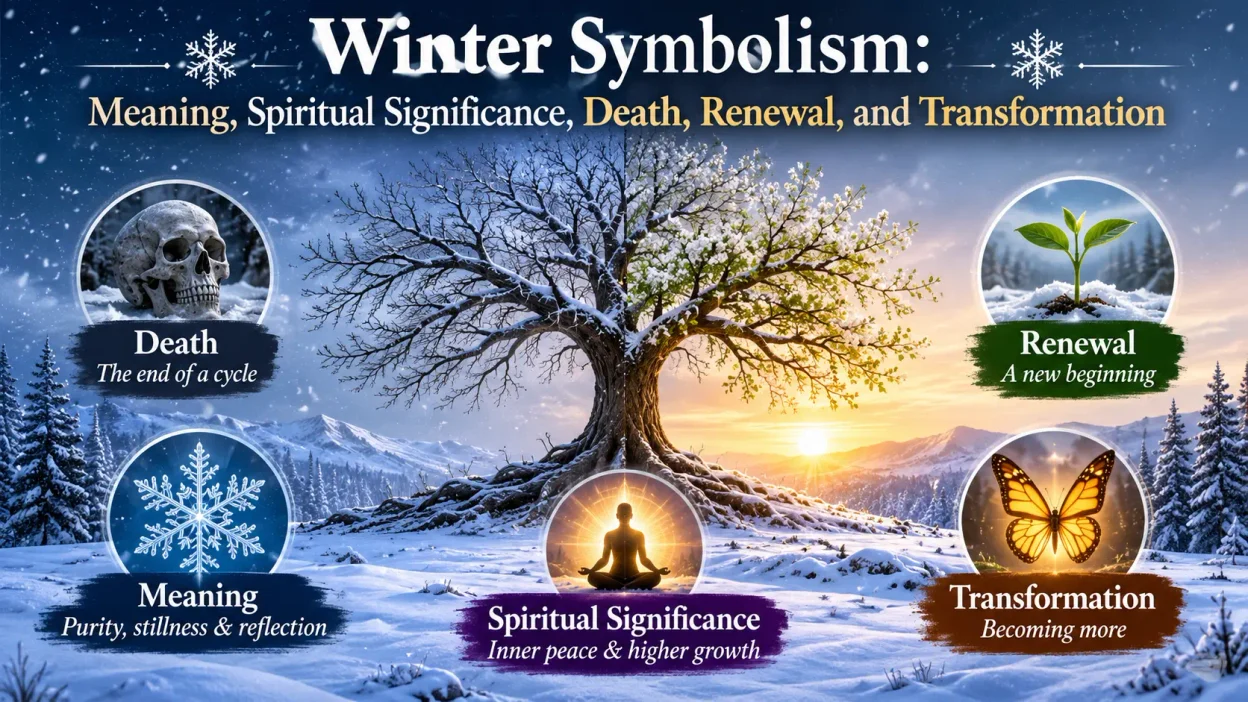
Winter is one of the most symbolically powerful seasons of the year. Its cold temperatures, bare trees, snow-covered landscapes, and long nights create an atmosphere associated with silence, stillness, hardship, and reflection. Across literature, mythology, art, and spiritual traditions, winter often represents the ending of one phase and the preparation for another.
Winter symbolism is commonly connected with death, dormancy, solitude, endurance, purification, and renewal. The season’s harsh conditions can represent difficult periods in human life, while its quiet beauty can symbolize peace, emotional reflection, and the opportunity to begin again.
In spiritual interpretations, winter may represent a time of inner growth when outward progress appears limited. Just as nature becomes dormant before spring, people may experience periods when they need rest, patience, and time to recover.
Whether winter appears in a dream, a poem, a painting, or a personal experience, its symbolism offers meaningful insights into change, resilience, hope, and the cycles of life.
What Does Winter Symbolize?
Winter commonly symbolizes endings, death, solitude, hardship, patience, reflection, and renewal. Its meaning can be positive or negative depending on the context in which it appears.
The season’s natural characteristics provide the foundation for many of its symbolic associations.
| Symbolic Meaning | Interpretation |
|---|---|
| Death | The ending of a stage, relationship, or situation |
| Renewal | Preparing for a new beginning |
| Solitude | Spending time alone and reflecting |
| Silence | Peace, stillness, and quietness |
| Hardship | Challenges, suffering, and difficult circumstances |
| Endurance | Remaining strong during challenging periods |
| Purification | Releasing unnecessary influences |
| Patience | Accepting that meaningful change takes time |
| Hope | Believing that better days will come |
| Transformation | Moving from one stage of life to another |
| Rest | Recovering before a period of renewed activity |
| Reflection | Examining personal experiences and emotions |
The central message of winter symbolism is that endings and periods of stillness are not necessarily permanent. They can create the conditions for future growth.
Spiritual Meaning of Winter
The spiritual meaning of winter is often associated with introspection, patience, emotional healing, purification, and preparation for renewal.
In modern spiritual interpretations, winter represents a period when people are encouraged to turn inward, reconsider their priorities, and develop inner strength.
1. A Time for Inner Reflection
Winter’s quiet atmosphere can symbolize the importance of self-examination.
With fewer signs of visible growth in nature, the season encourages people to slow down and pay attention to their thoughts, emotions, and personal needs.
Spiritually, winter may represent an opportunity to:
- Examine your priorities.
- Reflect on past experiences.
- Recognize patterns that need to change.
- Develop a deeper understanding of yourself.
- Spend time considering your future direction.
2. Transformation and Personal Growth
Winter may appear lifeless, but many plants and animals are simply responding to seasonal conditions.
Trees enter dormancy, some animals hibernate or reduce their activity, and natural systems prepare for changing temperatures.
Symbolically, this process can represent personal transformation that happens quietly.
You may not always notice immediate results when developing new habits, recovering from difficulties, or changing your perspective. Winter reminds us that growth does not always need to be visible.
3. Patience and Endurance
Winter can bring freezing temperatures, snowstorms, and challenging environmental conditions.
These characteristics make it a symbol of endurance and the ability to remain steady during difficult circumstances.
Its spiritual message may encourage you to accept that some situations require patience rather than immediate solutions.
4. Purification and Letting Go
Snow-covered landscapes are often associated with purity, cleansing, and simplicity.
In modern spiritual interpretations, winter can symbolize releasing emotional burdens, unhealthy habits, or outdated beliefs.
This does not mean that winter automatically removes negativity. Rather, its symbolism can inspire you to make room for a healthier beginning.
5. Hope During Difficult Times
Winter is often followed by spring, making it a powerful representation of hope.
Even when the landscape appears lifeless, seasonal cycles continue. This natural pattern can symbolize the belief that difficult periods may eventually give way to better circumstances.
Winter Symbolism in Different Cultures
Winter has different meanings across cultures, religions, and historical traditions. Its symbolism is influenced by geography, climate, seasonal celebrations, mythology, and agricultural practices.
Ancient Greek Winter Symbolism
In Greek mythology, winter is closely associated with the story of Persephone and Demeter.
According to the myth, Persephone, the daughter of Demeter, spends part of the year in the underworld. Her separation from her mother is associated with the earth becoming less productive, while her return is connected with the renewal of nature.
The story is commonly interpreted as an explanation of seasonal change and the relationship between loss and renewal.
Winter, in this context, can represent separation, grief, dormancy, and the temporary absence of growth.
Roman Winter Symbolism
In ancient Rome, winter was connected with agricultural cycles, seasonal festivals, and the changing relationship between people and nature.
Saturnalia, a festival honoring Saturn, was celebrated in December and involved feasting, social gatherings, and gift-giving.
The festival is associated with a period of celebration during the winter season, although it should not be treated as identical to modern Christmas traditions.
Winter in Roman cultural contexts could represent both environmental hardship and opportunities for communal celebration.
Norse Winter Symbolism
Winter held considerable importance in Norse life because of the region’s long, cold seasons and challenging environmental conditions.
In Norse mythology, winter is associated with the Fimbulwinter, an exceptionally severe winter that precedes Ragnarök, the destruction and transformation of the existing cosmic order.
This myth gives winter associations with danger, hardship, destruction, and the transition between worlds.
At the same time, winter survival also required resourcefulness, preparation, and cooperation.
Japanese Winter Symbolism
In Japanese culture, winter is often represented through seasonal art, poetry, and traditional aesthetics.
Snow-covered landscapes, bare branches, and quiet gardens can communicate simplicity, transience, solitude, and natural beauty.
The Japanese aesthetic concept of wabi-sabi emphasizes the beauty of imperfection and impermanence. Although it is not exclusively a winter philosophy, winter landscapes can provide powerful examples of its visual qualities.
Winter imagery may therefore express peacefulness, reflection, and appreciation for temporary beauty.
Chinese Winter Symbolism
In traditional Chinese philosophy, winter is associated with the water phase in the Five Phases system, which also includes wood, fire, earth, and metal.
Within traditional Chinese seasonal correspondences, winter is associated with stillness, storage, conservation, and the inward movement of energy.
It is also connected with the yin aspect of the yin-yang framework, which emphasizes qualities such as darkness, coldness, and inwardness.
These associations are part of traditional philosophical systems and should not be confused with universal beliefs shared by all Chinese communities.
Winter Symbolism in Indigenous Traditions
Winter has different meanings among Indigenous peoples around the world, depending on geography, cultural history, and traditional knowledge.
For communities living in regions with severe winters, the season can involve important practices related to food storage, hunting, shelter, community cooperation, and environmental awareness.
It may also feature in seasonal storytelling, ceremonies, and teachings.
There is no single Indigenous interpretation of winter. Specific meanings should be understood within the traditions of individual nations and communities.
Winter Symbolism in Literature
Winter is a powerful literary symbol because writers can use its cold, darkness, snow, and silence to communicate emotional and thematic ideas.
It can represent death, loneliness, emotional distance, hardship, and the possibility of renewal.
1. Winter as a Symbol of Death
In literature, winter often represents death or the end of something important.
Bare trees, frozen ground, and dormant plants can create images of lifelessness.
Writers may use winter settings to reflect the death of a character, the collapse of a relationship, or the end of a particular stage of life.
2. Winter as a Symbol of Loneliness
Snow-covered landscapes and long nights can create an atmosphere of isolation.
A character surrounded by winter may feel emotionally disconnected from others or separated from the world.
Winter settings can therefore reinforce themes of loneliness, abandonment, and emotional distance.
3. Winter as a Symbol of Hardship
Harsh weather can represent difficult circumstances that test a character’s strength.
A journey through a snowstorm, for example, may symbolize a struggle against obstacles or uncertainty.
Winter can also represent social hardship, poverty, conflict, and emotional suffering.
4. Winter as a Symbol of Renewal
Winter is not always a negative symbol.
Because it is followed by spring, it can represent the preparation for a new beginning.
A story that moves from winter into spring may suggest that suffering is temporary and that positive change is possible.
5. Winter as a Symbol of Emotional Coldness
Writers sometimes use cold weather to describe characters who appear distant, unkind, or emotionally unavailable.
Phrases such as a cold heart or a frozen relationship connect physical coldness with emotional detachment.
This symbolism can help readers understand a character’s personality without requiring lengthy explanations.
Winter Symbolism in Poetry
Winter has inspired poets for centuries because its natural imagery can communicate complex emotions through simple descriptions.
Snow, ice, frost, darkness, and bare branches are frequently used to represent different aspects of human experience.
| Winter Image | Possible Poetic Meaning |
|---|---|
| Snow | Purity, silence, and emotional stillness |
| Ice | Emotional coldness and separation |
| Frost | Fragility, hardship, and temporary beauty |
| Bare trees | Loss, dormancy, and vulnerability |
| Long nights | Loneliness, uncertainty, and reflection |
| Snowstorms | Confusion, conflict, and overwhelming challenges |
| Melting snow | Change, recovery, and renewal |
| Winter sunlight | Hope, warmth, and reassurance |
Winter in Robert Frost’s Poetry
Robert Frost frequently used natural settings to explore human emotions, uncertainty, isolation, and the relationship between people and nature.
In poems such as Stopping by Woods on a Snowy Evening, the snowy landscape creates a quiet atmosphere that invites reflection.
The winter setting contributes to themes of stillness, solitude, beauty, and responsibility.
Winter in Shakespeare’s Writing
William Shakespeare used winter imagery in several works to communicate aging, hardship, emotional distance, and the passage of time.
In Sonnet 97, the speaker compares a period of separation from a loved one to winter, even though the actual season is associated with summer.
This contrast demonstrates how winter can symbolize emotional absence rather than simply cold weather.
Winter Symbolism in Dreams
Dreaming about winter can have several possible symbolic interpretations. Its meaning depends on the dream’s setting, weather, events, and your emotional response.
Dream interpretation is subjective, so these meanings should be considered reflective possibilities rather than predictions or guaranteed spiritual messages.
Dreaming of Snow
Snow in a dream may symbolize purity, emotional stillness, a fresh start, or the desire for peace.
If the snowfall feels beautiful and peaceful, it may reflect a desire for calmness.
If the snow creates difficulties, it may represent emotional distance or obstacles.
Dreaming of a Snowstorm
A snowstorm may symbolize confusion, emotional pressure, or uncertainty.
It could reflect a situation in which you feel overwhelmed and cannot clearly see your next steps.
Dreaming of a Frozen Lake
A frozen lake may represent emotions that feel hidden, restricted, or difficult to express.
It can also symbolize a period of inactivity or uncertainty.
Dreaming of Walking Through Snow
Walking through snow may represent persistence and the effort required to move through a challenging period.
If you reach your destination, the dream may reflect confidence in your ability to overcome obstacles.
Dreaming of a Winter Forest
A winter forest may symbolize solitude, introspection, mystery, or an unfamiliar stage of life.
The atmosphere of the forest can influence the interpretation.
Dreaming of Winter Turning Into Spring
A transition from winter to spring may symbolize hope, emotional recovery, renewal, or the beginning of a new chapter.
It can reflect a desire to leave behind a difficult experience and move toward positive change.
Winter Symbolism in Love and Relationships
In relationships, winter can symbolize emotional distance, loneliness, separation, and periods of uncertainty. However, it can also represent loyalty, patience, and the strength required to maintain a connection during difficult circumstances.
1. Emotional Distance
Cold temperatures are frequently used as metaphors for emotional coldness.
In relationships, winter may represent a period when communication becomes limited or affection feels less visible.
2. Separation and Loneliness
Winter’s long nights and isolated landscapes can symbolize missing someone or feeling disconnected.
This interpretation often appears in romantic poetry, songs, and literature.
3. Commitment During Difficult Times
Winter can also symbolize the ability to remain committed when a relationship faces challenges.
Its harsh conditions may represent circumstances that test patience, understanding, and mutual support.
4. A New Beginning in Love
The transition from winter to spring can represent healing after a breakup or the possibility of developing a new relationship.
It may symbolize learning from previous experiences and becoming emotionally ready for change.
Winter Symbolism in Christianity and the Bible
Winter appears in the Bible as a season connected with weather, travel, agricultural conditions, and particular events.
However, the Bible does not establish one universal symbolic meaning for winter.
Its significance depends on the passage and the surrounding context.
Winter as a Season of Difficulty
In biblical settings, winter could make travel and outdoor activities more challenging.
In Matthew 24:20, Jesus tells his followers to pray that their flight does not take place in winter or on a Sabbath.
This reference reflects the practical difficulties associated with winter conditions rather than presenting the season as inherently evil.
Winter as a Time of Waiting
In Ecclesiastes 3:1, the writer explains that there is a season for everything and a time for every purpose.
Although the verse does not specifically describe winter, its message can be applied to seasonal symbolism.
Winter may serve as an illustration of waiting, patience, and recognizing that different stages of life have different purposes.
Winter and God’s Creation
Psalm 74:17 speaks about God establishing the boundaries of the earth and making summer and winter.
This passage presents seasonal change as part of the created order.
For Christian reflection, winter can therefore provide an opportunity to appreciate nature, recognize human dependence on the environment, and consider the changing seasons of life.
These interpretations should be distinguished from claims that winter has one fixed biblical meaning.
Winter Symbolism and Death
Winter is strongly associated with death because many plants lose their leaves, vegetation becomes dormant, and landscapes appear lifeless.
In literature and art, this visual transformation frequently represents mortality, endings, grief, and the passage of time.
However, winter does not necessarily symbolize permanent death.
Many plants survive winter and resume growth when conditions become favorable. Some animals also change their behavior to conserve energy or survive colder conditions.
This natural cycle gives winter a second meaning: temporary dormancy.
Symbolically, winter can represent the end of an old identity, the conclusion of a relationship, or the closing of an important chapter.
It may also remind us that endings can create opportunities for future growth.
Winter Symbolism and Renewal
Although winter is associated with endings, it also symbolizes preparation and renewal.
The season creates a natural pause between periods of growth. During this time, many living organisms conserve resources and respond to colder conditions.
In symbolic interpretations, this process can represent:
- Recovering after a difficult experience.
- Developing new goals.
- Reconsidering personal priorities.
- Releasing habits that no longer serve you.
- Preparing for future opportunities.
- Building strength during periods of uncertainty.
Winter teaches that not every stage of life requires visible achievement. Sometimes rest and preparation are necessary parts of progress.
Winter Symbolism in Art and Visual Imagery
Artists often use winter landscapes to create emotional atmospheres and communicate symbolic ideas.
The appearance of a winter scene can change its meaning significantly.
Snow-Covered Landscapes
Snow can represent purity, silence, isolation, or a fresh beginning.
A peaceful snowy landscape may communicate calmness, while an empty snow-covered environment may create a feeling of loneliness.
Bare Trees
Leafless trees can symbolize loss, vulnerability, mortality, and temporary dormancy.
They can also represent endurance because the trees remain standing through difficult weather.
Frozen Water
Frozen lakes and rivers may symbolize emotional restriction, stillness, or obstacles.
Melting ice can represent emotional release and the return of movement.
Winter Sunlight
Winter sunlight can represent hope, comfort, and reassurance.
Even a small amount of warmth may stand out against a cold landscape, making it a powerful image of optimism.
Different Colors Associated With Winter Symbolism
Winter imagery often uses particular colors to communicate emotional and symbolic meanings.
| Color | Winter Symbolism |
|---|---|
| White | Purity, peace, simplicity, and renewal |
| Blue | Coldness, sadness, calmness, and reflection |
| Gray | Uncertainty, silence, and emotional neutrality |
| Black | Darkness, mystery, loss, and endings |
| Silver | Stillness, elegance, and reflection |
| Pale Green | Dormant life and the possibility of renewal |
| Deep Red | Warmth, love, and survival against the cold |
These associations are common artistic interpretations rather than universal meanings.
Winter Symbolism Compared With Other Seasons
Each season has its own symbolic associations, and winter often represents the closing stage of a larger natural cycle.
| Season | Common Symbolic Meaning |
|---|---|
| Spring | Birth, growth, hope, and new beginnings |
| Summer | Energy, passion, abundance, and maturity |
| Autumn | Change, harvest, aging, and letting go |
| Winter | Endings, rest, solitude, patience, and renewal |
Together, the seasons can represent the continuous cycles of human life.
Spring may symbolize childhood or new beginnings, summer may represent maturity and abundance, autumn may suggest aging and transition, and winter may represent reflection and the completion of a cycle.
These are metaphorical interpretations rather than fixed meanings.
What Does Winter Teach Us About Life?
Winter symbolism offers several meaningful lessons that can be applied to everyday experiences.
1. Growth does not always have to be visible. Some of the most important changes happen quietly.
2. Difficult periods are part of life. Challenges can test your patience and reveal your resilience.
3. Rest is necessary. Taking time to recover can help prepare you for future responsibilities.
4. Endings are not always permanent. The completion of one chapter can create space for another.
5. Solitude can be valuable. Spending time alone may help you understand your emotions and priorities.
6. Hope matters during uncertainty. Even when circumstances seem difficult, change remains possible.
7. Nature follows cycles. Life includes periods of activity, rest, loss, and renewal.
Conclusion
Winter symbolism represents endings, solitude, hardship, patience, reflection, and renewal. Its cold temperatures, long nights, bare trees, and snow-covered landscapes make it a powerful metaphor for difficult periods and the quieter stages of life.
Across literature, mythology, art, and spiritual interpretations, winter can represent both death and transformation. It reminds us that periods of stillness do not necessarily mean that growth has stopped. Sometimes they provide the time and conditions needed for recovery and preparation.
Whether winter appears in a dream, a poem, a painting, or a personal experience, its deeper message is that life moves through changing seasons. Even after the coldest period, the possibility of renewal remains.
Frequently Asked Questions About Winter Symbolism
1. What does winter symbolize spiritually?
Winter commonly symbolizes introspection, patience, endurance, purification, and preparation for renewal in modern spiritual interpretations. It can represent a period of inner growth and reflection.
2. What does winter symbolize in literature?
In literature, winter often represents death, loneliness, emotional coldness, hardship, isolation, and the ending of a chapter. It can also symbolize hope and renewal when followed by spring.
3. Is winter a symbol of death?
Yes. Winter frequently symbolizes death because plants become dormant, trees lose their leaves, and landscapes appear lifeless. However, it can also represent temporary rest and the preparation for new growth.
4. What does winter symbolize in the Bible?
Winter appears in the Bible as a natural season associated with weather, travel, and God’s creation. Its meaning depends on the passage rather than one universal symbolic interpretation.
5. What does dreaming about winter mean?
Dreaming about winter may represent loneliness, reflection, emotional distance, patience, or a period of change. The interpretation depends on the dream’s atmosphere and your personal experiences.
6. What does snow symbolize spiritually?
Snow is commonly associated with purity, peace, stillness, and renewal in modern spiritual interpretations. It can also represent emotional isolation or a fresh beginning.
7. Why is winter associated with loneliness?
Winter often brings long nights, cold weather, and quiet landscapes. Writers and artists use these characteristics to represent isolation, emotional distance, and separation.
8. What does winter symbolize in love?
In relationships, winter may symbolize emotional distance, loneliness, separation, or challenges. It can also represent patience, commitment, and the strength required to maintain love during difficult periods.
9. What does winter symbolize in mythology?
Winter has different meanings across mythologies. In Greek mythology, it is connected with Persephone’s time in the underworld and Demeter’s grief. In Norse mythology, Fimbulwinter represents a severe winter preceding Ragnarök.
10. What does winter symbolize compared with spring?
Winter commonly represents endings, rest, and dormancy, while spring symbolizes birth, growth, hope, and new beginnings. Together, they represent the cycles of life and transformation.
11. What does a winter landscape symbolize in art?
A winter landscape may represent solitude, purity, silence, hardship, beauty, or reflection. Its meaning depends on the colors, atmosphere, and artistic context.
12. What is the main message of winter symbolism?
The central message of winter symbolism is that periods of stillness and hardship can be meaningful parts of life. Winter reminds us to remain patient, develop inner strength, and recognize the possibility of renewal after difficult times.