
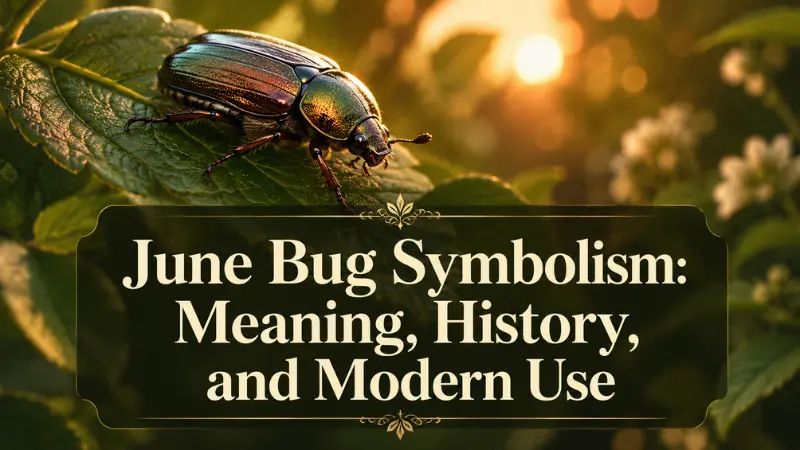
June bug symbolism grows from an insect many Americans recognize by sound before sight: a heavy beetle buzzing around a porch light on a warm evening. Its seasonal arrival, underground development, and awkward determination have inspired associations with renewal, patience, transformation, and summer nostalgia.
Unlike the sacred scarab of ancient Egypt, the June bug does not belong to one established symbolic tradition. Most meanings attached to it are modern interpretations based on its behavior, life cycle, and familiar place in American yards and rural communities.
That distinction matters. Understanding the real insect reveals why certain interpretations feel natural while preventing borrowed folklore from being presented as historical fact.
Quick Answer
June bug symbolism most commonly represents seasonal renewal, persistence, transformation, and the return of summer in modern American use. These meanings come from the beetle’s late-spring arrival, long development underground, complete metamorphosis, and place in Southern and rural memory rather than from one ancient June-bug tradition.
TL;DR
- Seasonal appearances connect June bugs with renewal and summer.
- Underground development suggests patience and unseen personal growth.
- Metamorphosis supports modern interpretations of change and maturity.
- Awkward flight can represent persistence despite imperfection.
- Southern nicknames give the insect warmth and familiarity.
- June bugs have no universal religious or supernatural meaning.
What a June Bug Actually Is
“June bug” is a common name rather than the name of one species. Americans often use it for several scarab-family beetles that become noticeable during late spring and summer.
Many common June beetles belong to the genus Phyllophaga. These are usually sturdy, reddish-brown beetles with shiny wing covers and fan-shaped antenna tips. The name can also refer to metallic green June beetles in the Southeast, ten-lined June beetles in western states, and other related species.
Adults are usually active during the evening or at night. They fly around trees, lawns, windows, streetlights, and illuminated porches. Their relatively heavy bodies and noisy, uneven flight make encounters memorable.
Before becoming adults, these beetles live as pale, C-shaped grubs in soil. Depending on the species and local climate, the underground part of the life cycle may last one or more years. The grubs feed mainly on roots before pupating and emerging as adults.
These physical traits—not an inherited mythology—form the basis of most present-day interpretations.
The Most Common Meanings at a Glance
A June bug’s meaning changes according to the behavior or setting being emphasized.
| Context | Common Modern Meaning | Natural Basis | Important Note |
| Seasonal appearance | Renewal and returning joy | Adults emerge in warm months | Timing varies by species and climate |
| Underground development | Patience and hidden progress | Grubs develop beneath the soil | Growth may remain unseen for years |
| Metamorphosis | Personal transformation | Beetles pass through four life stages | This is a modern symbolic reading |
| Flight around lights | Direction, desire, or distraction | Adults are attracted to artificial light | They are not consciously seeking guidance |
| Awkward movement | Imperfect persistence | Adults are bulky, noisy fliers | It can also suggest impulsiveness |
| Garden presence | Interdependence and tension | They are both wildlife food and plant feeders | Their ecological role is not purely positive or negative |
No single meaning applies in every context. A tattoo may celebrate endurance, while a childhood memory of porch lights may represent home, family, or a particular summer.
Why Seasonal Arrival Suggests Renewal
The name “June bug” comes from timing. The beetles become especially visible during the warmer part of the year, although some appear in May, July, or later depending on their species and location.
In much of the United States, their arrival overlaps with longer evenings, school vacations, outdoor gatherings, and the return of active gardens. That timing links them with the opening of a new season. Seeing one may recall the first genuinely warm nights of the year or the familiar rhythm of summer returning.
Renewal is therefore an understandable modern association, but it is not the same as an ancient belief. The beetle marks change because its appearance is seasonal and noticeable. Its meaning comes from repetition: it disappears, develops out of sight, and returns when conditions are right.
This symbolism can suit someone beginning again after a quiet or difficult period. It emphasizes reentry rather than instant reinvention.
Life Underground and the Meaning of Hidden Growth
A June beetle spends far more of its life underground than buzzing around a porch. As a grub, it feeds, molts, and develops beneath the surface, largely unnoticed by people above it.
That hidden stage supports an interpretation centered on patience. Progress does not always produce immediate evidence. Learning, recovery, creative preparation, and emotional maturity can occur privately before becoming visible.
The insect can also represent delayed results. Some species require multiple seasons to complete their development, so their brief adult appearance follows a long period of preparation. In personal art, this contrast may honor work that others never witnessed.
The association should not be romanticized too far. Grubs can damage turf and plant roots. Yet that inconvenient fact adds realism: hidden growth can affect its surroundings, and change is not always neat or harmless.
Metamorphosis and Personal Transformation
June beetles undergo complete metamorphosis: egg, larva, pupa, and adult. Each stage has a different form and function.
This biological change makes transformation one of the clearest contemporary meanings attached to the insect. A person might choose the image after changing careers, leaving an old identity, surviving a demanding period, or becoming more comfortable with an unconventional part of themselves.
The adult does not simply become a larger version of the grub. Its body is reorganized during the pupal stage. Symbolically, that can represent change that alters how a person moves through the world rather than merely improving an existing routine.
Unlike a butterfly, the June bug gives transformation a less polished appearance. Its adult form remains noisy, sturdy, and somewhat awkward. For some people, that makes it a more honest emblem of growth: change does not require becoming graceful or flawless.
Attraction to Light: Direction or Distraction?
June bugs commonly gather around porch lights, illuminated windows, and streetlamps. Scientists describe this as a response to light, not a deliberate attempt to reach a spiritual destination.
As a symbol, however, the behavior can carry two opposing meanings. A light may represent purpose, hope, curiosity, or a desired future. The beetle’s repeated movement toward it can suggest commitment to a goal.
The same scene can warn against fixation. Artificial light may disorient night-flying insects, causing them to circle, collide with objects, or exhaust themselves. In that reading, the June bug represents pursuing something attractive without understanding whether it is helpful.
This double meaning makes the image more useful than a simple “follow the light” message. It asks whether a chosen direction offers genuine guidance or merely captures attention.
Awkward Flight and Persistence Without Perfection
June bugs are often remembered for bumping into screens, walls, people, and patio furniture. They are not blind, despite the common joke that their erratic movement makes them appear that way.
Their flight can symbolize persistence without elegance. The insect keeps moving even when its route looks inefficient. That quality may appeal to people who value determination more than polished appearances.
It can also communicate self-acceptance. Someone who has felt socially awkward, underestimated, or out of place may identify with an animal that is conspicuous but continues on its way.
There is a less flattering interpretation as well. Reckless movement can suggest poor planning, impulsiveness, or repeated effort without reflection. Context determines whether the image celebrates determination or cautions against charging forward blindly.
What the June Bug Means in the United States
In American culture, June bugs are more familiar than ceremonial. They belong to backyards, lawns, farms, fishing stories, and summer evenings rather than official celebrations or formal religious practices.
People who grew up in the South, Midwest, or other areas where the beetles are common may connect them with family homes and outdoor childhood experiences. Someone raised in a dense city may instead view the insect as strange, intrusive, or slightly comic.
Their American meaning often combines four qualities:
- The predictable return of summer
- Ordinary rural or suburban life
- Persistence expressed through clumsy movement
- Affection for something imperfect and familiar
This mixture explains why a June bug can appear endearing in one setting and irritating in another. American interpretation depends heavily on memory, region, and personal experience.
Porch Lights, Rural Memory, and Summer Nostalgia
Few natural scenes are more closely associated with the June bug than a porch light after dark. The sound of beetles hitting a screen can recall humid evenings, open windows, family conversations, and time spent outdoors.
This sensory connection gives the insect nostalgic value. It may stand for a childhood home, a grandparent’s yard, a rural upbringing, or summers before adult responsibilities took over. In this context, the beetle represents a setting rather than an abstract moral quality.
Older accounts from the American South also describe children tying thread to June beetles and letting them fly in circles. The memory survives in regional stories, but the practice can injure the insect and is better treated as a historical childhood custom than something to repeat.
Nostalgia does not mean every memory is pleasant. For some people, the buzzing and sudden collisions create discomfort. A truthful interpretation can hold affection and uneasiness at the same time.
Nicknames, Expressions, and Popular Culture
“Junebug” has long worked as a playful nickname or term of endearment, particularly in Southern speech. It can express affection for a child, relative, partner, or person with an energetic, cheerful, or slightly unpredictable personality.
The regional expression “on it like a duck on a June bug” describes someone responding quickly and eagerly. It draws on the image of a duck immediately snapping up an available beetle. Depending on tone, the phrase can praise decisive action or tease someone for being overly eager.
The word also appears in names of songs, fictional characters, films, businesses, and creative projects. Writers often choose it because it sounds informal, youthful, and distinctly American. It can suggest rural roots or an unconventional personality without explaining those qualities directly.
These uses have helped soften the insect’s image. In language, “Junebug” often sounds warmer and more affectionate than “beetle.”
Ancient Scarab Connections and Their Limits
June bugs belong to the scarab beetle family, which invites comparisons with ancient Egyptian scarabs. That biological relationship does not make their symbolism identical.
Ancient Egyptian scarab imagery was based mainly on dung beetles. Their ball-rolling behavior was associated with the movement of the sun, while the apparent emergence of young beetles from the ground supported ideas about regeneration. Scarab-shaped amulets became connected with life, protection, solar renewal, and rebirth.
North American June beetles do not share that exact cultural history. Calling a June bug an ancient Egyptian emblem of rebirth erases the importance of the particular beetle and behavior that inspired Egyptian beliefs.
A modern artist may intentionally combine June beetle imagery with scarab themes, but the connection should be identified as a contemporary adaptation. It is not evidence that ancient Egyptians recognized the American June bug as a sacred animal.
Elsewhere, different beetles have acquired meanings related to summer, strength, agriculture, childhood, or luck. Those traditions belong to their own species and cultural settings and should not be treated as interchangeable.
Spiritual and Religious Interpretations
No major religious tradition assigns a standard spiritual message specifically to the June bug. It is not a recognized biblical emblem, nor does its arrival carry an established Christian prediction.
People may still use its life cycle as a personal religious analogy. Emerging from the soil can suggest renewal, while metamorphosis may illustrate conversion, restoration, or a changed life. Patient underground development can represent faith during a period when results remain invisible.
These readings can be meaningful within private belief, but they should be presented as reflections rather than religious doctrine. Seeing a beetle does not prove that a supernatural event, blessing, or warning is approaching.
The most grounded spiritual interpretation treats the encounter as an invitation to reflect—not a coded message with one guaranteed answer.
Emotional Meaning and Dreams
Emotionally, a June bug may express tenderness, embarrassment, resilience, restlessness, or longing for home. Its meaning depends on whether a person remembers it as a welcome sign of summer or an insect that caused alarm.
In dreams, a June bug does not have a universal interpretation. A beetle repeatedly hitting a lamp could reflect distraction or frustration. One emerging from soil might fit a period of growing confidence, while a swarm may mirror feeling overwhelmed by small but persistent concerns.
The dreamer’s reaction is more informative than the insect alone. Curiosity points toward discovery, affection may connect with memory, and fear may represent a waking discomfort with unpredictability or loss of control.
Dreams are shaped by memory and emotion. They should not be treated as reliable forecasts of death, money, romance, or future events.
Tattoos, Jewelry, Art, and Digital Culture
A June bug tattoo can represent transformation, summer, persistence, or pride in rural roots. Some designs emphasize the beetle’s realistic brown shell, while others use the brilliant green coloring of a green June beetle.
The surrounding elements refine the message. Soil and roots highlight hidden development. A moon or porch light suggests direction, longing, or distraction. Flowers and summer plants create a seasonal theme, while a date or place name can turn the image into a memorial.
In jewelry and home decor, the beetle often appears as a nature motif rather than a formal talisman. Metallic finishes work especially well because many beetles already have glossy or iridescent surfaces.
Online illustrations sometimes pair June bugs with phrases about growth, good luck, or following the light. Such posts can spread a meaning quickly, but popularity does not make that meaning historical. Digital culture often creates new symbolic conventions from attractive natural traits.
Ecological Meaning: Pest and Participant
June bugs occupy an uneasy place in gardens. Their larvae can damage lawns, crops, and ornamental plants by feeding on roots. Adults of some species eat foliage, fruit, or flowers. Homeowners may therefore associate them with disruption, hidden problems, or neglected maintenance.
At the same time, they are part of larger food webs. Birds, amphibians, reptiles, mammals, predatory insects, and parasitic wasps consume June beetles or their larvae. Their bodies transfer nutrients to other animals, while predators searching for grubs disturb and aerate soil.
This dual role supports a symbolism of interdependence. An organism can be inconvenient in one relationship and valuable in another. The June bug challenges the habit of dividing nature into entirely “good” and “bad” species.
That tension also makes it an appropriate emblem for complicated identity: a person may be misunderstood in one setting yet essential in another.
Common Misunderstandings and Invented Omens
The beetle’s unpredictable flight has produced several misconceptions. June bugs are not blind, and one that bumps into a person is not attacking or selecting them for a special reason.
A beetle repeatedly appearing near a house usually reflects seasonal emergence, suitable habitat, or nighttime lighting. It does not automatically predict visitors, pregnancy, financial luck, or a coming death.
Some modern interpretations call June bugs lucky because they belong to the scarab family. That can be a valid personal association, but it is largely borrowed from Egyptian scarab imagery rather than a widespread American belief about June beetles.
Finding a dead June bug is also not a recognized bad omen. Adult life is relatively brief, and insects may die from predators, weather, exhaustion, pesticides, or collision with human structures.
The most responsible interpretation begins with ordinary biological explanations before considering personal symbolism.
How the Meaning Has Evolved
The June bug began as a practical seasonal name for beetles appearing during warm weather. Farmers and gardeners often viewed the larvae as pests, while children and rural families encountered the adults as familiar parts of summer life.
Regional language added affection and humor. “Junebug” became a nickname, and the duck expression turned the beetle into an image of quick, eager action. Later appearances in music, film, personal names, tattoos, and online art expanded its emotional range.
Modern symbolism has placed greater emphasis on the insect’s life cycle. Hidden development now suggests private growth, metamorphosis represents identity change, and uneven flight stands for persistence without perfection.
This evolution shows how symbolism often forms. People begin with an animal’s real traits, connect those traits to lived experience, and gradually create meanings that feel shared—even when they do not come from an ancient tradition.
Choosing a Personal Interpretation
A useful meaning should match the feature that matters most to the person using the image. Someone honoring a quiet period of preparation might focus on the grub’s underground development. A person remembering childhood summers may choose a porch light or a metallic green beetle.
For a tattoo or memorial, consider whether the design represents:
FAQs
- Renewal after absence
- Patience during unseen growth
- Transformation without perfection
- Affection for an unconventional person
- Southern or rural family identity
- The difference between guidance and distraction
Seeing one usually means adult beetles are active in your area and may be attracted to nearby lights. Symbolically, the encounter can suggest seasonal renewal or persistence, but it is not a fixed omen.
Is a June bug a symbol of good luck?
Some people treat it as lucky because June beetles are related to scarabs. However, good fortune is a modern or personal interpretation rather than a widely documented American tradition.
What does a June bug tattoo represent?
A tattoo commonly represents transformation, patience, summer nostalgia, or determination despite imperfection. The design’s color and surrounding imagery usually reveal which meaning the wearer intends.
Does a June bug have a biblical meaning?
The Bible does not give the June bug a specific symbolic role. Christian associations with rebirth, faith, or spiritual change are modern devotional analogies based on the beetle’s life cycle.
Why do June bugs keep appearing around me?
Seasonal emergence and artificial lighting are the most likely explanations. Outdoor lights, healthy soil, lawns, and nearby vegetation can make a property especially noticeable to adult beetles.
Does a green June beetle have a different meaning?
A green June beetle can carry the same associations with summer and transformation. Its metallic color may additionally suggest vitality, abundance, or individuality, although those meanings are artistic choices rather than established traditions.
Does a green June beetle have a different meaning?
A green June beetle can carry the same associations with summer and transformation. Its metallic color may additionally suggest vitality, abundance, or individuality, although those meanings are artistic choices rather than established traditions.
Conclusion
June bug symbolism is best understood as a modern interpretation grounded in observable nature. Seasonal arrival suggests renewal, underground development represents patient progress, metamorphosis supports personal change, and awkward flight offers an unusually honest picture of persistence.
The insect also carries a distinctly American warmth through porch-light memories, Southern expressions, and affectionate nicknames. Its meaning does not depend on invented omens; it comes from the meeting point between a real beetle and the memories people attach to summer.


