
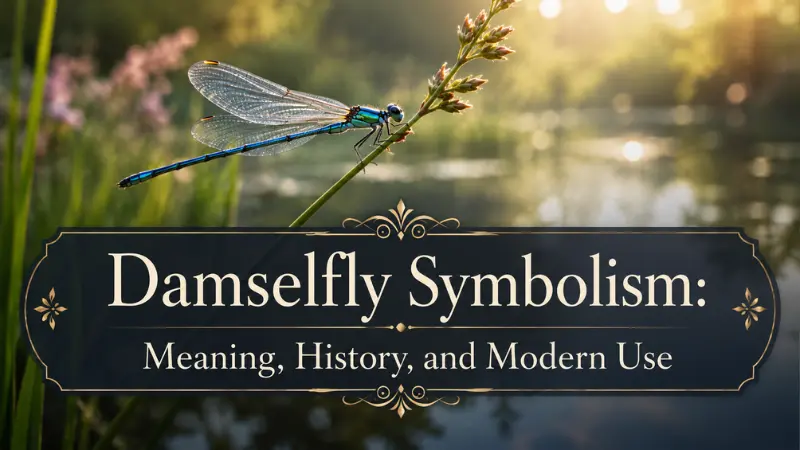
Damselfly symbolism usually centers on transformation, calm adaptability, and graceful strength. The insect’s slender body, widely separated eyes, and folded resting wings create an impression of delicacy, while its movement from aquatic youth to winged adulthood offers a clear image of personal change. (Yard and Garden)
In the United States, people most often encounter damselflies around ponds, wetlands, slow-moving streams, and water gardens. They also appear in nature education, conservation programs, photography, jewelry, tattoos, and decorative art, where their recognizable shape carries both ecological and personal associations. (National Park Service)
The damselfly does not have one fixed meaning shared by every culture. Much of its modern interpretation comes from its biology and appearance, while older cultural associations frequently belong to dragonflies or the broader insect order that includes both groups.
Quick Answer
Damselfly symbolism commonly represents transformation, adaptability, emotional balance, and quiet resilience in modern American use. Historically, its meanings often overlap with broader dragonfly traditions involving water, seasonal change, courage, and forward movement. (The Metropolitan Museum of Art)
TL;DR
- Aquatic beginnings make the damselfly a natural symbol of personal change.
- Its light flight suggests adaptability rather than weakness.
- Americans often associate it with renewal, balance, and mindful attention.
- Historical meanings usually belong to dragonflies broadly, not damselflies alone.
- Tattoos and jewelry turn it into a personal transition marker.
- Cultural claims should remain specific, not generalized across entire peoples.
What a Damselfly Looks Like and Where It Lives
Damselflies belong to the insect order Odonata and the suborder Zygoptera. They resemble dragonflies, but their bodies are generally slimmer, their large compound eyes sit apart, and most species hold their wings together above or along the abdomen while resting. Dragonflies usually have heavier bodies and rest with their wings extended. (Wikipedia)
Their colors range from muted brown and green to bright blue, red, violet, or metallic shades. Transparent wings and long abdominal segments make them appear almost weightless when perched on reeds, grasses, or shoreline plants.
Although adults live above water, the early stages of life are aquatic. Eggs are placed in or near water, and the young, called nymphs or naiads, develop beneath the surface before climbing onto vegetation and emerging as winged adults. (Yard and Garden)
These physical characteristics shape nearly every modern interpretation of the insect. Water suggests emotional depth and beginnings, flight suggests expanded freedom, and the narrow body with transparent wings suggests precision, restraint, and lightness.
Core Meanings at a Glance
| Context | Meaning in the USA | Common Associations | Notes |
| Personal growth | Transformation | Recovery, maturity, new direction | Based largely on its water-to-air life cycle |
| Emotional life | Balance | Calmness, sensitivity, self-control | A modern psychological interpretation |
| Nature | Ecological connection | Wetlands, clean water, biodiversity | Grounded in the insect’s real habitat |
| Personal identity | Quiet resilience | Grace, adaptability, inner capability | Delicacy does not imply helplessness |
| Memorial use | Continuing connection | Memory, transition, remembrance | Usually chosen for personal reasons |
| Art and design | Light movement | Summer, water, elegance, freedom | Meaning changes with color and composition |
Why Its Life Cycle Represents Transformation
The damselfly’s association with transformation is rooted in an observable change of habitat and form. It begins life underwater, grows through several nymphal stages, then leaves the water and becomes a flying adult.
This is incomplete metamorphosis rather than the egg-caterpillar-pupa-butterfly sequence. There is no pupal stage. Even so, the contrast between an aquatic nymph and an airborne adult is visually dramatic enough to support ideas of development, emergence, and changed perspective. (Yard and Garden)
As a personal emblem, the damselfly can represent a person who has entered a new phase without denying the experiences that came before it. Its adult life does not erase its relationship with water; the insect still returns there to reproduce. Symbolically, that pattern can suggest growth that remains connected to one’s origin.
This makes the image especially suitable for graduations, moves, career changes, recovery milestones, and periods of identity development. It represents change as a process rather than a sudden escape from the past.
Water, Air, and the Meaning of Transition
Few creatures move as visibly between symbolic environments as the damselfly. Its life connects water, shoreline vegetation, open air, and sunlight.
Water commonly functions in modern American art and psychology as an image of emotion, memory, and the less visible parts of experience. Air often suggests thought, movement, possibility, and independence. A damselfly passing from one environment to the other therefore lends itself to stories about bringing internal growth into outward life.
Its connection to freshwater also gives the symbol an ecological dimension. Dragonflies and damselflies are studied as indicators of watershed conditions because their life cycles depend on aquatic habitats, and changes in their populations can help researchers assess environmental quality. (National Park Service)
For this reason, a damselfly image may represent more than private transformation. In conservation art, park programs, and nature photography, it can stand for wetland protection, biodiversity, and attention to environmental changes that are easy to overlook.
Grace Without Fragility
A damselfly looks delicate, but delicacy is not the same as weakness. Adults are active predators that capture smaller insects, while aquatic nymphs hunt other small organisms beneath the water.
Compared with most dragonflies, damselflies are lighter and less forceful fliers. Their flight often appears fluttering or measured rather than fast and commanding. Nevertheless, they can maneuver precisely, defend territories, reproduce in demanding environments, and survive as effective hunters. (Ask an Entomologist)
This combination supports a modern meaning of quiet capability. The damselfly can represent someone who does not rely on aggression, volume, or physical dominance to remain effective.
In personal symbolism, it may express:
- Sensitivity combined with firm boundaries
- Adaptability without loss of identity
- Calm action under pressure
- Strength expressed through precision
- Confidence that does not require display
The insect is therefore a fitting image for people who identify with gentleness but reject the assumption that gentleness means passivity.
What It Commonly Means in the United States
The damselfly is not attached to a single American ceremony, holiday, or national tradition. Its meaning is shaped more by personal interpretation, nature education, environmental awareness, and its similarity to the better-known dragonfly.
For many Americans, it represents a peaceful relationship with change. Its association with ponds and summer vegetation can evoke childhood exploration, quiet walks, fishing trips, gardens, and time spent near water.
In areas where uncommon species are being protected, the insect may also represent ecological vulnerability. The San Francisco forktail, for example, depends on limited freshwater habitat in the Presidio, where drought, saltwater intrusion, and habitat change threaten its future. (National Park Service)
This conservation context adds a less romantic but important meaning: some forms of beauty survive only when their environments are protected. A damselfly design used by a nature group may therefore communicate stewardship, local identity, or concern for freshwater habitats.
In private life, Americans may choose the image to mark sobriety, emotional recovery, a new home, a changed relationship, or the memory of someone associated with lakes and gardens. These meanings are personal rather than culturally mandatory.
Historical Roots and the Broader Dragonfly Tradition
A separate, continuous historical tradition devoted specifically to damselflies is difficult to document. Older artworks and texts often use a general dragonfly category without showing whether the insect would now be classified as a dragonfly or damselfly.
As a result, many meanings assigned to damselflies today have been borrowed from broader dragonfly imagery. Museum collections contain dragonfly designs on armor, sword fittings, lacquerware, ceramics, and decorative objects, but their records do not usually frame the smaller damselfly as an independent symbol. (The Metropolitan Museum of Art)
This distinction matters. A modern writer should not claim that every old dragonfly belief automatically belongs to damselflies. Scientific classification and historical visual culture do not always divide animals in the same way.
The most accurate approach is to describe two layers of meaning:
- Damselfly-specific interpretation, based on its slender form, gentler flight, habitat, and life cycle.
- Shared odonate tradition, inherited from cultural representations of dragonflies and similar aquatic insects.
Recognizing both layers gives the damselfly a meaningful history without inventing an ancient tradition that may not have existed separately.
Japanese Art and the Meaning of Forward Movement
Japanese art provides one of the clearest documented historical traditions involving dragonfly imagery. Dragonflies appeared on samurai helmets and sword guards, where they were associated with bravery, direct movement, and victory.
The insect was described as kachimushi, often translated as “victorious insect” or “winning insect.” Surviving objects connect this meaning with the belief that a dragonfly moved forward toward its target instead of retreating. (The Metropolitan Museum of Art)
Damselflies should not automatically be substituted for every Japanese dragonfly motif. The historical objects are identified as dragonflies, and the martial association belongs to that documented tradition.
However, contemporary artists may intentionally adapt the idea of forward movement to a damselfly design. When used carefully, the result can combine the older theme of determination with the damselfly’s modern associations of grace and adaptability.
This creates a more nuanced message than simple victory: continue moving forward, but do so with awareness, precision, and restraint.
Indigenous Traditions Require Cultural Specificity
There is no single “Native American meaning” for the damselfly or dragonfly. Indigenous nations have distinct languages, environments, histories, and artistic traditions, so their interpretations should not be combined into one generalized belief.
One recorded account from a Cahuilla informant describes a Dragonfly Song learned from a Serrano elder. In that account, the dragonfly is connected with good intentions and communication between the physical and spiritual worlds. That tradition belongs to a particular cultural setting and should be presented as such. (USC Digital Folklore Archives)
Dragonfly forms also appear in contemporary Indigenous educational crafts and material culture, including cornhusk artwork. Their presence demonstrates cultural and artistic continuity, but the image does not carry an identical meaning in every community or object. (National Museum of the American Indian)
A respectful interpretation avoids phrases such as “all Native Americans believed.” It also avoids treating “spirit animal” as a generic label that anyone can apply to an Indigenous tradition.
People may still form a private relationship with a damselfly encounter. That personal response should be described as individual meaning, not borrowed authority from an unnamed Indigenous culture.
Emotional and Psychological Meaning
Psychologically, the damselfly can represent a way of responding to change without becoming overwhelmed by it. The insect does not suggest immobility; it suggests controlled movement.
Someone may identify with it during a period when sensitivity has become a source of awareness rather than a liability. Its light body and alert posture can communicate attentiveness, while its predatory ability complicates the assumption that a refined appearance means vulnerability.
The symbol may express several emotional states:
Emotional balance: Moving between feeling and action without denying either one.
Adaptability: Adjusting to new conditions while retaining a clear sense of self.
Present-moment attention: Watching carefully before choosing a direction.
Recovery: Emerging from a difficult stage with new abilities and perspective.
Quiet confidence: Acting effectively without seeking constant recognition.
These meanings are interpretive, not clinical. A damselfly cannot diagnose an emotional condition or objectively deliver instructions. Its value comes from the story a person uses it to express.
Tattoos, Jewelry, Decor, and Digital Culture
A damselfly’s narrow body and symmetrical wings translate easily into visual design. Artists can render it as a realistic insect, a fine-line silhouette, a geometric figure, or a small metallic ornament.
In tattoo culture, it often marks a personal transition. A wearer may use it to remember a move away from an unhealthy situation, a period of recovery, a new identity, or a decision to approach life more calmly.
A memorial tattoo may connect the insect with a loved one who enjoyed ponds, fishing, gardening, or summer landscapes. The design does not prove communication from the deceased; it creates a visible place for memory.
In jewelry, the damselfly usually emphasizes elegance and movement. Long wings suit brooches, pendants, earrings, and hair accessories, while iridescent materials imitate the shifting appearance of the living insect.
Home decor tends to place damselflies in botanical, waterside, cottage, and nature-inspired settings. On social media, illustrations may accompany messages about growth, healing, slowing down, or beginning again.
The meaning ultimately depends on the surrounding elements. A damselfly beside reeds feels peaceful and ecological, while one paired with broken chains, dates, names, or storm imagery may represent survival and release.
How Color Changes the Interpretation
Damselflies occur in many natural colors, but color meanings in art and tattoos usually come from modern design conventions rather than inherited damselfly traditions.
Blue damselfly: Often represents calmness, clear communication, reflection, or emotional control. Blue also reinforces the insect’s association with freshwater.
Green damselfly: Suggests renewal, environmental connection, health, and gradual growth. It works especially well in conservation or botanical designs.
Red damselfly: Can convey courage, urgency, passion, or renewed vitality. It creates a more energetic image than pale blue or green.
Black damselfly: May represent grief, endurance, privacy, or an identity formed through hardship. In minimalist tattoos, black may simply be an aesthetic choice.
Gold damselfly: Often communicates achievement, value, sunlight, or a transition that deserves celebration.
Iridescent damselfly: Suggests complexity, shifting perspective, and an identity that looks different under changing conditions.
None of these meanings is compulsory. A blue insect may have been chosen because it matches a real species, while a black design may reflect the practical limits of tattoo ink rather than mourning.
Common Misunderstandings and Misuse
The most common mistake is treating damselflies and dragonflies as identical. They are related, but their body shape, eye placement, wing position, and flight style create different visual impressions.
Another problem is presenting recent internet interpretations as ancient facts. Claims that the damselfly universally means resurrection in Christianity, wealth in Asia, or communication with ancestors across all Indigenous cultures usually lack the necessary historical and cultural detail.
Older names such as “devil’s darning needle” and “horse stinger” also encouraged fear of these insects. The suggestion that they sew people’s eyes, sting horses, or deliberately harm humans is folklore rather than biology; damselflies do not possess a stinger and are not dangerous to people. (Yard and Garden)
The word damsel can produce another distortion. It may encourage people to call the insect exclusively feminine or assign it fixed meanings of female beauty and submission. Male and female damselflies exist, and the symbolic language of grace or delicacy does not have to be gendered.
Finally, an encounter should not be presented as an objective omen. A damselfly landing nearby may feel memorable, but the event has a natural explanation. Any spiritual or emotional meaning comes from the observer’s beliefs and circumstances.
How the Meaning Has Evolved
The damselfly’s modern identity has developed from several overlapping sources: close observation of its life cycle, older dragonfly traditions, nature art, environmental education, and personal design culture.
Its aquatic development made transformation the dominant contemporary theme. Its gentler appearance encouraged additional meanings such as emotional balance, sensitivity, and understated resilience. Conservation concerns then added ideas of habitat protection and ecological responsibility.
Tattoos, jewelry, and digital illustration have made the image more personal. Instead of representing one public doctrine, the damselfly now commonly functions as a flexible emblem that people adapt to a specific life event.
This flexibility can be useful, provided it is not mistaken for historical certainty. The strongest interpretations connect the chosen meaning to a visible characteristic of the insect or to a clearly identified cultural tradition.
FAQs
Is a damselfly a symbol of good luck?
It can represent good luck in a personal design, but there is no universal rule that every damselfly encounter predicts fortune. In modern use, the insect more commonly suggests positive change, adaptability, and a favorable new beginning.
What is the spiritual meaning of seeing a damselfly?
Some people interpret the encounter as a reminder to remain flexible, examine their emotions, or approach a transition calmly. That meaning is personal or spiritual rather than a scientifically verifiable message.
What does a damselfly tattoo mean?
A damselfly tattoo often represents transformation, recovery, quiet strength, or freedom after a difficult period. Names, dates, flowers, water, or colors can make the meaning more specific to the wearer.
Is damselfly meaning different from dragonfly meaning?
The two share themes of change, water, flight, and adaptability. Damselfly imagery usually places more emphasis on grace, sensitivity, and restrained strength, while traditional dragonfly imagery more often emphasizes speed, courage, victory, or forceful movement.
Can a damselfly represent a deceased loved one?
Yes, it can serve as a private memorial symbol, especially when the person had a connection with water, nature, or summer. The image expresses remembrance, but it should not be treated as proof that the insect carries a message from the dead.
Does the damselfly have a biblical meaning?
The Bible does not establish the damselfly as a specific religious symbol. Modern Christian interpretations sometimes associate its emergence from water with renewal or resurrection, but this is a later analogy rather than a biblical doctrine.
What does a blue damselfly symbolize?
Blue commonly adds meanings of calmness, reflection, honesty, and emotional clarity. These associations come from modern color symbolism and personal design choices, not from one universal historical tradition
Conclusion
Damselfly symbolism is most convincing when it remains connected to the real insect: an aquatic beginning, a winged adulthood, precise movement, and continued dependence on freshwater. These traits support modern meanings of transformation, adaptability, emotional balance, and quiet resilience.
Its historical background is best understood as part of broader dragonfly traditions rather than a single ancient belief shared worldwide. Japanese martial imagery, specific Indigenous traditions, European folklore, and contemporary American design each provide different contexts that should not be blended carelessly.
The damselfly offers a grounded image of change without spectacle. It shows that growth can be light, attentive, and controlled while still carrying a person into an entirely new stage of life.


