Corn is much more than an everyday food. For thousands of years, it has represented nourishment, survival, prosperity, fertility, and the relationship between people and the natural world. Its golden kernels, tall stalks, and abundant harvests have made it an important symbol in agricultural societies, traditional ceremonies, mythology, and spiritual beliefs.
In many cultures, corn represents the blessings of the earth and the importance of sharing what nature provides. A healthy cornfield can symbolize abundance and success, while a single kernel can represent potential, growth, and the beginning of something meaningful. Because corn feeds communities and supports agricultural life, it is also closely associated with family, gratitude, cooperation, and cultural identity.
But what does corn symbolize spiritually? Does its color influence its meaning, and what does it mean when you see corn in a dream or encounter it during an important moment in life?
Let’s explore the deeper meanings of corn symbolism, its cultural importance, spiritual interpretations, and the lessons this remarkable crop can teach us.
What Does Corn Symbolize?
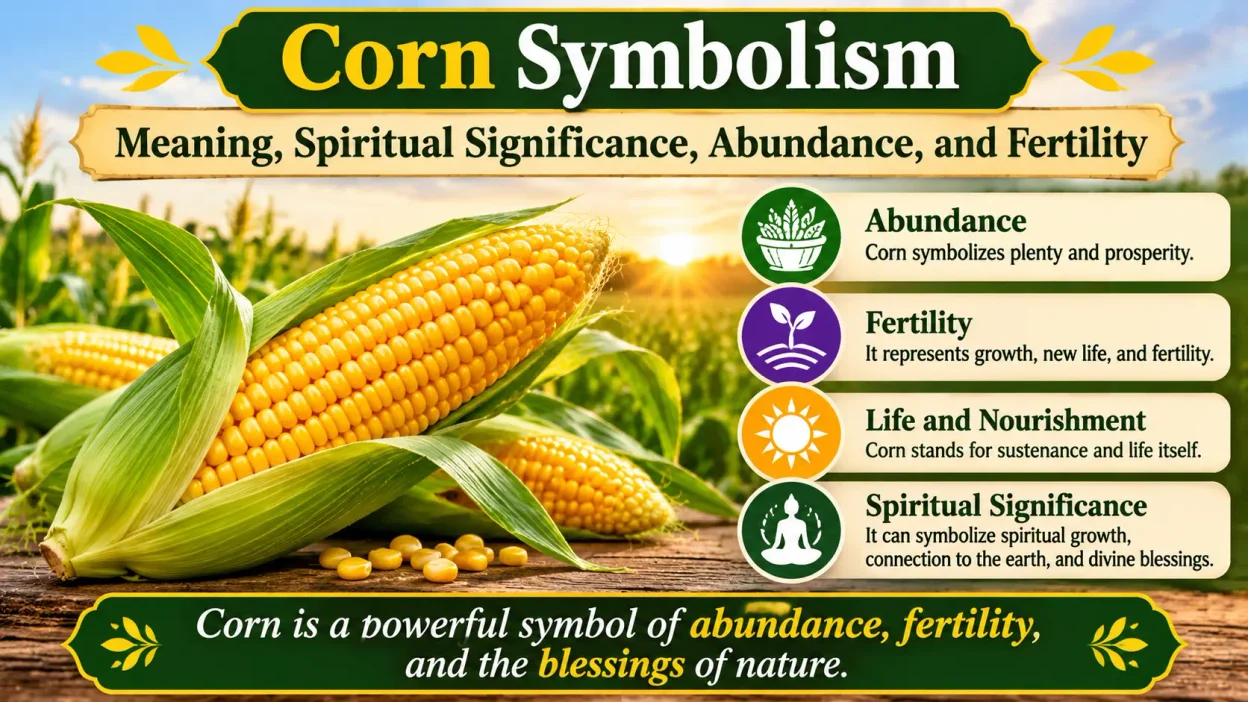
Corn commonly symbolizes abundance, fertility, prosperity, nourishment, growth, gratitude, and community. Its importance as a food crop has connected it with life, survival, and the ability of people to support one another.
Some of the most widely recognized symbolic meanings of corn include:
- Abundance: A full ear of corn represents plenty, successful harvests, and material blessings.
- Fertility: Its numerous kernels symbolize reproduction, potential, and the ability to create new life.
- Nourishment: Corn represents food, survival, health, and the importance of sustaining life.
- Prosperity: A successful corn harvest can symbolize financial stability, good fortune, and rewards for hard work.
- Growth: The development of a corn plant represents patience, progress, and personal development.
- Gratitude: Corn reminds people to appreciate food, nature, and the resources that support everyday life.
- Community: Because corn has historically supported entire communities, it symbolizes cooperation, sharing, and collective well-being.
- Resilience: Its agricultural importance represents the ability to adapt and continue growing through changing conditions.
- Connection to nature: Corn reflects humanity’s dependence on the land, seasonal cycles, and natural resources.
These meanings can differ across cultures and traditions. Corn has particularly deep cultural and spiritual significance among many Indigenous peoples of the Americas, and those traditions should be understood within their specific communities.
The Spiritual Meaning of Corn
In spiritual interpretations, corn is often associated with nourishment, abundance, gratitude, fertility, and the blessings of the natural world. Its growth from a small seed into a productive plant provides a meaningful metaphor for the development of life.
1. Abundance and Prosperity
One of the strongest symbolic meanings of corn is abundance.
An ear of corn contains many kernels arranged in organized rows. This abundance makes it a natural representation of plentiful resources, successful work, and the rewards of patience.
Spiritually, corn may remind people to recognize the blessings they already have while remaining hopeful about future opportunities.
2. Fertility and Creation
Corn is closely connected with fertility because it produces numerous kernels that can become new plants.
In symbolic interpretations, these kernels represent the potential for new beginnings, creativity, family growth, and the continuation of life.
Corn can therefore symbolize the ability to create something meaningful and nurture it over time.
3. Nourishment and Sustenance
Corn has provided food for generations and remains an important source of nourishment in many parts of the world.
Its spiritual meaning can extend beyond physical food to include emotional, intellectual, and spiritual nourishment.
It may represent the people, experiences, and values that help us grow stronger.
4. Gratitude and Appreciation
A successful harvest requires suitable conditions, time, effort, and care.
For this reason, corn can symbolize gratitude for the resources that sustain life. It encourages people to appreciate food, family, community, and the natural world.
5. Personal Growth and Patience
Corn does not grow into a mature plant overnight. It requires water, sunlight, healthy soil, and time.
Symbolically, this process represents personal development. It reminds us that meaningful achievements often require consistent effort and patience.
6. Generosity and Sharing
Because corn has historically been an important community food source, it can symbolize generosity and cooperation.
Its abundance may encourage people to share their resources, support their families, and contribute to the well-being of others.
Corn Symbolism in Different Cultures
Corn has played an important role in the history, agriculture, mythology, and spiritual traditions of different societies. Its meaning is particularly significant in the Americas, where Indigenous communities cultivated and developed maize over thousands of years.
Corn Symbolism in Indigenous American Cultures
Corn has deep cultural, agricultural, and spiritual importance among many Indigenous peoples of the Americas.
However, Indigenous communities are diverse, and their beliefs about corn are not identical.
For many communities, corn is connected with life, creation, nourishment, family, ceremony, and the relationship between people and the land.
It has also been central to traditional agricultural knowledge, food preparation, seasonal celebrations, and community identity.
Corn should therefore be understood not simply as a symbol of prosperity but as a living part of the cultural and historical traditions of many Indigenous peoples.
Corn Symbolism in Maya Culture
Corn held profound importance in ancient Maya civilization.
In the Popol Vuh, a foundational K’iche’ Maya narrative, humans are created from maize dough after earlier attempts at creation fail.
This story reflects the central place of corn in Maya understandings of human life, identity, and the natural world.
Corn was not merely an agricultural product. It was deeply connected with creation, nourishment, and the relationship between humanity and the earth.
Corn Symbolism in Aztec Culture
Corn was central to the agricultural and religious life of the Aztec civilization.
The maize deity Centeotl was associated with corn and agricultural fertility. Chicomecóatl was another important deity connected with maize, food, and agricultural abundance.
Corn’s importance in Aztec society reflected its role as a foundation of nourishment and community survival.
Corn Symbolism in Native American Traditions
Corn has significant spiritual and cultural meanings among numerous Native American nations.
For some communities, it is associated with creation, fertility, sustenance, gratitude, and ceremonial life. Corn also appears in traditional stories and agricultural practices.
The Three Sisters agricultural system, commonly associated with several Indigenous farming traditions, combines corn, beans, and squash. These crops support one another through complementary growing patterns and symbolize cooperation in some cultural interpretations.
However, specific stories, ceremonies, and meanings vary among nations. There is no single universal Native American interpretation of corn.
Corn Symbolism in African Traditions
Corn became an important food crop in many African societies following its introduction from the Americas through global trade.
Today, maize is closely connected with food security, farming, family life, and community celebrations in many regions.
Its symbolic associations with nourishment, abundance, and prosperity often reflect its practical importance, although individual cultural meanings differ.
Corn Symbolism in European Harvest Traditions
Corn and other grain crops have long been associated with harvest celebrations and agricultural abundance in Europe.
In some traditions, the final sheaf of grain was treated with special significance, representing the completion of the harvest and hope for future fertility.
Modern autumn celebrations and harvest festivals continue to emphasize gratitude, food, and the rewards of agricultural work.
What Does an Ear of Corn Symbolize?
<text></text>
An ear of corn is often interpreted as a symbol of abundance, fertility, prosperity, and nourishment.
Its rows of kernels represent the results of growth and the potential for future life.
Different aspects of an ear of corn can suggest different meanings:
- Full kernels: Abundance, success, and plentiful resources.
- Golden color: Wealth, warmth, harvest, and prosperity.
- Husk: Protection, preparation, and the hidden potential within.
- Silk: Growth, development, and the reproductive process of the plant.
- Seeds and kernels: New beginnings, possibility, and future opportunities.
An ear of corn can also represent the importance of recognizing the effort and resources behind the things we enjoy.
What Do Different Corn Colors Symbolize?
Corn comes in several colors, and each variety can inspire different symbolic associations.
| Corn Color | Common Symbolic Meaning |
|---|---|
| Yellow corn | Happiness, prosperity, warmth, and abundance |
| White corn | Purity, nourishment, peace, and simplicity |
| Red corn | Strength, vitality, courage, and protection |
| Blue corn | Wisdom, spirituality, tradition, and connection to nature |
| Purple corn | Mystery, creativity, transformation, and individuality |
| Black corn | Mystery, resilience, and the unknown |
| Multicolored corn | Diversity, unity, celebration, and abundance |
These meanings are general symbolic interpretations, not universal cultural rules. In particular, blue, red, white, and other corn varieties may carry specific ceremonial or traditional meanings within individual Indigenous communities.
Yellow Corn Symbolism
Yellow corn is commonly associated with abundance, happiness, warmth, and prosperity.
Its golden color resembles sunlight and ripe harvest fields, making it a natural symbol of nourishment and success.
In personal interpretations, yellow corn may represent financial opportunities, positive energy, and appreciation for life’s blessings.
White Corn Symbolism
White corn is often associated with purity, peace, nourishment, and simplicity.
In some Indigenous traditions, white corn has specific ceremonial and cultural significance. Its meaning depends on the community and the context in which it is used.
More generally, white corn can symbolize the essential role of food in supporting life and community.
Red Corn Symbolism
Red corn may symbolize vitality, strength, courage, and protection.
Its deep color can also suggest passion, energy, and the power of nature.
In some cultural traditions, red corn has specific agricultural and ceremonial importance that should not be reduced to generalized color symbolism.
Blue Corn Symbolism
Blue corn is particularly associated with traditional agriculture in parts of the American Southwest.
Symbolically, it may represent wisdom, cultural continuity, nourishment, and connection with ancestral knowledge.
For some Indigenous communities, blue corn has important food and ceremonial roles. These meanings are community-specific rather than universal.
Purple Corn Symbolism
Purple corn is often associated with creativity, individuality, mystery, and transformation.
Its unusual appearance can represent diversity and the richness of nature.
In modern symbolic interpretations, purple corn may also suggest the importance of embracing qualities that make someone unique.
What Does It Mean When You See Corn?
Seeing corn can have different symbolic meanings depending on the circumstances and personal beliefs.
Because corn is closely associated with nourishment and harvest, people often connect it with abundance, gratitude, and the results of hard work.
Seeing a Cornfield
A cornfield may symbolize growth, prosperity, opportunity, and the potential for success.
Rows of healthy corn plants can represent steady progress and the rewards of patience.
Seeing a Full Ear of Corn
A full ear of corn is commonly associated with abundance and fulfillment.
It may remind you to appreciate the resources, relationships, and opportunities already present in your life.
Seeing Fresh Green Corn
Fresh green corn can symbolize new beginnings, growth, energy, and potential.
It may represent a project or personal goal that is still developing.
Seeing Dried Corn
Dried corn may symbolize preservation, preparation, maturity, and the importance of planning for the future.
It can also represent the completion of a growing season and the value of what has been gathered.
Seeing Corn During a Difficult Period
Some people interpret an encounter with corn during a challenging time as a reminder of resilience and nourishment.
Its symbolic meaning may encourage patience, gratitude, and confidence in gradual progress.
These interpretations are personal reflections rather than predictions or guaranteed spiritual messages.
Corn Symbolism in Dreams
Dreaming about corn is often associated with abundance, nourishment, growth, prosperity, and personal development.
However, dream meanings are subjective. The details of the dream and your emotions during it can influence your interpretation.
| Corn Dream | Possible Symbolic Meaning |
|---|---|
| Seeing a green cornfield | Growth, potential, and new opportunities |
| Harvesting corn | Rewards, achievement, and the results of hard work |
| Eating corn | Nourishment, satisfaction, and appreciation |
| Seeing yellow corn | Prosperity, happiness, and abundance |
| Seeing white corn | Peace, simplicity, and emotional nourishment |
| Planting corn | New beginnings, investment, and long-term goals |
| Buying corn | Preparing for the future or seeking stability |
| Rotten corn | Disappointment, neglected opportunities, or wasted resources |
| Dry corn | Preservation, maturity, and preparation |
| A large harvest | Success, fulfillment, and plentiful resources |
Dreaming of Harvesting Corn
Harvesting corn may represent receiving the results of your efforts.
If you have been working toward an important goal, the dream may reflect your hopes for success and recognition.
Dreaming of Planting Corn
Planting corn can symbolize investing in your future.
It may reflect a new project, relationship, educational goal, or personal decision that requires patience before producing results.
Dreaming of Rotten Corn
Rotten corn may represent disappointment, neglected responsibilities, or concerns about wasted opportunities.
It could encourage you to examine areas of your life that need attention.
Dreaming of Eating Corn
Eating corn may symbolize satisfaction, comfort, nourishment, and the enjoyment of simple pleasures.
It can also reflect a desire for emotional security or a stronger connection with family.
Corn Symbolism in Love and Relationships
Corn can represent the qualities that help relationships grow and remain healthy.
Its symbolic connection with nourishment, fertility, and abundance makes it a meaningful metaphor for emotional partnership.
Fertility and Family Growth
Because corn produces many kernels, it is sometimes associated with fertility, family growth, and the continuation of life.
For couples who value family traditions, corn may represent the hope of building a loving and supportive household.
Nourishment and Care
Just as corn provides nourishment, a healthy relationship requires emotional support, understanding, and care.
Corn symbolism can remind partners that love grows through everyday actions and mutual attention.
Abundance in Love
A plentiful harvest can represent emotional richness and the happiness that comes from a meaningful relationship.
It may symbolize gratitude for companionship, affection, and shared experiences.
Growing Together
Corn develops gradually, making it a useful metaphor for relationships that become stronger through patience and shared effort.
Its symbolism suggests that meaningful love is cultivated rather than created instantly.
Corn Symbolism in Agriculture and Harvest Celebrations
Corn has been an essential agricultural crop for thousands of years, particularly in the Americas.
Its importance extends beyond individual farms because it has supported communities, economies, and cultural traditions.
Harvest and Gratitude
A successful corn harvest represents the results of agricultural labor and favorable growing conditions.
Harvest celebrations often express gratitude for food, land, and the people whose work sustains communities.
Community and Cooperation
Growing and harvesting corn can involve shared knowledge, cooperation, and collective effort.
This makes corn a symbol of community support and the importance of working together.
Survival and Food Security
Corn is a major food crop in many parts of the world. It is used in traditional dishes, animal feed, and various food products.
Its role in sustaining populations makes it a symbol of survival, nourishment, and the connection between agriculture and human well-being.
Corn Symbolism in Art, Literature, and Tattoos
Corn’s appearance and cultural importance make it a meaningful subject in creative expression.
Corn in Art
Artists may use corn to represent agricultural life, prosperity, rural identity, cultural heritage, and the relationship between people and nature.
Cornfields can also create visual associations with harvest, seasonal change, and the passage of time.
Corn in Literature
In literature, corn may symbolize nourishment, family traditions, economic survival, fertility, or the connection between communities and the land.
A cornfield can also represent growth, abundance, or the challenges of agricultural life.
Corn Tattoos
Corn tattoos can have several personal meanings, depending on the design and the wearer’s background.
Common interpretations include:
- Ear of corn tattoo: Abundance, nourishment, and prosperity.
- Cornfield tattoo: Growth, nature, and connection to the land.
- Yellow corn tattoo: Happiness, warmth, and gratitude.
- Blue corn tattoo: Cultural heritage, tradition, and personal identity.
- Corn with other harvest symbols: Fertility, family, and appreciation for nature.
For people with Indigenous ancestry or cultural connections, corn tattoos may carry meanings that are specific to their community. It is important to approach culturally significant imagery with respect and understanding.
What Can Corn Teach Us About Life?
Corn symbolism offers several meaningful lessons about growth, gratitude, and community.
- Growth requires patience: Just as corn takes time to mature, meaningful goals require consistent effort.
- Abundance comes with responsibility: Having resources also creates opportunities to share and support others.
- Nourishment matters: Physical, emotional, and spiritual well-being all require care.
- Community creates strength: Cooperation helps individuals and families thrive.
- Gratitude changes perspective: Appreciating everyday resources can create a deeper sense of fulfillment.
- Small beginnings have potential: A single kernel can become a productive plant under the right conditions.
- Nature deserves respect: Agriculture reminds us of our dependence on the land and natural resources.
Ultimately, corn teaches us that growth is connected with care, patience, and the ability to appreciate what sustains us.
Frequently Asked Questions About Corn Symbolism
1. What does corn symbolize spiritually?
Corn commonly symbolizes abundance, nourishment, fertility, gratitude, prosperity, and growth. In many cultural traditions, it is also connected with creation, community, and the sacred relationship between people and the earth.
2. Is corn a symbol of abundance?
Yes. Corn is widely associated with abundance because an ear contains many kernels and a successful harvest provides food for communities. It represents plenty, prosperity, and the rewards of hard work.
3. What does an ear of corn symbolize?
An ear of corn commonly symbolizes fertility, nourishment, growth, and prosperity. Its numerous kernels can represent potential, new beginnings, and the continuation of life.
4. What does yellow corn symbolize?
Yellow corn is often associated with happiness, warmth, prosperity, sunlight, and abundance. Its golden color makes it a natural symbol of successful harvests and positive energy.
5. What does corn symbolize in Indigenous cultures?
Corn has deep cultural and spiritual importance among many Indigenous peoples of the Americas. It can represent nourishment, creation, fertility, community, and the relationship between people and the land. Specific meanings vary among nations and communities.
6. What does corn symbolize in Maya culture?
In Maya tradition, corn is deeply connected with human creation, nourishment, and identity. The Popol Vuh, a foundational K’iche’ Maya narrative, describes humans being created from maize dough.
7. What does dreaming about corn mean?
Dreaming about corn may symbolize prosperity, personal growth, nourishment, achievement, or new opportunities. The interpretation depends on the dream’s details and the dreamer’s personal circumstances.
8. What does harvesting corn symbolize?
Harvesting corn often represents achievement, fulfillment, and receiving the rewards of hard work. It can also symbolize gratitude and the completion of an important stage.
9. What does rotten corn symbolize in a dream?
Rotten corn may represent disappointment, neglected opportunities, wasted resources, or concerns about something that has not developed as expected. It is a subjective dream interpretation, not a prediction.
10. Why is corn spiritually important?
Corn has supported human communities for thousands of years. Its importance as a food source has made it central to many agricultural, cultural, and spiritual traditions, where it can represent life, nourishment, fertility, and gratitude.
Conclusion: The Deeper Meaning of Corn Symbolism
Corn symbolism is deeply connected with the foundations of life. As a source of nourishment and an essential agricultural crop, corn represents abundance, fertility, prosperity, growth, gratitude, and community. Its many kernels symbolize potential, while its growing cycle reminds us that meaningful results require time, care, and patience.
Across Indigenous American traditions, ancient civilizations, harvest celebrations, and modern interpretations, corn has remained a powerful symbol of humanity’s relationship with nature. Its significance extends beyond food to include cultural identity, family, creation, and the importance of sharing resources.
Ultimately, corn reminds us to appreciate the things that sustain us, remain patient as we grow, and recognize that abundance becomes even more meaningful when it is shared with others.