Poetry is a form of literature that communicates ideas and emotions through carefully chosen words, images, sounds, and literary devices. Sometimes, however, a poet’s message goes beyond the literal meaning of the words. An ordinary object, a particular color, an animal, or an element of nature may represent something much deeper. This literary technique is known as symbolism in poetry.
Symbolism allows poets to express complicated feelings and abstract concepts without explaining everything directly. A rose, for example, may represent love, beauty, or passion, while a storm might suggest emotional conflict, uncertainty, or major change. Similarly, darkness can represent fear, grief, or the unknown, depending on the poem’s context.
Poets use symbolism to make their work more meaningful, imaginative, and emotionally powerful. It encourages readers to look beyond the surface and consider the deeper significance of the images presented.
In this guide, we explore the meaning of symbolism in poetry, its history, major types, famous examples, and the ways readers can identify and interpret symbols in poems.
Quick Answer: What Is Symbolism in Poetry?
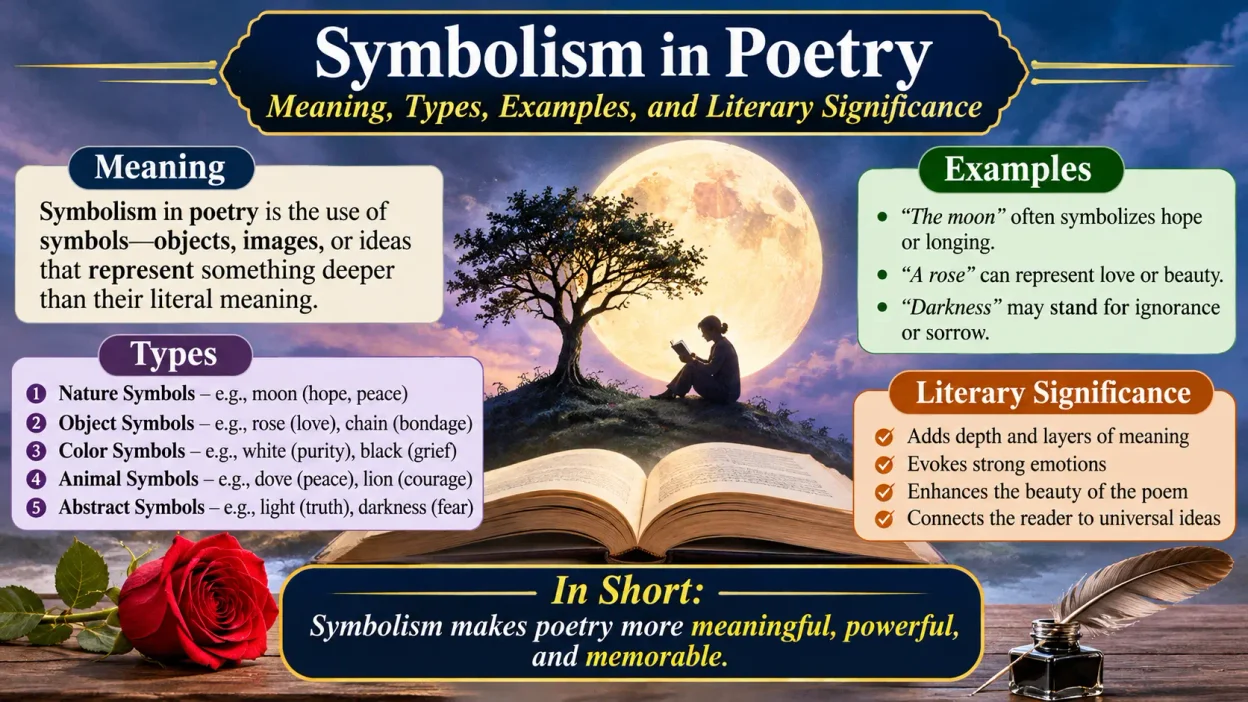
Symbolism in poetry is a literary technique in which a poet uses something concrete, such as an object, color, animal, person, or natural element, to represent an abstract idea or deeper meaning.
For example:
A rose may symbolize love, beauty, or passion.
A dove may symbolize peace, hope, or innocence.
A storm may represent conflict, emotional turmoil, or change.
Darkness may symbolize fear, uncertainty, or sadness.
Light may represent knowledge, truth, hope, or understanding.
A journey may symbolize personal growth or the experience of life.
Winter may represent hardship, loneliness, or the end of a particular stage.
The meaning of a symbol depends on the poem’s language, context, cultural associations, and overall theme. A symbol does not always have one fixed interpretation.
- What Does Symbolism Mean in Poetry?
Symbolism in poetry means using images, objects, characters, or experiences to communicate ideas that extend beyond their literal meanings.
A symbol is something that represents or suggests something else. It can be a physical object, a natural element, a color, an animal, or even an action.
For example, when a poet describes a candle burning in a dark room, the candle may represent hope, faith, knowledge, or the persistence of life during difficult circumstances.
The candle still exists as an actual object within the poem, but its significance may extend beyond its physical function.
Symbolism helps poets communicate several layers of meaning at once.
Literal Meaning and Symbolic Meaning
Understanding the difference between literal and symbolic meanings is essential when analyzing poetry.
Element
Literal Meaning
Possible Symbolic Meaning
Rose
A flowering plant
Love, beauty, or passion
Broken mirror
A damaged reflective object
Lost identity or shattered expectations
Rain
Water falling from clouds
Sadness, renewal, or emotional release
Road
A path connecting places
Life choices or personal journeys
Bird
A feathered animal
Freedom, hope, or the human spirit
Winter
The coldest season
Loneliness, hardship, or endings
The symbolic interpretation depends on how the poet uses the image. Rain, for instance, may represent sadness in one poem and purification or renewal in another.
- History of Symbolism in Poetry
Symbolism has existed in poetry for centuries. Ancient writers used natural objects, animals, religious images, and mythological figures to express ideas about life, death, love, morality, and the human experience.
However, symbolism became particularly influential as a literary movement during the nineteenth century.
Ancient Poetry and Symbolic Imagery
Ancient Greek, Roman, and other literary traditions frequently used symbolic images.
Mythological characters and natural elements often represented human qualities, divine powers, and moral concepts.
For example, the sun could represent life or divine authority, while darkness could suggest death or uncertainty.
Animals also carried symbolic meanings. Lions were frequently associated with courage and strength, while serpents could represent danger, wisdom, temptation, or transformation depending on the cultural context.
Medieval Poetry
During the medieval period, symbolism became especially important in religious and allegorical literature.
Poets used symbolic images to explore faith, morality, spiritual journeys, and the struggle between good and evil.
Gardens, light, darkness, rivers, and journeys often carried religious or philosophical meanings.
Renaissance Poetry
Renaissance poets frequently used symbolism to explore love, beauty, time, nature, and human ambition.
Flowers, seasons, stars, and mythological references became important ways of expressing emotional and philosophical ideas.
A flower, for example, could represent beauty and youth while also reminding readers that life is temporary.
The Nineteenth-Century Symbolist Movement
Symbolism became a recognizable literary and artistic movement in nineteenth-century France.
Writers such as Charles Baudelaire, Stéphane Mallarmé, and Paul Verlaine explored indirect expression, musical language, sensory imagery, and suggestive meanings.
Rather than describing everything directly, Symbolist poets often used images to create moods and evoke emotions.
Their influence extended beyond France and helped shape modern poetry.
Modern and Contemporary Poetry
In modern poetry, symbolism remains an important literary technique.
Contemporary poets use everyday objects, urban environments, technology, landscapes, and personal experiences as symbols.
A locked door may suggest an unavailable opportunity, while an empty room may represent loneliness or emotional distance.
The technique continues to evolve because symbols can reflect changing cultural experiences and personal perspectives.
- Why Do Poets Use Symbolism?
Poets use symbolism to communicate deeper meanings, create emotional connections, and make their writing more imaginative.
Instead of explaining every idea directly, they allow readers to discover meaning through images and associations.
Here are some important reasons poets use symbolism.
To Express Complex Emotions
Some emotions are difficult to describe through ordinary language.
A poet may use a storm to communicate anger, a fading flower to suggest grief, or a sunset to express the sadness of saying goodbye.
These images can communicate emotional experiences in a powerful and memorable way.
To Create Deeper Meaning
Symbolism gives a poem more than one layer of interpretation.
An image may have a literal purpose while also contributing to the poem’s larger theme.
For example, a journey may describe physical travel while also representing personal development.
To Encourage Imagination
Symbols invite readers to think about the meaning behind an image.
Rather than receiving a complete explanation, readers participate in interpreting the poem.
To Create Emotional Impact
A familiar symbol can quickly establish a mood.
Darkness may create a sense of uncertainty, while sunlight may create feelings of hope or happiness.
To Communicate Universal Themes
Symbols can help poets explore experiences shared by many people, including love, loss, freedom, fear, hope, and the passage of time.
They make abstract themes easier to visualize and understand.
- Common Types of Symbolism in Poetry
Poets use many different kinds of symbols. Some are based on objects and natural elements, while others involve colors, animals, seasons, or cultural traditions.
Object Symbolism
Ordinary objects can represent emotions, memories, relationships, or life experiences.
Examples include:
A key representing opportunity or access.
A mirror representing identity or self-reflection.
A clock representing time and mortality.
A broken chain representing freedom.
A candle representing hope or guidance.
An object becomes symbolic when the poet gives it significance beyond its everyday function.
Nature Symbolism
Nature is one of the richest sources of poetic symbolism.
Common natural symbols include:
Mountains representing challenges or ambition.
Rivers representing time and the continuous movement of life.
Trees representing growth, stability, or family connections.
Storms representing conflict or emotional struggles.
Flowers representing beauty, love, or the temporary nature of life.
Nature imagery is especially effective because readers often connect natural experiences with their own emotions.
Animal Symbolism
Animals can represent human qualities, instincts, cultural beliefs, or spiritual ideas.
For example:
A lion may represent courage and authority.
A dove may represent peace.
A raven may represent mystery, death, or transformation.
A butterfly may represent change and personal development.
An owl may represent wisdom or knowledge.
These meanings are not universal. Different cultures and poems may assign different meanings to the same animal.
Color Symbolism
Colors are frequently used to communicate moods and ideas.
Color
Common Symbolic Associations
Red
Love, passion, anger, or danger
Blue
Peace, sadness, loyalty, or reflection
White
Innocence, purity, or new beginnings
Black
Death, mystery, fear, or power
Green
Growth, nature, renewal, or jealousy
Yellow
Happiness, hope, energy, or caution
Purple
Royalty, spirituality, mystery, or creativity
The meaning of a color depends on its context. For example, white may represent innocence in one poem and mourning in another cultural tradition.
Religious and Spiritual Symbolism
Religious and spiritual symbols are often used to explore faith, morality, hope, sacrifice, and the meaning of existence.
Examples include:
A cross representing Christian faith or sacrifice.
Light representing divine guidance or spiritual understanding.
Water representing purification or renewal.
A garden representing paradise or spiritual growth.
A journey representing the search for truth or salvation.
Seasonal Symbolism
The seasons frequently represent different stages of life and emotional experiences.
Season
Common Symbolic Meaning
Spring
Birth, youth, hope, and renewal
Summer
Energy, happiness, passion, and abundance
Autumn
Maturity, change, reflection, and decline
Winter
Loneliness, hardship, rest, and endings
Poets often use seasonal changes to communicate the passage of time and the changing nature of human experiences.
- Famous Examples of Symbolism in Poetry
Many well-known poems use symbolism to communicate complex ideas. Studying these examples helps readers understand how symbols contribute to literary meaning.
“The Raven” by Edgar Allan Poe
Poet: Edgar Allan Poe
Published: 1845
Edgar Allan Poe’s famous poem “The Raven” uses a mysterious black bird as a central symbolic figure.
The raven repeatedly appears to the speaker and responds with the phrase “Nevermore.”
The bird is commonly interpreted as a symbol of death, grief, memory, and the speaker’s inability to escape emotional suffering.
Its repeated response reinforces the speaker’s growing despair.
The raven also contributes to the poem’s atmosphere of mystery and psychological tension.
“The Road Not Taken” by Robert Frost
Poet: Robert Frost
Published: 1916
In “The Road Not Taken,” Robert Frost describes a traveler who encounters two roads in a forest and must choose between them.
The roads are commonly interpreted as symbols of choices and the different directions life can take.
The poem explores decision-making, uncertainty, and the way people reflect on past choices.
However, the poem is more complicated than the popular idea that it simply celebrates choosing an unusual path. Frost also explores the uncertainty surrounding choices and the stories people tell themselves about their decisions.
“Ode to a Nightingale” by John Keats
Poet: John Keats
Published: 1819
In “Ode to a Nightingale,” John Keats uses the nightingale as an important symbol connected with beauty, imagination, and the contrast between temporary human life and the seemingly enduring world of art and nature.
The bird’s song inspires the speaker to reflect on mortality, suffering, and the desire to escape ordinary human limitations.
The nightingale therefore becomes more than a bird. It helps express the relationship between beauty, time, and human existence.
“I Wandered Lonely as a Cloud” by William Wordsworth
Poet: William Wordsworth
Published: 1807
This poem, commonly known as “Daffodils,” describes the speaker’s encounter with a large group of golden daffodils.
The flowers represent natural beauty, happiness, and the emotional value of experiencing nature.
Their image remains in the speaker’s memory and later provides comfort and pleasure.
The poem demonstrates how a natural scene can become a symbol of lasting emotional richness.
“Because I Could Not Stop for Death” by Emily Dickinson
Poet: Emily Dickinson
Published: 1890
Emily Dickinson personifies Death as a courteous carriage driver who takes the speaker on a journey.
The carriage ride becomes a symbolic representation of the passage from life toward death.
The stages of the journey suggest different periods of human existence, while the movement toward the grave encourages readers to reflect on mortality and eternity.
This poem demonstrates how symbolism and personification can work together to create deeper meaning.
- Symbolism in Poetry Examples: Common Symbols and Their Meanings
Many symbols appear repeatedly in poetry because they are connected with familiar human experiences.
The following table provides examples of common poetic symbols and their possible meanings.
Symbol
Possible Meaning
Common Literary Theme
Rose
Love and beauty
Romance
Dove
Peace and innocence
Hope
Raven
Death and mystery
Grief
Butterfly
Transformation
Personal growth
Ocean
Freedom and uncertainty
Human experience
Mountain
Strength and obstacles
Ambition
Mirror
Identity and self-awareness
Self-discovery
Candle
Hope and guidance
Faith
Clock
Time and mortality
Life and death
Garden
Growth and beauty
Renewal
Chains
Restriction or oppression
Freedom
Broken glass
Loss or damaged relationships
Conflict
Stars
Dreams and guidance
Aspiration
Rain
Sadness or renewal
Emotional change
Road
Choices and journeys
Destiny
These interpretations are useful starting points, but readers should always consider the specific poem before deciding what a symbol means.
- Symbolism vs. Metaphor in Poetry
Symbolism and metaphor are closely related literary techniques, but they are not identical.
A metaphor directly compares two different things without using words such as “like” or “as.” Symbolism uses an object, image, or idea to represent something beyond its literal meaning.
For example:
Metaphor: “Her voice was music.”
This sentence compares a person’s voice with music to suggest beauty or pleasantness.
Symbolism: A poet repeatedly describes a candle burning in a dark room.
The candle may represent hope, faith, or knowledge throughout the poem.
The main difference is that a metaphor creates a comparison, while a symbol carries an additional meaning.
Feature
Symbolism
Metaphor
Main Purpose
Represents a deeper idea
Compares two different things
Meaning
Often develops through context
Usually appears through a comparison
Use
Can continue throughout a poem
Can appear in a single phrase or extended passage
Example
A dove representing peace
“Time is a thief”
Interpretation
Often open to multiple meanings
Depends on the comparison being made
A poem can use both techniques at the same time.
- Symbolism vs. Allegory in Poetry
Symbolism and allegory are also related, but they work differently.
Symbolism usually involves an image or object representing a deeper idea. Allegory is an extended narrative in which characters, events, and settings consistently represent broader moral, political, philosophical, or spiritual concepts.
For example, a single rose may symbolize love in a poem.
In an allegorical poem, an entire journey through a dangerous landscape might represent the struggle between good and evil.
Feature
Symbolism
Allegory
Structure
May involve one or several symbols
Usually extends across a larger narrative
Meaning
Represents deeper ideas
Represents a broader system of ideas
Example
A rose representing love
A journey representing a moral or spiritual struggle
Interpretation
Often flexible
Usually follows a more developed pattern
Both techniques allow poets to communicate abstract ideas through concrete images and experiences.
- How to Identify Symbolism in a Poem
Identifying symbolism requires more than simply recognizing an object or image. Readers must consider why the poet included it and how it contributes to the poem’s meaning.
The following steps can help.
Step 1: Identify Repeated Images
Look for objects, colors, animals, or natural elements that appear repeatedly.
Repetition may indicate that an image has special importance.
For example, if a poet repeatedly describes darkness, shadows, and closed doors, these images may contribute to a larger theme involving uncertainty or isolation.
Step 2: Consider the Literal Meaning
First, understand what the object or image represents in the real world.
A clock measures time, a river carries water, and a bird can fly.
Knowing the literal meaning provides a foundation for interpreting the symbolic meaning.
Step 3: Examine the Poem’s Context
Consider the poem’s subject, mood, setting, and emotional direction.
A flower appearing in a poem about a funeral may carry a different meaning from one appearing in a poem about a wedding.
Context helps readers avoid incorrect interpretations.
Step 4: Look for Cultural Associations
Some symbols have established cultural, religious, or historical associations.
For example, a dove is widely associated with peace, while a cross is strongly connected with Christianity.
However, cultural meanings can vary, so they should not automatically be applied to every poem.
Step 5: Connect the Symbol With the Main Theme
Ask how the image contributes to the poem’s central message.
Does it communicate hope, fear, freedom, love, loss, or transformation?
A symbol becomes easier to interpret when it is connected to the poem’s larger purpose.
Step 6: Consider More Than One Interpretation
A symbol may have several possible meanings.
Instead of assuming that one interpretation is always correct, examine which meaning is best supported by the poem’s language and structure.
- How Symbolism Creates Deeper Meaning in Poetry
Symbolism makes poetry more meaningful because it allows writers to communicate ideas indirectly.
A simple image can represent a complicated emotional or philosophical experience.
Emotional Depth
A poet may describe a fading flower instead of directly explaining the sadness of losing someone.
The image allows readers to experience the emotion through their imagination.
Multiple Interpretations
Symbols can create different meanings for different readers.
A road may represent opportunity to one person and uncertainty to another.
Both interpretations may be reasonable if they are supported by the poem.
Stronger Imagery
Symbolism makes abstract ideas easier to visualize.
Instead of describing freedom as an abstract concept, a poet may describe a bird flying beyond a cage.
Universal Connections
Symbols connect personal experiences with broader human themes.
A sunset may represent the end of a day, but it can also suggest aging, endings, memory, or the passage of time.
Lasting Impressions
A powerful symbol can remain in the reader’s memory long after the poem has been read.
This is one reason poets continue to use symbolic images across different literary periods.
- Symbolism in Different Types of Poetry
Symbolism appears in many forms of poetry, although its purpose and style may differ depending on the type of writing.
Romantic Poetry
Romantic poets frequently used nature, seasons, flowers, birds, and landscapes to explore beauty, imagination, freedom, and emotion.
For example, a mountain might represent the power of nature, while a flower might represent the temporary beauty of life.
Modern Poetry
Modern poets often use ordinary objects and everyday experiences as symbols.
An empty room might represent loneliness, a city street might represent isolation, and a machine might represent the pressures of modern life.
Religious Poetry
Religious poetry frequently uses symbols connected with faith, sacrifice, salvation, and spiritual understanding.
Light, water, gardens, and journeys are common examples.
Love Poetry
Love poetry often uses flowers, stars, seasons, and natural beauty to express affection, desire, longing, and heartbreak.
A rose may represent romantic love, while winter may represent emotional distance.
Nature Poetry
Nature poetry uses natural elements to explore human emotions and philosophical ideas.
Rivers, trees, mountains, birds, and storms can represent different aspects of life and personal experience.
- Symbolism in Poetry for Students
Symbolism is an important concept in literature classes because it helps students understand how writers communicate ideas beyond literal language.
Students may encounter symbolism in poems, short stories, novels, plays, and other forms of creative writing.
When analyzing symbolism, students should focus on three important questions:
What is the symbol? Identify the object, image, character, or natural element.
What might it represent? Consider its possible deeper meaning.
How does it support the theme? Explain how the symbol contributes to the poem’s central message.
Simple Example
Consider this original poetic example:
“The little candle fought the night,
A trembling flame, yet burning bright.”
The candle has a literal meaning: it is a small source of light.
However, symbolically, it may represent hope, courage, or determination.
The darkness may represent fear, hardship, or uncertainty.
Together, these images communicate the idea that even a small amount of hope can remain powerful during difficult times.
This simple example demonstrates how symbolism allows poets to communicate meaningful ideas through ordinary objects.
- Common Mistakes When Analyzing Symbolism in Poetry
Although symbolism can make poetry easier to understand, readers sometimes make mistakes when interpreting it.
Avoiding these mistakes can improve literary analysis.
Assuming Every Object Is a Symbol
Not every object in a poem has a hidden meaning.
Sometimes a poet describes an object simply because it belongs in the scene.
Readers should look for contextual clues before assigning symbolic importance.
Ignoring the Poem’s Context
A symbol should not be interpreted separately from the poem.
For example, a black bird may represent death in one poem but freedom, intelligence, or mystery in another.
Treating Symbolic Meanings as Universal
Symbols can carry different meanings across cultures and historical periods.
A particular color or animal may represent something different depending on the poet’s background and intended audience.
Confusing Symbolism With Metaphor
A metaphor creates a comparison, while symbolism gives an image a deeper representative meaning.
Although they can overlap, they are not interchangeable literary terms.
Forcing a Hidden Meaning
Readers should not invent interpretations that have no support in the poem.
A strong symbolic analysis should connect its explanation to the poet’s actual words, images, and themes.
- How to Write Symbolism in Your Own Poetry
Symbolism is not only useful for understanding poetry. It can also help writers create more expressive and imaginative poems.
The following techniques can help beginners use symbolism effectively.
Start With an Emotion
Choose an emotion or idea you want to communicate, such as hope, loneliness, courage, love, or fear.
Select a Meaningful Image
Find an object, animal, color, or natural element that can communicate the emotion.
For example:
A candle for hope.
A locked door for limitation.
A butterfly for transformation.
A storm for emotional conflict.
A sunrise for a new beginning.
Build the Symbol Into the Poem
Introduce the image naturally through the poem’s setting, characters, or descriptions.
Avoid explaining its meaning immediately.
Use Repetition Carefully
Repeating a symbol can help establish its importance.
For example, a writer may mention a fading flower at different stages of a poem to represent the passage of time.
Allow Readers to Interpret
Good symbolism does not always require a direct explanation.
Give readers enough context to understand the image while leaving room for imagination.
Keep the Symbol Connected to the Theme
Every important symbol should contribute to the poem’s emotional or literary purpose.
Using too many unrelated symbols can make a poem confusing rather than meaningful.
Frequently Asked Questions About Symbolism in Poetry
- What is symbolism in poetry?
Symbolism in poetry is a literary technique in which poets use objects, colors, animals, people, or natural elements to represent deeper ideas and emotions. It allows writers to communicate meanings beyond the literal words of a poem.
- What is an example of symbolism in poetry?
A rose representing love is a simple example of symbolism. Similarly, a storm may represent emotional conflict, a dove may symbolize peace, and a road may represent life’s choices.
- Why is symbolism important in poetry?
Symbolism is important because it creates deeper meaning, communicates complex emotions, strengthens imagery, and encourages readers to think beyond literal descriptions.
- What are the common types of symbolism in poetry?
Common types include object symbolism, nature symbolism, animal symbolism, color symbolism, religious symbolism, and seasonal symbolism. Each type allows poets to explore different themes and emotions.
- What is the difference between symbolism and metaphor in poetry?
Symbolism uses an object or image to represent a deeper idea, while a metaphor directly compares two different things. Both techniques create figurative meaning, but they work in different ways.
- What is the difference between symbolism and allegory?
Symbolism usually involves an image or object representing a deeper meaning. Allegory is an extended narrative in which characters, events, and settings represent broader ideas or messages.
- How do you identify symbolism in a poem?
Look for repeated images, unusual objects, colors, animals, and natural elements. Examine their literal meanings, consider the poem’s context, and determine how they connect with its main theme.
- Can one symbol have multiple meanings?
Yes. A single symbol can represent different ideas depending on the poem, cultural background, and historical context. For example, darkness may represent fear, peace, mystery, or the unknown.
- Who are some famous poets known for using symbolism?
Famous poets associated with symbolic writing include Edgar Allan Poe, William Wordsworth, John Keats, Emily Dickinson, Charles Baudelaire, Stéphane Mallarmé, and Paul Verlaine.
- Is symbolism used only in poetry?
No. Symbolism is also used in novels, short stories, drama, films, paintings, religious texts, and other forms of creative expression.
Conclusion
Symbolism in poetry is a powerful literary technique that allows writers to communicate deeper meanings through ordinary images, objects, colors, animals, and natural elements.
From the raven representing grief in Edgar Allan Poe’s poetry to the roads representing choices in Robert Frost’s work, symbols help transform simple descriptions into meaningful literary experiences.
They create emotional depth, strengthen imagery, and encourage readers to explore the relationship between literal language and abstract ideas.
Understanding symbolism makes poetry more engaging because it reveals how poets express complex thoughts without always stating them directly. Whether you are studying literature or writing your own poems, recognizing and using symbols can help you appreciate the imagination, creativity, and deeper messages that make poetry meaningful.