
Few backyard birds are as instantly recognizable in the United States as the American robin. With its warm orange-red breast, upright stance, early-morning song, and habit of searching lawns for food, it has become closely tied to ordinary American experiences of changing seasons. Robin symbolism grows largely from that familiarity: the bird is commonly associated with spring, renewal, hope, fresh beginnings, home, and the return of activity after a quiet period.
Some meanings, however, come from much older European traditions surrounding the European robin, a different species that happens to share the same common name and a reddish breast. Christian legends, Christmas imagery, protective folklore, and modern associations with remembrance have all contributed layers of meaning that now sometimes overlap with interpretations of the American bird.
The result is a symbol that can feel cheerful in one setting and deeply emotional in another. A robin on a spring lawn may simply suggest a new season, while the same bird on a memorial keepsake may represent the continuing memory of someone who has died.
Quick Answer
Robin symbolism most commonly represents renewal, hope, new beginnings, and the arrival of spring in modern American culture. Older European traditions also connect robins with compassion, protection, Christmas, remembrance, and, in some forms of folklore, death and the afterlife.
TL;DR
- Robins most often symbolize spring, renewal, hope, and fresh starts.
- Their seasonal visibility helped create the “first robin of spring” tradition.
- European folklore added Christian, Christmas, and protective associations.
- Robins can represent home, family, care, and everyday resilience.
- Memorial culture sometimes treats robins as reminders of deceased loved ones.
- American and European robin traditions should not be treated as identical.
What the Robin Is and Why Its Appearance Matters
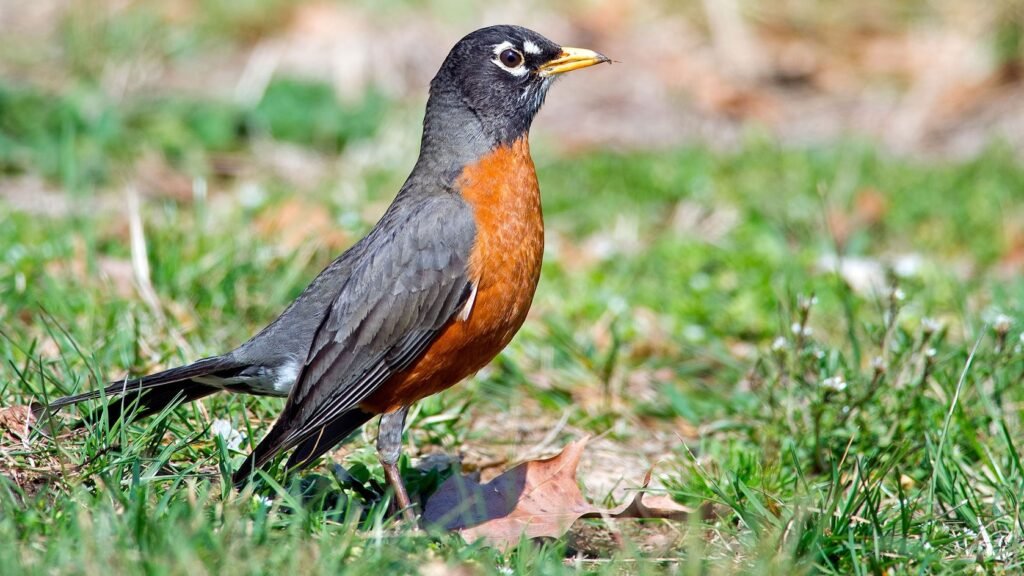
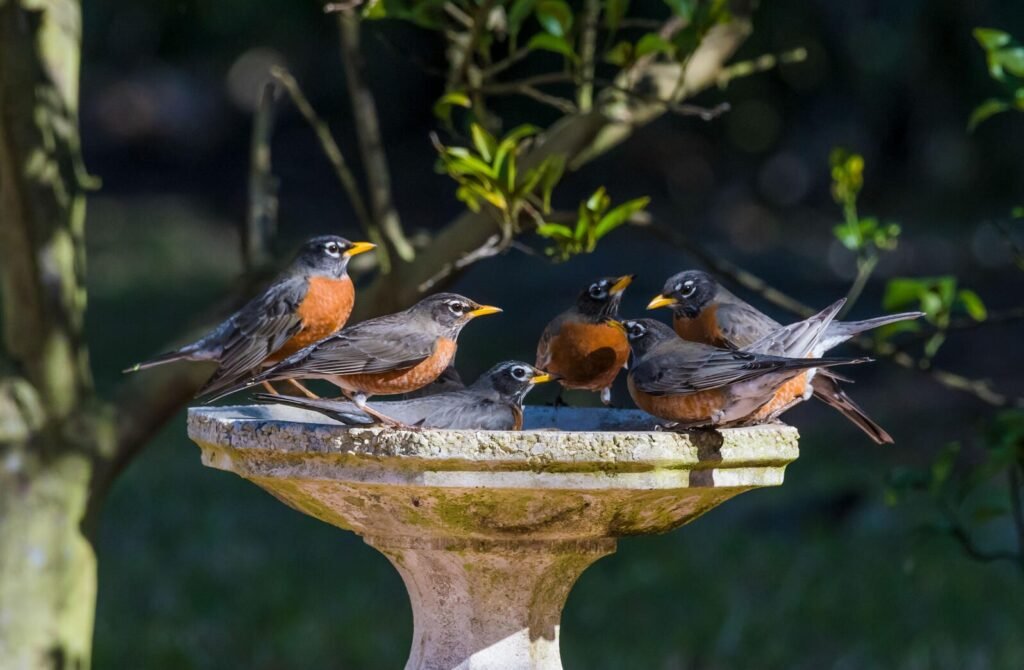
The bird Americans usually mean by “robin” is the American robin, Turdus migratorius, a large North American thrush. Adults generally have gray-brown backs, darker heads, yellow bills, and warm orange or reddish underparts. They are common in forests, parks, gardens, suburban neighborhoods, and grassy areas across much of North America. (National Zoo)
Their behavior contributes almost as much to their symbolic identity as their coloring. Robins frequently forage on open lawns, build nests close to homes, and sing conspicuously around dawn during the breeding season. In fall and winter, their behavior changes: many gather in flocks and spend more time around trees and fruiting plants, making them less noticeable in yards. (All About Birds)
That visibility matters symbolically. People tend to assign meaning to animals they repeatedly encounter during emotionally noticeable moments. A robin appearing when snow begins to disappear, flowers emerge, or mornings become lighter easily becomes associated with transition.
Its reddish breast strengthens that impression. Warm colors visually contrast with gray winter landscapes, making the bird seem especially vivid during seasonal change.
What It Commonly Means in the United States
In contemporary American culture, the robin’s strongest meaning is renewal. It represents a period beginning again rather than simply continuing as before.
That idea branches into several related interpretations.
| Context | Meaning in the USA | Common Associations | Notes |
| Spring | Renewal | warmer weather, growth, activity | The most established U.S. association |
| Personal change | New beginnings | moving forward, starting over | Common in tattoos and personal symbolism |
| Home and garden | Familiarity | family, nesting, belonging | Linked to suburban and backyard life |
| Emotional recovery | Hope | persistence, brighter periods ahead | Usually metaphorical rather than religious |
| Memorial use | Remembrance | deceased relatives, continuing bonds | More personal and modern |
| Red breast | Warmth and vitality | courage, life, affection | Often emphasized in artistic interpretations |
The robin can also suggest optimism without implying that life has suddenly become easy. Spring itself is transitional: cold days still occur, storms return, and growth happens gradually. Because of that, the bird works particularly well as a symbol of hope during change, rather than guaranteed good fortune.
Its place in American public culture is unusually strong for an ordinary backyard species. The American robin is the official state bird of Connecticut, Michigan, and Wisconsin, showing how closely it has become associated with regional identity and familiar North American landscapes.
Why the Robin Became a Sign of Spring
The expression “first robin of spring” remains one of the bird’s most recognizable American associations.
There is an obvious natural reason for it. Robin activity becomes much more visible as spring approaches. Birds begin occupying breeding territories, males sing frequently, pairs form, and robins return to lawns and open spaces where people notice them. Their song is itself widely regarded as a familiar sound of spring. (All About Birds)
But the popular saying simplifies what robins actually do.
Many American robins do not disappear completely during winter. Some remain relatively far north, gathering in wooded areas where berries and other foods are available. They may therefore be present all winter while remaining largely unnoticed by people accustomed to seeing them on lawns. (NIEHS)
So seeing a robin is not a reliable meteorological prediction that warm weather has arrived.
Symbolically, though, scientific precision is not the point. The tradition developed from observation: robins become more conspicuous at roughly the same time Americans begin noticing longer days, thawing ground, new plant growth, and other seasonal changes.
That repeated experience made the bird a natural shorthand for winter ending and life becoming active again.
How European Robin Lore Reached North America
An important distinction is often missed in discussions of robin meaning: the American robin and European robin are not simply regional versions of the same bird.
The European robin belongs to the Old World flycatcher family, while the American robin is a thrush. They are not closely related. Their shared name largely comes from appearance, especially their reddish-orange breasts. (All About Birds)
Early European settlers in North America applied the familiar name “robin” to the North American bird because it reminded them of the robin they knew in Europe. Connecticut’s historical account of its state bird specifically notes that colonists used the name in remembrance of the English bird. (CT.gov)
That naming history had an important cultural consequence.
Stories originally told about the European robin could gradually become attached to the American bird simply because both were called robins. Today, websites, artwork, tattoos, greeting cards, and popular symbolism frequently combine traditions without distinguishing between the species.
This explains why American interpretations can contain two apparently different themes: springtime renewal drawn from North American seasonal experience and religious or memorial meanings largely inherited from European folklore.
Christian Folklore and the Robin’s Red Breast
The robin appears in Christian folklore, but readers should distinguish folk legend from scripture.
The Bible does not establish the robin as a specific Christian symbol. Instead, later European stories attempted to explain why the European robin has a red breast.
One well-known legend says that a small robin approached Jesus during the Crucifixion and tried to remove a thorn from his crown. A drop of blood stained the bird’s breast red, leaving the mark on later generations. Versions of stories connecting the robin’s red coloring with Christ’s suffering appear in European literary and folkloric traditions. (Project Gutenberg)
Within that legend, the bird symbolizes compassion, mercy, courage, and service despite smallness. Its significance comes from attempting to relieve suffering when it lacks the strength to change the larger event.
This interpretation remains meaningful in Christian art or personal devotion, but it should be described as folklore rather than biblical doctrine.
It also originally concerns the European robin. Applying the story directly to the American robin is a later cultural transfer created by their shared name.
The Robin as a Symbol of Home, Family, and Care
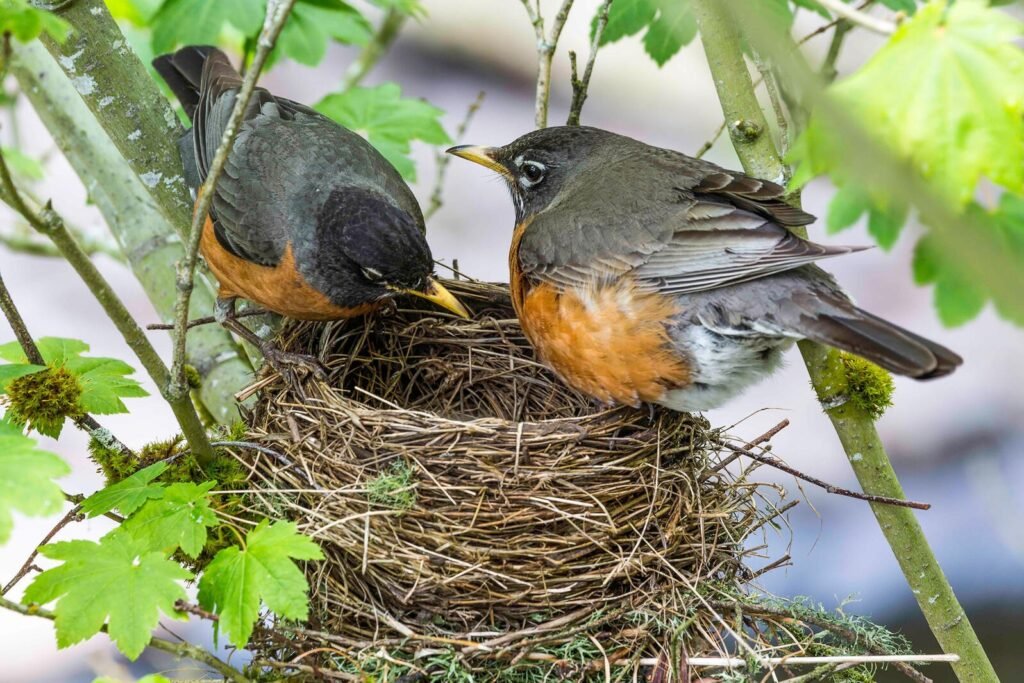
Robins are unusually comfortable living around people. Their nests may appear in trees, shrubs, ledges, porches, and other structures close to homes. This everyday proximity has encouraged meanings involving domestic life, belonging, parenthood, and care.
The symbolism is easy to understand when a nesting pair becomes part of someone’s spring routine. People may watch a nest being constructed, see adults bringing food, and eventually notice young birds leaving it.
The nest itself becomes a compact image of temporary safety.
For that reason, robin imagery can work well in art connected with:
- establishing a new home;
- becoming a parent;
- protecting family life;
- returning home after an absence;
- creating stability after disruption.
This does not mean the bird has universally represented motherhood or family in historical tradition. Those meanings are better understood as modern interpretations based on observable nesting behavior.
That distinction keeps the symbolism grounded rather than turning every natural behavior into an ancient spiritual rule.
Hope, Renewal, and Emotional Resilience
The robin’s strongest emotional meaning comes from change that can actually be seen.
Winter gives way to longer daylight. Soil becomes workable. Plants return. Birdsong becomes more noticeable. Against that background, a robin can represent the moment someone begins to believe that a difficult period may not last forever.
That is why the bird often fits experiences such as recovering from disappointment, rebuilding after a major life change, starting a new job, moving to a new place, or choosing a different direction.
The symbolism is less about dramatic transformation than gradual re-entry into life.
Robins themselves are active, alert birds. They repeatedly cross lawns searching for food, pause to examine their surroundings, fly away, and return. That ordinary persistence allows people to read qualities such as diligence and adaptability into them.
Psychologically, the robin therefore works best as an image of hope with movement attached to it. It suggests beginning again by doing ordinary things: getting up, searching, building, caring, and continuing.
Remembrance, Grief, and the Idea of a Visiting Loved One
One of the most emotionally important modern robin beliefs is the idea that a bird appearing after a death represents someone who has passed away.
The familiar saying that robins appear when deceased loved ones are near is especially widespread in Britain and Ireland and now appears frequently on memorial cards, ornaments, jewelry, social-media posts, and bereavement gifts. Contemporary personal stories often describe an unexpected robin encounter as comforting during grief. (Pure Cremation)
In the United States, this interpretation exists alongside more established spring symbolism.
It is useful to separate personal meaning from factual claim. There is no scientific basis for concluding that a robin is literally carrying a message from a deceased person. Yet symbolic rituals do not have to operate as scientific statements.
Someone may associate a robin with a parent who loved birds, a grandparent’s garden, a funeral, or a meaningful coincidence. From that point forward, seeing one can trigger memory and emotional connection.
In that context, the bird represents remembrance rather than proof of supernatural communication.
Robin Tattoos, Jewelry, and Personal Symbols
A robin tattoo can communicate several meanings depending on the imagery surrounding it.
A bird shown with spring flowers usually emphasizes renewal, growth, or a fresh stage of life. One beside a name or date may function as a memorial. A robin near a nest may represent family, parenthood, or creating a safe home.
A flying robin can shift the emphasis toward leaving an old situation and moving forward.
The red or orange breast is often important artistically because it supplies warmth against neutral feathers. Some people interpret that warm color as vitality, courage, affection, or emotional presence.
Robin jewelry works similarly. Pendants and charms are often selected for birthdays, memorial gifts, family keepsakes, or encouragement during major transitions.
The meaning does not need to come from a formal historical tradition. Personal symbols often work because an established cultural association—spring, return, home, remembrance—meets an individual’s own experience.
Modern Design, Decor, and Digital Culture
Today the robin appears far beyond wildlife illustration.
Spring decorations use the bird alongside flowering branches, nests, eggs, greenery, and gardens. In this setting, it communicates freshness and seasonal change almost immediately.
Its eggs have created another recognizable visual association: robin’s-egg blue, a soft blue-green shade frequently used in home decor, stationery, crafts, weddings, and nursery design. Because the color is tied to eggs and nesting, it naturally carries associations with beginnings, delicacy, and new life.
The European robin has a somewhat different decorative role. Victorian Christmas cards helped establish robins alongside holly, snowy landscapes, evergreens, churches, and other winter imagery that became part of familiar British Christmas iconography. (Victoria and Albert Museum)
Modern digital culture now blends these traditions freely.
A single social-media image may present the robin as a spring messenger, guardian, memorial visitor, spiritual sign, or symbol of courage. That flexibility makes the bird appealing, but it also explains why claims about its “traditional meaning” can become exaggerated.
Common Misunderstandings and Distorted Meanings
The largest misunderstanding is the assumption that every claimed robin meaning comes from one ancient tradition.
It does not.
Several distinct streams have merged over time:
American seasonal observation created strong associations with spring. European folklore contributed sacred and death-related stories. Victorian culture strengthened the robin’s Christmas identity. Modern memorial culture expanded its connection with deceased loved ones.
Another common mistake is declaring that seeing a robin has one fixed supernatural meaning.
A bird outside a window could simply be feeding, defending territory, nesting nearby, or responding to its environment. Symbolic interpretation begins with the observer, not with evidence that the animal intentionally delivered a message.
Claims about Indigenous symbolism also require particular caution. There is no single universal “Native American meaning of the robin” that can responsibly be assigned to hundreds of distinct Indigenous nations. Traditions should be connected to a specific community and reliable cultural context rather than combined into a generic spiritual interpretation.
Finally, red should not automatically turn the robin into a symbol of blood, danger, or passion. Color symbolism can enrich an interpretation, but the bird’s dominant American associations are much more strongly connected with seasonality and familiarity.
How the Robin’s Meaning Has Evolved
The robin demonstrates how symbols change through a combination of environment, language, migration, storytelling, and popular media.
European communities already had centuries of stories surrounding the robin redbreast. When settlers encountered a different red-breasted bird in North America, they gave it the same familiar name. That helped old stories travel to a new species.
North American experience then added something different.
The American robin became a backyard bird, a recognizable spring presence, and eventually a civic emblem. Its association with ordinary homes and lawns made it less exotic than many symbolic birds. Unlike an eagle, phoenix, or raven, it did not need grandeur or mystery to acquire meaning.
That everyday quality may explain its continuing popularity.
In the nineteenth and twentieth centuries, printed cards, poetry, children’s culture, state symbols, gardening traditions, and seasonal imagery reinforced its identity. In the twenty-first century, tattoos, memorial merchandise, social media, and personalized spirituality have made the bird’s meaning more individual.
The core theme remains remarkably consistent: something familiar returns, and its return makes change visible.
FAQs
What does seeing a robin symbolize?
Seeing a robin most commonly symbolizes renewal, hope, and the beginning of a new phase, particularly in the United States. The interpretation comes largely from the bird’s strong cultural connection with the transition from winter to spring.
Is seeing a robin a sign that a loved one is near?
Some people interpret an unexpected robin as a comforting reminder of someone who has died, and the belief is especially prominent in modern British and Irish memorial culture. It is best understood as a personal or spiritual interpretation rather than evidence that the bird is literally carrying a message.
What does a robin tattoo mean?
A robin tattoo often represents a fresh start, emotional recovery, hope, family, or remembrance. Flowers, nests, dates, names, or the bird’s direction of flight can make the intended meaning more specific.
Does a robin symbolize death?
Death is not the dominant modern American meaning of the robin. However, older European folklore sometimes connected the European robin with death and sacred protection, while modern bereavement traditions have turned that darker association toward remembrance and continuing emotional bonds.
What does the robin mean in Christianity?
Christian folk legends associate the robin with compassion because stories describe it attempting to relieve Christ’s suffering during the Crucifixion. This interpretation comes from later folklore and literature rather than a biblical passage specifically assigning symbolic meaning to robins.
Are robins really the first sign of spring?
Not always. Many American robins remain in northern parts of their range during winter but become more noticeable in spring as feeding, singing, and breeding behavior changes. (NIEHS) The phrase therefore works better as a cultural tradition than as a precise weather forecast.
Conclusion
Robin symbolism in the United States centers most clearly on spring, renewal, hope, home, and the possibility of beginning again. Those meanings grew from direct experience with a familiar bird whose song, nesting behavior, and increasing visibility coincide with one of the year’s most noticeable seasonal transitions.
Older European folklore adds other layers—compassion, sacred protection, Christmas, death, and remembrance—while modern personal culture has made the robin a particularly meaningful memorial symbol. Understanding those different origins makes the bird more interesting without turning every sighting into a supernatural message. Sometimes a robin is simply a robin; what makes it symbolic is the history, memory, and human experience attached to its appearance.