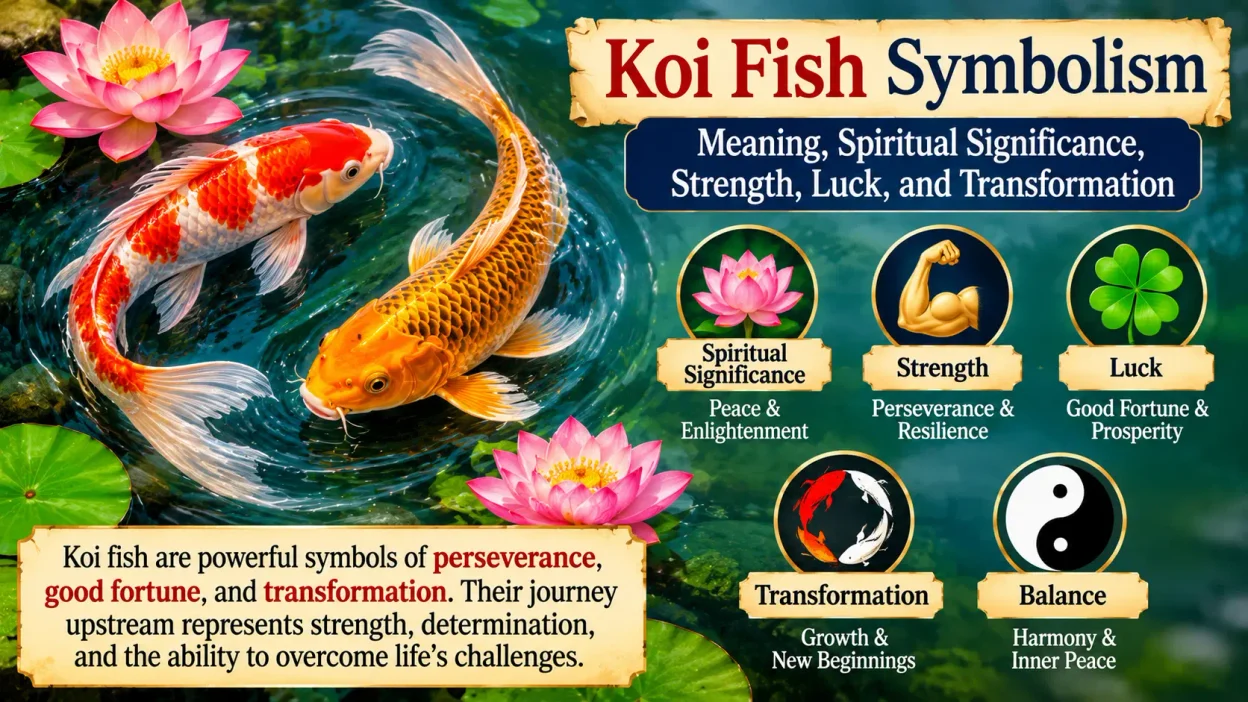
Koi fish symbolize perseverance, courage, good fortune, prosperity, and personal transformation. Known for swimming against strong currents, koi represent the strength to overcome challenges and continue moving toward meaningful goals. In Japanese and Chinese traditions, they are also associated with success, abundance, longevity, and spiritual growth.
Quick Answer
Koi fish symbolism centers on perseverance, determination, good luck, and transformation. Their ability to swim upstream makes them a powerful symbol of overcoming obstacles, while their beauty and presence in traditional gardens connect them with peace, prosperity, and harmony. Different koi colors carry additional symbolic meanings, although interpretations vary across cultures and traditions.
TL;DR: What Do Koi Fish Symbolize?
- Perseverance: Continuing forward despite difficulties and resistance.
- Strength and courage: Facing challenges with confidence and determination.
- Good fortune: Attracting luck, success, and positive opportunities.
- Prosperity: Representing wealth, abundance, and financial growth.
- Transformation: Becoming stronger and wiser through life’s challenges.
- Peace and harmony: Encouraging emotional balance and a calm spirit.
1. The Historical Origins of Koi Fish Symbolism
Himeji Castle, Arima Onsen, and Mount Rokko Day Trip | Departing from Osaka – Klook Australia
Koi fish have a long history in East Asian culture, particularly in China and Japan. Although koi are ornamental varieties of the common carp, their symbolic importance grew far beyond their appearance.
In Chinese tradition, the carp became associated with determination and achievement through the famous legend of the Dragon Gate. According to the story, a carp that successfully swims upstream and leaps over a powerful waterfall transforms into a dragon. This transformation represents the rewards of persistence, discipline, and extraordinary effort.
The story later became closely associated with koi imagery in Japanese culture. Koi appeared in paintings, decorative objects, gardens, and other forms of traditional art.
In Japan, koi became especially meaningful as symbols of strength, courage, and perseverance. Their ability to survive in different water conditions and swim against currents made them natural representations of people who refuse to surrender when life becomes difficult.
2. Koi Fish as a Symbol of Perseverance
One of the strongest meanings associated with koi fish is perseverance.
Koi are frequently pictured swimming against flowing water. This image represents the determination to keep going even when circumstances become challenging.
A koi fish can symbolize:
- Staying committed to long-term goals.
- Overcoming personal and professional obstacles.
- Remaining patient during difficult periods.
- Refusing to give up after disappointment.
- Finding the strength to begin again.
The koi’s symbolism is particularly meaningful when someone is facing uncertainty or working toward something that requires years of dedication.
Rather than suggesting that success comes easily, koi symbolism reminds us that meaningful progress often requires patience and consistent effort.
3. Koi Fish Symbolism in Japanese Culture
Japanese Carp from the series the series fish by Utagawa Hiroshige, (L – NIHONKOSHO
In Japanese culture, koi are associated with courage, perseverance, strength, and good fortune.
Their cultural significance is especially visible during Children’s Day, celebrated in Japan on May 5. Families traditionally display koinobori, colorful carp-shaped windsocks that fly above homes.
These decorations express the hope that children will grow up healthy, strong, courageous, and successful. The carp’s ability to swim against strong currents makes it an especially appropriate symbol of resilience.
Koi also appear in Japanese gardens, where their movement through the water contributes to an atmosphere of tranquility and balance.
In this setting, koi can represent both inner strength and peaceful living: the ability to remain determined without losing one’s sense of harmony.
4. Koi Fish Symbolism in Chinese Culture
In Chinese symbolism, carp are traditionally associated with prosperity, achievement, abundance, and success.
The Dragon Gate legend is particularly important because it connects the carp’s journey upstream with the possibility of transformation. The fish’s eventual transformation into a dragon represents an extraordinary achievement earned through persistence.
This story has made carp imagery meaningful in contexts involving:
- Academic achievement and examinations.
- Career advancement and ambition.
- Financial success and prosperity.
- Personal development and transformation.
- Overcoming limitations.
Koi and carp imagery may also appear in traditional decorations and artwork as a wish for good fortune and abundance.
5. Koi Fish Spiritual Meaning
Tải ngay 99+ hình nền cá chép hoa sen 4K nghệ thuật cực đẹp
Spiritually, koi fish can represent the journey toward wisdom, self-discovery, and inner strength.
Their movement through water is sometimes interpreted as a reflection of the human journey through emotions, uncertainty, and change. Just as koi continue swimming despite obstacles, people can continue developing even when their circumstances are difficult.
Common spiritual interpretations include:
- Spiritual growth: Becoming more aware and mature through experience.
- Inner strength: Discovering courage during challenging moments.
- Renewal: Leaving old habits and negative experiences behind.
- Balance: Maintaining peace while navigating life’s changes.
- Purpose: Continuing toward meaningful goals despite uncertainty.
These meanings are spiritual interpretations rather than universal religious teachings. Their significance depends on personal beliefs and cultural context.
6. Koi Fish Color Symbolism
Different koi colors have developed distinct symbolic associations in Japanese art, popular culture, and contemporary interpretations. These meanings are not fixed rules, but they can help explain why certain koi designs are chosen for tattoos, artwork, and decorative ponds.
Kohaku Koi: Breed Facts, Prices & Breeders | Creatures
Asagi Koi for Sale | Blue Net-Pattern Classic – RJ Aquatics
6
| Koi color | Common symbolic meaning |
|---|---|
| Red | Love, passion, courage, and vitality |
| White | Purity, renewal, and new beginnings |
| Black | Strength, overcoming adversity, and transformation |
| Gold or yellow | Wealth, prosperity, and abundance |
| Blue | Peace, calmness, and emotional balance |
| Orange | Energy, enthusiasm, and confidence |
| Silver | Success, elegance, and good fortune |
Red Koi Fish
Red koi are often associated with love, passion, courage, and strong emotional connections. They can represent determination fueled by powerful feelings.
White Koi Fish
White koi commonly symbolize purity, clarity, and fresh beginnings. Their light appearance makes them popular in interpretations involving renewal and spiritual development.
Black Koi Fish
Black koi are often connected with strength, resilience, and the ability to overcome hardship. In contemporary symbolism, they may represent surviving a difficult period and emerging stronger.
Gold Koi Fish
Gold koi are strongly associated with wealth, prosperity, abundance, and good fortune. They are especially popular in decorative settings where koi represent hopes for financial success.
Blue Koi Fish
Blue koi are often interpreted as symbols of calmness, peace, and emotional stability. They may represent patience and the ability to remain composed during difficult circumstances.
Orange Koi Fish
Orange koi can symbolize enthusiasm, energy, creativity, and confidence. Their bright color is often associated with optimism and positive momentum.
7. Koi Fish Symbolism in Love and Relationships
Koi fish can represent devotion, lasting affection, and emotional commitment.
Because koi are often depicted swimming together, pairs of koi are sometimes used to symbolize romantic partnership, companionship, and harmony. Their movement through water can also suggest the importance of adapting together when relationships face difficulties.
In love, koi symbolism may represent:
- Loyalty and commitment.
- Mutual support during challenging times.
- Emotional connection and understanding.
- A relationship that grows stronger with time.
- Balance between two different personalities.
Two koi swimming together are particularly popular in artwork and tattoos representing romantic love or a lasting partnership.
8. Two Koi Fish Symbolism
Картина инь и янь в спальне (67 фото) – красивые картинки и HD фото
Two koi swimming in opposite directions or forming a circular pattern often symbolize balance, harmony, and complementary energies.
This imagery is frequently connected with the concept of yin and yang, which describes how seemingly opposite forces can exist together and create balance.
The two fish may represent:
- Masculine and feminine energies.
- Partnership and mutual understanding.
- Balance between action and rest.
- The relationship between change and stability.
- Harmony between different aspects of life.
In romantic settings, two koi can represent a couple who support each other while maintaining their individual identities.
9. Koi Fish Symbolism in Tattoos
Koi fish tattoos are popular because their symbolism combines beauty with a powerful message of resilience.
People may choose koi tattoos to represent a personal challenge, a major life transition, or a commitment to keep moving forward.
Common tattoo interpretations include:
- Koi swimming upstream: Struggling against obstacles and refusing to give up.
- Koi swimming downstream: Peace, acceptance, or a different stage of life’s journey.
- Black koi: Strength after hardship.
- Red koi: Love, courage, and passion.
- Gold koi: Prosperity and ambition.
- Two koi: Partnership, balance, and harmony.
- Koi with a dragon: Transformation and extraordinary achievement.
Traditional Japanese tattoo imagery may also include waves, lotus flowers, and other motifs. These additions can deepen the design’s meaning, although the interpretation depends on the complete composition and the person wearing it.
10. Koi Fish Symbolism in Dreams
Dreaming about koi fish is sometimes interpreted as a reflection of personal growth, emotional balance, ambition, or hope.
The meaning depends on the dream’s circumstances and the feelings experienced during it. Dreams do not have universally established symbolic meanings, but koi imagery can provide a useful starting point for personal reflection.
| Dream image | Possible interpretation |
|---|---|
| Swimming koi | Progress, opportunity, and personal growth |
| Large koi | Ambition, confidence, or significant goals |
| Colorful koi | Creativity, optimism, and emotional expression |
| Koi swimming upstream | Perseverance through challenges |
| Dead koi | Disappointment, change, or a sense of lost motivation |
| Two koi together | Partnership, balance, and emotional connection |
| Feeding koi | Nurturing relationships or developing personal goals |
A koi swimming peacefully may reflect a desire for stability, while a koi fighting a strong current may mirror a challenging situation in waking life.
11. Koi Fish as a Symbol of Good Luck and Prosperity
Metaliczne odmiany Koi (Hikarimono) – jak wprowadzić blask i złoto do swojego stawu?
Koi are widely associated with good fortune and prosperity, particularly in East Asian decorative traditions.
Their connection with abundance comes partly from their association with wealth and achievement. Gold-colored koi are especially popular representations of financial success, while groups of koi may symbolize plentiful blessings.
People use koi imagery in:
- Home and garden decorations.
- Paintings and wall art.
- Business interiors.
- Jewelry and accessories.
- Traditional and contemporary tattoos.
Although koi imagery is often displayed with the hope of attracting good fortune, it is best understood as a cultural symbol rather than a guarantee of wealth or success.
12. Koi Fish Symbolism in Feng Shui
In feng shui-inspired decorating, koi fish are commonly associated with prosperity, abundance, positive energy, and harmony.
Koi paintings and pond imagery are often selected for homes and businesses because they represent movement, growth, and the flow of opportunities.
Common decorative interpretations include:
- Gold koi representing wealth and financial abundance.
- Red koi representing vitality and positive energy.
- Black koi representing protection and resilience.
- Two koi representing harmony and balanced relationships.
Some feng shui traditions also associate the number of fish in an arrangement with particular meanings. However, recommendations can vary between schools and practitioners, so there is no single universal rule for every koi display.
13. Koi Fish Symbolism and Personal Transformation
The koi’s association with transformation is closely connected to the Dragon Gate legend.
In that story, the carp’s difficult journey upstream ends with an extraordinary change: it becomes a dragon. This makes the fish a meaningful symbol of the potential for growth through adversity.
On a personal level, koi can represent:
- Learning from past mistakes.
- Developing confidence through experience.
- Moving beyond limiting beliefs.
- Rebuilding after disappointment.
- Becoming more resilient and self-aware.
The transformation symbolized by koi is not necessarily about becoming someone completely different. It can also mean discovering strengths that were already present but had not yet been fully developed.
14. Koi Fish Symbolism in Art and Modern Culture
15 Stunning Koi Pond Ideas for a Tranquil Backyard
Koi fish remain popular subjects in contemporary art, interior design, fashion, and personal accessories.
Their flowing shapes and striking colors make them visually appealing, while their cultural associations give them deeper significance.
In modern contexts, koi frequently represent resilience, ambition, peacefulness, and personal identity.
Artists may combine koi with lotus flowers, water, waves, dragons, or circular patterns to explore themes of renewal, transformation, and harmony.
However, koi symbolism should be understood within its cultural background. Japanese and Chinese traditions have their own histories, and modern interpretations may combine several influences.
15. What Does It Mean When You Keep Seeing Koi Fish?
Repeatedly encountering koi fish may feel meaningful, particularly during a period of change or uncertainty.
From a symbolic perspective, koi can serve as a reminder to remain persistent, trust your development, and approach challenges with courage.
You might interpret repeated koi imagery as an invitation to reflect on questions such as:
- Am I giving up too quickly on an important goal?
- What challenge is teaching me patience?
- Where do I need more courage?
- Am I allowing myself to grow beyond past experiences?
- How can I create more balance in my life?
There is no scientific evidence that repeatedly seeing koi predicts future events. Nevertheless, a symbol can become personally meaningful when it encourages reflection and positive action.
16. Koi Fish vs. Other Symbols of Strength and Transformation
Koi share several meanings with other well-known symbols, but each has its own distinctive associations.
| Symbol | Main meaning | What makes it distinctive |
|---|---|---|
| Koi fish | Perseverance and transformation | Overcoming resistance and progressing toward achievement |
| Phoenix | Rebirth and renewal | Rising again after destruction |
| Butterfly | Change and personal development | Transformation through metamorphosis |
| Dragon | Power and wisdom | Strength, authority, and extraordinary potential |
| Lotus flower | Purity and spiritual growth | Blooming beautifully despite growing in muddy water |
| Eagle | Freedom and vision | Independence, courage, and perspective |
The koi is especially meaningful when the focus is on the effort required to achieve transformation. While a phoenix represents rising after destruction, the koi represents continuing the journey despite resistance.
Frequently Asked Questions
1. What do koi fish symbolize spiritually?
Koi fish spiritually symbolize perseverance, personal growth, courage, transformation, and inner strength. They can represent the ability to overcome obstacles while maintaining balance and purpose.
2. Are koi fish a symbol of good luck?
Yes. Koi are widely associated with good fortune, prosperity, abundance, and success, especially in Japanese and Chinese cultural traditions.
3. What does a black koi fish symbolize?
Black koi are often interpreted as symbols of resilience, strength, and overcoming adversity. In modern symbolism, they can represent surviving difficult experiences and becoming stronger.
4. What does a red koi fish symbolize?
Red koi commonly represent love, passion, courage, and vitality. They may also symbolize strong emotional connections and determination.
5. What do two koi fish represent?
Two koi fish often symbolize balance, harmony, partnership, and complementary energies. They are also commonly used to represent romantic relationships and mutual support.
6. What does a koi fish swimming upstream mean?
A koi swimming upstream symbolizes perseverance, determination, and the courage to face difficulties. It represents continuing toward a goal even when progress is challenging.
7. What does a koi fish tattoo mean?
A koi fish tattoo often represents strength, ambition, personal transformation, and the determination to overcome obstacles. Its color, direction, and surrounding imagery can add further meaning.
Conclusion
Koi fish symbolism carries a powerful message of perseverance, courage, prosperity, and transformation. Rooted in East Asian cultural traditions, koi represent the determination to keep moving forward even when the journey becomes difficult.
Whether shown swimming upstream, forming a pair, or displaying brilliant colors, koi remind us that personal growth often requires patience, resilience, and faith in our own potential. Their enduring appeal comes from this simple but meaningful idea: challenges can become opportunities for growth.
Cultural note: The Dragon Gate story is one of the best-supported foundations of koi symbolism. It originated in Chinese tradition and became influential in Japan, where carp streamers (koinobori) are displayed for Children’s Day on May 5 to express hopes for children’s strength, health, and success. asianethnology.org+2
One important distinction: popular color meanings—such as red for love, blue for peace, and gold for wealth—are modern or interpretive associations, not a single set of universally established traditional meanings. San Diego Zoo Wildlife Alliance+1