
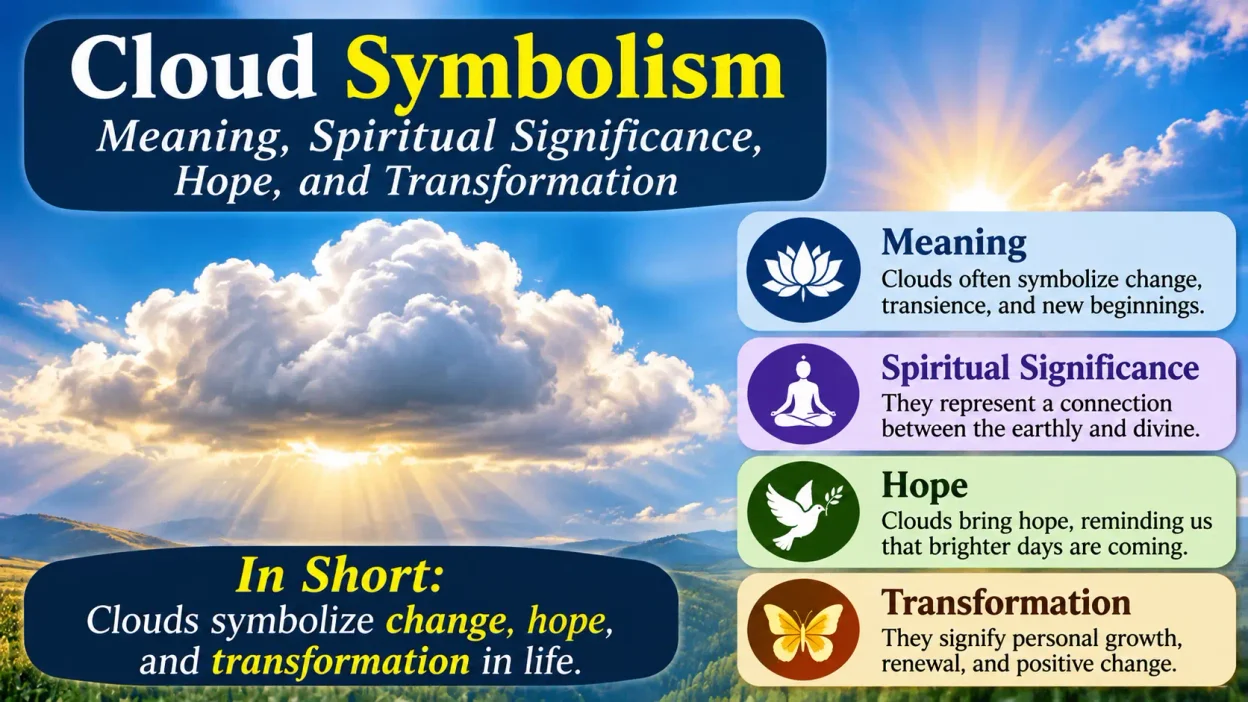
Clouds are among the most familiar yet fascinating elements of the natural world. They drift across the sky, change their shapes, soften the sunlight, and sometimes gather into powerful storms. Although they are formed through ordinary atmospheric processes, clouds have inspired countless symbolic interpretations throughout history. Their changing appearance makes them powerful representations of emotions, uncertainty, hope, imagination, and transformation.
In spiritual traditions, literature, art, and everyday expressions, clouds often represent the connection between the visible and invisible worlds. A bright white cloud may suggest peace and optimism, while dark storm clouds can symbolize emotional struggles, approaching challenges, or uncertainty. Meanwhile, clouds that slowly disappear may represent the temporary nature of difficulties and the possibility of a fresh beginning.
But what does cloud symbolism really mean? Why are clouds associated with mystery, dreams, spirituality, and change? Let’s explore their deeper meanings, cultural interpretations, different types, and the messages people commonly associate with seeing clouds.
What Do Clouds Symbolize?
Clouds commonly symbolize change, emotions, mystery, imagination, hope, uncertainty, and spiritual connection. Because they constantly move and transform, they are often used to represent the temporary and unpredictable nature of life.
Some of the most common symbolic meanings of clouds include:
- Transformation: Clouds continuously change shape, representing personal growth and life’s transitions.
- Emotions: Their appearance can reflect different emotional states, from happiness to sadness and confusion.
- Mystery: Clouds can hide the sun, mountains, and distant landscapes, symbolizing the unknown.
- Hope: Clouds parting to reveal sunlight can represent relief, optimism, and better days.
- Imagination: Their changing shapes inspire creativity, dreams, and new ideas.
- Spirituality: In many religious and cultural traditions, clouds are associated with divine presence and the heavens.
- Uncertainty: Overcast skies can symbolize confusion, doubt, or situations that are difficult to understand.
- Protection: Clouds can provide shade and shelter from direct sunlight, making them symbolic of comfort and protection.
- Freedom: Their movement across the open sky can represent independence and the desire to explore new possibilities.
These meanings are symbolic interpretations rather than universal rules. A cloud may represent something different depending on the culture, personal experience, and context in which it appears.
The Spiritual Meaning of Clouds
In spiritual interpretations, clouds are often viewed as symbols of divine presence, mystery, reflection, transformation, and the connection between heaven and earth.
Their position in the sky makes them natural symbols of something beyond ordinary human experience. They can appear beautiful and peaceful one moment and powerful or threatening the next, reflecting the complexity of spiritual and emotional life.
1. Divine Presence and Spiritual Connection
Clouds have been associated with divine presence in several religious traditions. Their appearance in the sky can create a sense of wonder and remind people of the vastness of the universe.
In spiritual interpretations, clouds may symbolize a connection between the earthly and heavenly realms. They can represent the feeling that something greater than ourselves exists beyond what we can see or understand.
2. Transformation and Personal Growth
Clouds are constantly changing. They form, expand, combine, separate, and eventually disappear.
This natural process makes them powerful symbols of personal transformation. Just as clouds never remain exactly the same, people also experience changes in their thoughts, relationships, emotions, and priorities.
Cloud symbolism can remind us that change is natural and that no stage of life lasts forever.
3. Mystery and the Unknown
Clouds sometimes cover the sun, obscure distant objects, and make the sky difficult to read.
Spiritually, this can symbolize uncertainty and the parts of life that remain hidden. A cloud may represent a period when the next step is unclear or when answers have not yet become visible.
It can encourage patience and acceptance when everything cannot be understood immediately.
4. Emotional Healing and Release
Rain clouds often carry symbolic associations with emotional release. Rain can represent tears, grief, cleansing, and the process of letting go.
After rainfall, the sky may become clearer, creating a natural metaphor for emotional recovery and renewed hope.
5. Hope and New Beginnings
When clouds move away and sunlight returns, the change can feel uplifting.
In symbolic interpretations, this moment represents the end of a difficult period, renewed confidence, and the possibility of a better future.
Cloud Symbolism in Different Cultures and Religions
Clouds appear in religious texts, mythology, traditional art, and cultural storytelling. Their meanings differ across societies, but they are frequently connected with the heavens, divine power, nature, and transformation.
Cloud Symbolism in Christianity and the Bible
Clouds have several important roles in the Bible. They are sometimes associated with God’s presence, guidance, glory, judgment, and the revelation of divine power.
Clouds as a Sign of God’s Presence
In Exodus 13:21, God guides the Israelites through the wilderness with a pillar of cloud by day and a pillar of fire by night.
The cloud represents divine guidance, protection, and God’s presence during the journey.
Clouds and Divine Glory
In Exodus 24:15–16, a cloud covers Mount Sinai, and the glory of the Lord rests upon it.
This passage connects clouds with holiness, majesty, and the presence of God.
Clouds and the Transfiguration
In Matthew 17:5, a bright cloud appears during the Transfiguration of Jesus, and a voice speaks from the cloud.
This event connects the cloud with divine authority and revelation.
Clouds and the Return of Christ
In Matthew 24:30, the Son of Man is described as coming on the clouds of heaven with power and great glory.
This imagery connects clouds with divine majesty and the Christian expectation of Christ’s return.
Overall, biblical cloud symbolism is strongly connected with God’s presence, guidance, glory, and power. These meanings come from specific scriptural passages rather than a single universal interpretation of every cloud.
Cloud Symbolism in Ancient Greek Mythology
In Greek mythology, clouds were sometimes associated with divine power and the gods of the sky.
Zeus, the ruler of the Olympian gods, was connected with thunder, lightning, storms, and the atmosphere. Clouds could therefore form part of the imagery surrounding his authority.
Clouds also appear in Greek literature and mythology as elements of transformation, concealment, and illusion.
In Aristophanes’ comedy The Clouds, clouds are personified as a chorus and connected with philosophical speculation and intellectual satire.
Cloud Symbolism in Chinese Culture
In traditional Chinese art and decorative symbolism, clouds often represent good fortune, prosperity, longevity, and the presence of heavenly forces.
Cloud patterns appear in paintings, textiles, ceramics, architecture, and ceremonial objects.
Certain stylized cloud motifs are associated with auspicious meaning, although their interpretation depends on the design and historical context.
Cloud Symbolism in Japanese Culture
Clouds are common features in traditional Japanese paintings, screens, textiles, and decorative arts.
They can represent nature’s changing conditions, movement, mystery, and the relationship between the earthly and spiritual worlds.
Their flowing shapes also create a sense of depth and atmosphere in traditional artwork.
Cloud Symbolism in Hindu Traditions
Clouds and rain have important connections with fertility, agricultural abundance, renewal, and divine power in Hindu traditions.
The god Indra is traditionally associated with rain, storms, and the atmosphere. Monsoon clouds can also carry associations with fertility and the renewal of the natural world.
In poetry and literature, clouds may serve as messengers of longing and emotional connection. A famous example is Kalidasa’s Sanskrit poem Meghaduta, in which an exiled yaksha asks a cloud to carry a message to his distant beloved.
Cloud Symbolism in Indigenous Traditions
Clouds and rain hold important meanings in the stories, ceremonies, and relationships with the natural world of many Indigenous peoples.
In some communities, clouds are connected with rainfall, agricultural cycles, seasonal knowledge, and the life-giving forces of nature.
However, Indigenous traditions are diverse. There is no single universal Native American interpretation of clouds, and specific meanings should be understood within the traditions of individual nations and communities.
What Do Different Types of Clouds Symbolize?
Different cloud formations can inspire different symbolic interpretations. Their shapes, colors, and movements influence how people understand them in art, spirituality, and everyday life.
| Cloud Type | Common Symbolic Meaning |
|---|---|
| Cumulus clouds | Happiness, optimism, and new possibilities |
| Stratus clouds | Reflection, calmness, and uncertainty |
| Cirrus clouds | Freedom, subtle change, and inspiration |
| Cumulonimbus clouds | Powerful emotions, conflict, and transformation |
| Altocumulus clouds | Transition, complexity, and changing circumstances |
| Nimbostratus clouds | Emotional release, sadness, and renewal |
| Lenticular clouds | Mystery, imagination, and unusual experiences |
| Mammatus clouds | Strength, dramatic change, and the beauty of nature |
These associations are creative and symbolic rather than fixed meanings established by meteorology.
White Cloud Symbolism
<text></text>
White clouds are commonly associated with peace, purity, optimism, innocence, and spiritual calmness.
Their bright appearance against a blue sky often creates a feeling of openness and tranquility.
Symbolically, white clouds may represent:
- Peace and emotional balance
- Hope and positive thinking
- New beginnings
- Clarity and simplicity
- Freedom and imagination
Seeing white clouds may inspire someone to slow down, appreciate the present moment, and approach life with a more positive outlook.
Dark Cloud Symbolism
<text></text>
Dark clouds are often associated with uncertainty, emotional struggles, hidden fears, and approaching challenges.
Their heavy appearance can symbolize a period when life feels difficult or when important decisions are not yet clear.
However, dark clouds do not always represent something negative. They can also symbolize preparation, emotional depth, and the possibility of change.
Just as storm clouds may eventually bring rain that supports life, difficult experiences can sometimes lead to reflection and personal growth.
Black Cloud Symbolism
Black clouds often represent mystery, fear, emotional heaviness, and uncertainty.
In literature and everyday expressions, a black cloud may symbolize an overwhelming problem or a situation that seems difficult to escape.
However, the symbolism depends on the context. A black cloud can also represent the power of nature, the unknown, or a dramatic transition.
Grey Cloud Symbolism
Grey clouds are commonly associated with emotional uncertainty, neutrality, sadness, and reflection.
Because they often create an overcast sky without the intensity of a storm, they can represent periods of waiting, indecision, or emotional ambiguity.
A grey cloud may also symbolize the space between two stages of life, when the past is fading but the future is not yet clear.
Pink Cloud Symbolism
Pink clouds are often associated with romance, tenderness, happiness, affection, and emotional warmth.
They frequently appear during sunrise and sunset, when the changing light creates beautiful shades across the sky.
Symbolically, pink clouds may represent:
- Romantic feelings
- Emotional healing
- Compassion and kindness
- Beauty and appreciation
- Hopeful new beginnings
Their gentle appearance makes them popular symbols in romantic photography, poetry, and artwork.
Orange Cloud Symbolism
Orange clouds are often associated with creativity, enthusiasm, energy, and transformation.
Their warm appearance during sunrise or sunset can create a feeling of excitement and possibility.
In symbolic interpretations, orange clouds may represent renewed motivation, courage, and the willingness to embrace new experiences.
Purple Cloud Symbolism
Purple clouds can symbolize mystery, imagination, spirituality, wisdom, and transformation.
Their unusual appearance during certain lighting conditions can make the sky seem dreamlike or otherworldly.
In personal symbolism, purple clouds may encourage reflection, creativity, and a deeper exploration of one’s beliefs.
Red Cloud Symbolism
Red clouds are often associated with passion, intensity, warning, and powerful emotions.
They can appear during dramatic sunrises and sunsets, when sunlight passes through the atmosphere at a low angle.
In artistic and symbolic settings, red clouds may represent strong feelings, significant change, or an important turning point.
Their meaning depends on the surrounding imagery and personal interpretation.
What Does It Mean When You See Clouds?
Seeing clouds is a normal part of everyday life, but people sometimes attach personal or spiritual meanings to particular cloud formations.
The symbolism may depend on the cloud’s appearance, the circumstances of the encounter, and what the person is experiencing emotionally.
Seeing Beautiful Clouds
Beautiful cloud formations may symbolize peace, inspiration, gratitude, and appreciation for life’s simple moments.
They can remind you to notice the beauty around you rather than focusing only on responsibilities and worries.
Seeing Dark Clouds Suddenly
A sudden change in the sky may symbolize uncertainty or an approaching transition in personal interpretations.
It can encourage reflection and preparation, although meteorologically it may simply indicate changing weather conditions.
Seeing Clouds Parting
Clouds moving away to reveal sunlight are often associated with relief, clarity, hope, and the end of a difficult period.
This imagery is especially meaningful in stories about overcoming obstacles.
Seeing Clouds Moving Quickly
Fast-moving clouds may symbolize change, restlessness, or the temporary nature of circumstances.
They can serve as a reminder that situations are rarely permanent.
Seeing Clouds Forming Unusual Shapes
People often recognize familiar objects, animals, or faces in clouds. This experience is called pareidolia, the tendency to perceive familiar patterns in ambiguous visual information.
Symbolically, an unusual cloud shape may inspire personal reflection or creativity, but it does not necessarily carry a supernatural message.
Cloud Symbolism in Dreams
Dreaming about clouds can reflect emotions, uncertainty, hope, imagination, and changing circumstances.
The meaning depends on the dreamer’s feelings and the details of the dream. Dream interpretations are subjective and should not be treated as predictions.
| Cloud Dream | Possible Symbolic Meaning |
|---|---|
| White clouds in a blue sky | Peace, optimism, and emotional balance |
| Dark storm clouds | Stress, uncertainty, or unresolved feelings |
| Grey clouds | Confusion, waiting, or emotional reflection |
| Pink clouds | Romance, affection, and happiness |
| Clouds covering the sun | Hidden possibilities or temporary difficulties |
| Clouds disappearing | Relief, clarity, and renewed hope |
| Flying above clouds | Freedom, ambition, or a desire for perspective |
| Clouds moving quickly | Change, uncertainty, or shifting priorities |
| Clouds shaped like animals | Imagination, personal associations, or creativity |
| Clouds bringing rain | Emotional release, cleansing, or renewal |
A useful way to understand a cloud dream is to consider how you felt. Peaceful clouds may create a different personal association from dark clouds that produce fear or anxiety.
Cloud Symbolism in Love and Relationships
Clouds can represent the changing emotions and experiences that occur in romantic relationships.
Their changing forms make them useful metaphors for the complexity of love.
Emotional Connection
Soft, bright clouds may symbolize affection, emotional warmth, and peaceful relationships.
They can represent the comfort of sharing meaningful moments with someone.
Uncertainty in Love
Dark or grey clouds may symbolize confusion, unresolved issues, or uncertainty about a relationship.
This does not mean a relationship is destined to fail. It may simply reflect the emotional questions someone is currently experiencing.
Romantic Dreams and Imagination
Pink clouds are frequently associated with romance and idealized love.
They may represent the excitement of a new relationship, affectionate feelings, or the desire for emotional closeness.
Growth Through Challenges
Storm clouds can symbolize disagreements and difficult periods.
However, the passing of a storm may represent forgiveness, understanding, and the opportunity to rebuild trust.
Cloud Symbolism in Literature and Art
Clouds have inspired writers, poets, painters, and photographers because they can communicate complex emotions without words.
Clouds as Symbols of Change
In literature, moving clouds often represent the passage of time and the temporary nature of human experiences.
Their changing appearance can reflect characters who are growing, struggling, or moving toward a new stage of life.
Clouds as Symbols of Mystery
Clouds that hide mountains, sunlight, or distant landscapes can represent secrets and unanswered questions.
Writers may use them to create suspense or suggest that something important remains unknown.
Clouds as Symbols of Emotions
A bright sky may reflect happiness, while an overcast sky may mirror sadness or uncertainty.
This technique helps establish the emotional atmosphere of a story.
Clouds as Symbols of Freedom
Clouds moving across an open sky can represent independence, imagination, and the desire to escape limitations.
They may also suggest the ability to explore possibilities beyond familiar surroundings.
Cloud Symbolism in Everyday Expressions
Clouds appear in many common expressions, and these phrases reveal how people connect weather with emotions and experiences.
| Expression | Meaning |
|---|---|
| Every cloud has a silver lining | Even difficult situations may contain something positive |
| On cloud nine | Feeling extremely happy |
| Under a cloud | Experiencing suspicion, criticism, or disgrace |
| Head in the clouds | Being distracted, unrealistic, or overly imaginative |
| A cloud hanging over someone | A feeling of worry or an ongoing problem |
| Cloud one’s judgment | To make someone’s thinking less clear |
| A dark cloud on the horizon | A possible future problem or threat |
These expressions demonstrate how clouds have become powerful metaphors for human emotions and circumstances.
What Can Clouds Teach Us About Life?
Cloud symbolism offers several useful lessons about change, patience, and emotional awareness.
- Nothing stays the same: Clouds constantly change, reminding us that circumstances are temporary.
- Uncertainty is natural: Not every stage of life comes with clear answers.
- Difficult periods can pass: Storms eventually move, creating a metaphor for hope during challenges.
- Beauty exists in ordinary moments: Even a familiar sky can inspire wonder and gratitude.
- Emotions are complex: Just as the sky changes, human feelings can shift over time.
- Perspective matters: Looking at the sky can remind us that our immediate problems are part of a much larger world.
- Growth requires patience: Some changes happen gradually and cannot be rushed.
Clouds remind us that life is always moving. Even when the sky looks uncertain, its appearance is never permanent.
Frequently Asked Questions About Cloud Symbolism
1. What is the main symbolism of clouds?
The main symbolism of clouds includes change, emotions, mystery, hope, imagination, uncertainty, and spirituality. Their constantly changing appearance makes them powerful symbols of life’s temporary nature.
2. What do clouds symbolize spiritually?
Spiritually, clouds are often associated with divine presence, mystery, spiritual connection, transformation, and guidance. Their meaning varies across religious and personal belief systems.
3. What do white clouds symbolize?
White clouds commonly symbolize peace, purity, optimism, innocence, and new beginnings. Their bright appearance often creates associations with calmness and hope.
4. What do dark clouds symbolize?
Dark clouds often represent uncertainty, emotional struggles, hidden fears, and approaching challenges. They can also symbolize transformation and the possibility of renewal.
5. What do clouds symbolize in the Bible?
In the Bible, clouds are associated with God’s presence, guidance, glory, and divine power. Examples include the pillar of cloud in Exodus 13:21 and the bright cloud during the Transfiguration in Matthew 17:5.
6. What does seeing clouds mean spiritually?
Some people interpret seeing clouds as a reminder of change, patience, reflection, or spiritual connection. However, an ordinary cloud sighting does not have one universally accepted spiritual meaning.
7. What do pink clouds symbolize?
Pink clouds are commonly associated with romance, affection, tenderness, emotional warmth, and happiness.
8. What do grey clouds symbolize?
Grey clouds can represent uncertainty, emotional reflection, sadness, or a transitional period. Their meaning depends on the surrounding context.
9. What do clouds symbolize in dreams?
Clouds in dreams may represent emotions, uncertainty, hope, personal change, or imagination. Their interpretation depends on the dreamer’s feelings and circumstances.
10. What does it mean when clouds cover the sun?
Symbolically, clouds covering the sun may represent temporary obstacles, hidden opportunities, or uncertainty. Their eventual movement can suggest the possibility of renewed clarity and hope.
Conclusion: The Deeper Meaning of Cloud Symbolism
Cloud symbolism reflects the changing nature of life and the complexity of human emotions. Their movement across the sky represents transformation, while their different colors and formations inspire associations with hope, mystery, uncertainty, freedom, and spiritual connection.
Across cultures and religious traditions, clouds have been used to express divine presence, natural power, renewal, and the relationship between heaven and earth. In everyday life, they remind us that even the most familiar parts of nature can carry meaningful personal associations.
Ultimately, clouds teach us that change is unavoidable, uncertainty is part of the human experience, and difficult moments do not last forever. Whether they appear as bright white formations or dark storm clouds, they remind us to remain patient, appreciate the present, and stay open to what comes next.