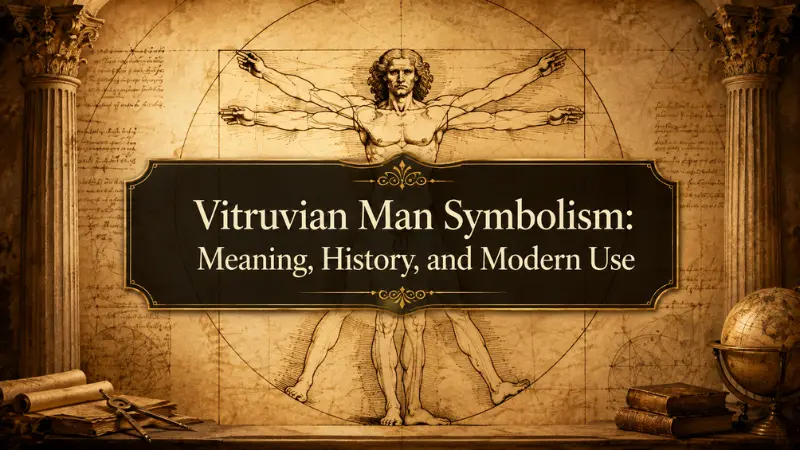
Vitruvian Man symbolism centers on proportion, balance, human potential, and the connection between art and scientific observation. Leonardo da Vinci’s famous drawing shows a nude male figure in two overlapping poses, surrounded by a circle and a square.
Although the image is now printed on everything from medical logos to T-shirts, it began as a serious study of the human body. Leonardo was testing ideas recorded by the ancient Roman architect Vitruvius, who argued that well-designed buildings should display the same harmony found in the proportions of the body.
For modern American viewers, the drawing commonly represents intelligence, curiosity, anatomy, health, and the search for order. It also raises questions about who gets presented as the universal model of humanity.
Quick Answer
Vitruvian Man symbolism commonly represents the balance of body and mind, the relationship between humanity and the universe, and the union of art with science. Historically, the drawing illustrated Renaissance ideas about ideal human proportions and their use as a model for harmonious architecture.
TL;DR
- The image joins human anatomy with geometry, measurement, and architectural proportion.
- Leonardo adapted ideas from the Roman architect Vitruvius around 1490.
- The circle and square require different centers and body positions.
- Americans associate it with science, medicine, balance, and human potential.
- Modern criticism questions its male body as a universal human standard.
- Golden-ratio claims are popular but not firmly supported by the drawing.
What the Vitruvian Man Actually Shows
Leonardo created the drawing around 1490 using ink and other drawing materials on paper. The original sheet measures roughly 13.5 by 9.6 inches and is kept at the Gallerie dell’Accademia in Venice, Italy. Because light can damage the fragile paper, the original is displayed only under controlled conditions.
The drawing shows one man in two superimposed positions. In one pose, his legs are together and his arms extend horizontally. This position fits within the square. In the second pose, his legs spread apart and his arms rise diagonally, allowing his hands and feet to reach the circle.
The figure appears to have four arms and four legs, but Leonardo was not drawing a supernatural being. He was showing two moments of movement on the same page.
Handwritten notes surround the body. Leonardo wrote them in his characteristic mirror script, moving from right to left. The notes record measurements and proportions drawn from Vitruvius, while also reflecting Leonardo’s own study of real bodies.
Core Meanings at a Glance
The drawing can communicate several related ideas, depending on where it appears.
| Context | Common Meaning in the USA | Main Association | Important Note |
| Art and education | Renaissance knowledge | Creative and intellectual curiosity | Combines drawing with written observation |
| Medicine and anatomy | The studied human body | Health, structure, and physical care | Not a modern anatomical chart |
| Architecture | Proportion and harmony | Parts working within a whole | Based on ideas recorded by Vitruvius |
| Technology | Human-centered innovation | Science serving human needs | Often simplified into a logo |
| Personal symbolism | Balance and self-development | Body, mind, and disciplined growth | Meaning depends on the wearer or designer |
| Social criticism | A limited “universal” ideal | Gender, ability, and representation | Depicts one idealized male body |
The image does not have one official symbolic definition. Its modern meaning comes from its historical purpose, Leonardo’s reputation, and the settings in which reproductions now appear.
Vitruvius and the Architectural Origin
The name comes from Marcus Vitruvius Pollio, a Roman architect and engineer who lived during the first century BCE. His surviving work, commonly known as Ten Books on Architecture, discusses construction, materials, temples, machines, water systems, and architectural proportion.
Vitruvius argued that a building should possess a harmonious relationship among its parts. A column, room, or temple should not appear disconnected from the larger structure. To explain this idea, he compared architecture with the human body.
The hand, foot, face, head, and limbs form measurable parts of a complete person. According to Vitruvius, the same type of proportional order should guide a successful building. He described the navel as a central point from which a circle could be drawn around an outstretched body. He also stated that a person’s height was equal to the span of the extended arms, allowing the body to fit within a square.
Vitruvius’s purpose was architectural. The body provided a familiar model for understanding symmetry, scale, and the relationship between individual parts and a complete design.
How Leonardo Turned Words Into an Image
Vitruvius left written measurements, but the surviving text did not provide Leonardo with a clear original illustration. Renaissance artists and architects therefore had to decide how the described body, circle, and square should fit together.
Leonardo’s solution was unusually effective because he did not force one fixed pose into both shapes. Instead, he showed the body moving between two positions.
The square and circle also have different centers. The center of the circle is at the navel, following Vitruvius’s description. The square sits lower, with its central line closer to the groin. This shift allows both geometric forms to fit the changing figure more convincingly.
That detail is central to the drawing’s meaning. Harmony does not come from forcing everything around one point. It comes from understanding that different systems may require different centers while still belonging to one complete design.
Leonardo also compared inherited ideas with observation. He respected the ancient text, but he did not treat it as unquestionable. The finished drawing reflects classical learning, practical measurement, artistic judgment, and careful adjustment.
What the Circle and Square Represent
The circle and square first serve a practical purpose: they test Vitruvius’s claims about bodily proportions. Their symbolic meanings developed partly from the broader cultural ideas associated with geometry.
A circle has no beginning or end. It is commonly connected with continuity, unity, cycles, the heavens, and completeness. In Leonardo’s drawing, the raised limbs reach into the circular boundary, creating a more open and dynamic pose.
A square suggests structure, measurement, stability, and the material world. Its equal sides and right angles make it useful in architecture and construction. The figure standing with his feet together and arms extended fits its orderly frame.
Modern viewers often interpret the combined shapes as a meeting between heaven and earth, spirit and matter, or the infinite and measurable. Those readings can be meaningful, but they should be presented as interpretations rather than Leonardo’s single documented message.
At its most historically secure level, the composition shows that the human body can be examined through geometry without losing its living movement.
The Renaissance Ideal of Human Potential
The drawing emerged during the Italian Renaissance, when scholars and artists were studying Greek and Roman literature with renewed attention. Classical texts were not simply copied. They were translated, discussed, tested, illustrated, and adapted for contemporary needs.
Renaissance humanism placed strong value on human education, ethical development, language, history, and individual ability. It did not necessarily reject religion. Instead, it gave greater attention to what people could learn and accomplish through disciplined study.
Leonardo’s figure fits this intellectual climate. The human body stands at the center of the composition, surrounded by geometry rather than placed passively within a religious scene. The person becomes an object of serious investigation.
For modern viewers, this central position often represents human dignity, reason, and potential. The body is not shown as shameful or unimportant. It is treated as something worthy of measurement, artistic care, and intellectual curiosity.
However, the figure should not be read as proof that Renaissance thinkers believed humans literally controlled the universe. It expresses confidence in human observation, but it also shows a person contained within larger mathematical structures.
The Human Body as a Microcosm
One influential interpretation presents the human being as a microcosm, or a small model of the larger world. In this view, patterns found in the body reflect patterns found in nature and the universe.
Leonardo studied anatomy, water movement, geology, light, plants, machines, and flight. He frequently looked for similarities between systems. Muscles could be understood through mechanics, branching blood vessels could be compared with rivers, and bodily structures could suggest engineering solutions.
The figure inside the circle and square supports this search for correspondence. The person becomes a meeting place for natural form and mathematical order. Body, architecture, and world are not identical, but they can be studied through related principles.
Modern spiritual interpretations sometimes turn this idea into a claim that the drawing contains a hidden map of the cosmos. That goes beyond the available evidence. The microcosm reading is strongest when understood as an intellectual analogy: studying one organized system may help people think about another.
The image therefore represents connection without requiring supernatural claims.
Where Art and Science Meet
One reason the drawing remains familiar is that it does not separate artistic beauty from investigation. The lines are measured, but the man does not look like a lifeless diagram. His hair, muscles, expression, and posture receive careful artistic attention.
The surrounding notes make the page resemble a research record. Meanwhile, the controlled composition gives it the visual unity of a finished artwork. Neither side cancels the other.
This balance reflects Leonardo’s working method. Drawing helped him investigate subjects that words alone could not explain. Observation improved his art, while artistic skill allowed him to record and communicate what he observed.
In modern American culture, the image often appears wherever people want to express this partnership. Schools use it to represent broad learning. Designers use it to suggest proportion. Technology companies adapt it to communicate human-centered invention. Medical organizations choose it because it connects anatomy with intellectual study.
The symbol is especially attractive to people who reject the idea that creativity and logical thinking belong to separate types of minds.
Anatomy, Measurement, and the Limits of an Ideal
Leonardo’s notes describe proportional relationships such as the span of the arms equaling the body’s height. They also divide the body into smaller units based on the hand, foot, face, and head.
These measurements were not intended to describe every person. Human bodies naturally differ because of sex, age, ancestry, nutrition, disability, genetics, and ordinary individual variation. Even healthy adults do not all match one proportional model.
The word “ideal” can also cause confusion. In this context, an ideal body is a theoretical standard used to study relationships among parts. It is not proof that one body type is more beautiful, valuable, healthy, or human than another.
Modern measurement studies have found that some of the drawing’s broad relationships are reasonably close to average proportions in certain groups. That does not make the figure a universal biological rule.
The drawing is best understood as a model developed for a particular artistic and architectural problem. It organizes observation, but it does not define normality for everyone.
What It Commonly Means in the United States
Americans generally encounter the image apart from its original manuscript setting. It may appear in a science classroom, physician’s office, gym, anatomy textbook, documentary, advertisement, or college poster.
As a result, its most common American meanings are intelligence, health, physical balance, innovation, and broad human ability. Leonardo’s reputation strengthens these associations. Because he worked across art, engineering, anatomy, and invention, the figure has become a visual abbreviation for the “Renaissance person”—someone with knowledge in many fields.
The drawing can also express a human-centered approach. A company may use an adapted figure to suggest that its products are designed around the needs and measurements of people. A wellness practice may use it to represent the whole body rather than one symptom.
During the American space age, an adapted version appeared on a Skylab mission emblem, connecting the historic figure with exploration, physical science, and human life beyond Earth.
These uses simplify the original drawing, but they preserve its central relationship among humanity, measurement, and discovery.
Medicine, Fitness, and Technology
Medical and wellness organizations frequently use simplified versions of the figure in their branding. Chiropractic clinics, physical therapists, anatomy programs, rehabilitation centers, and fitness businesses may place the body inside a circle to communicate movement and physical alignment.
This modern use makes sense visually, but it can suggest more anatomical accuracy than the drawing actually provides. Leonardo was studying bodily proportion, not producing a diagnostic image or exercise standard.
Fitness culture often treats the figure as an emblem of balanced physical development. In that context, it may represent symmetry, mobility, strength, and attention to the complete body. Still, using it as an exact model for the “perfect physique” ignores normal bodily diversity.
Technology companies adapt the design to express the relationship between machines and human users. A robotic or digital version may symbolize artificial intelligence, biotechnology, wearable devices, or the attempt to extend human abilities.
Each industry selects a different part of the drawing’s history. Medicine emphasizes anatomy, fitness emphasizes proportion, and technology emphasizes invention.
Why It Appears in Tattoos and Personal Style
A tattoo based on the drawing can represent balance between the body and mind. It may also honor curiosity, creativity, science, architecture, medicine, or Leonardo himself.
Artists often modify the figure to make the meaning personal. Mechanical parts can represent engineering or the body as a machine. A skeleton may emphasize mortality and anatomical study. A female or gender-neutral figure can challenge the original male standard. Planets and stars strengthen the connection between the individual and the cosmos.
Broken circles or incomplete squares may communicate imperfection, freedom from rigid expectations, or a life that no longer fits an imposed standard. In contrast, clean geometric lines usually emphasize order and discipline.
The image also appears on clothing, jewelry, posters, notebooks, and home decor. In these forms, it commonly signals intellectual identity. The owner may want to be associated with learning, invention, Renaissance culture, or the combination of creative and analytical thinking.
Global Recognition and Cross-Cultural Comparisons
Although the drawing has become internationally recognizable, it comes from a specific European tradition. Its immediate sources are Roman architectural writing and Italian Renaissance art.
Other cultures have also connected the body with architecture, geometry, medicine, or the cosmos. Indian architectural traditions, for example, include the Vastu Purusha Mandala, which maps a cosmic being onto a geometric plan. Various Asian medical traditions developed detailed bodily diagrams based on their own theories of health and circulation.
These systems may offer useful comparisons, but they should not be collapsed into one universal teaching. Similar images can emerge from different religious, philosophical, and practical concerns.
The drawing’s worldwide popularity came through museums, publishing, education, advertising, mass reproduction, and Leonardo’s international fame. Global recognition does not make its original meaning culturally neutral.
A respectful interpretation recognizes both sides: the image now belongs to a wide visual vocabulary, yet its historical foundation remains Renaissance European.
The Golden Ratio Misconception
One of the most repeated claims is that the drawing was constructed according to the golden ratio, often represented by the Greek letter phi. This ratio is approximately 1 to 1.618 and has become widely associated with pleasing proportions in art and nature.
Leonardo later worked with mathematician Luca Pacioli, whose book on divine proportion examined geometric relationships. Leonardo supplied illustrations for that work. This connection makes the golden-ratio story sound plausible.
However, the famous body study was probably created before Leonardo’s close collaboration with Pacioli. Researchers who have measured its circle, square, and figure do not agree that the golden ratio provides the governing structure.
Some distances can be made to approximate phi, especially when viewers select favorable points. Approximation alone does not prove intention. The written notes focus on the fractional proportions reported by Vitruvius rather than announcing a golden-ratio system.
The safest interpretation is that the drawing investigates proportion and geometry, but it should not be promoted as clear evidence of a hidden golden-ratio formula.
Is It a Religious or Sacred Geometry Symbol?
The image is sometimes described as sacred geometry because it combines a human figure with a circle and square. Modern spiritual communities may interpret these shapes as signs of cosmic harmony, divine design, or unity between physical and spiritual existence.
Such readings are modern extensions of the composition. The drawing was not created as a church icon, devotional image, magical seal, or official religious emblem.
Renaissance thinkers did live in a culture where geometry, creation, beauty, and divine order could be discussed together. Therefore, spiritual associations are not completely foreign to the period. The problem begins when a possible philosophical layer is presented as a proven secret code.
Someone may use the image today to express spiritual balance or connection with the universe. That personal meaning is valid as a modern interpretation, provided it is not confused with a documented statement from Leonardo.
The Problem With Calling One Body Universal
The traditional title is sometimes translated as “Universal Man.” That phrase captures the ambition to express general principles, but it also reveals the limits of the model.
The figure is male, youthful, able-bodied, and shaped according to a European artistic ideal. Women, older adults, children, disabled people, and people with different proportions are absent. A single body stands in for humanity as a whole.
Modern artists have responded by creating Vitruvian women, wheelchair users, larger bodies, aging figures, transgender bodies, and people from different racial backgrounds. Some versions keep the circle and square while replacing the person. Others deliberately break the geometry.
These adaptations do more than update the picture. They ask whether human value depends on fitting a measured standard. They also show that the original composition remains useful for questioning the very ideal it once illustrated.
The historical drawing does not need to be rejected because it reflects its period. It becomes more informative when viewers understand both its achievement and its boundaries.
How Its Meaning Changed Over Time
Leonardo’s page began as a private working study rather than a public monument. It brought an ancient architectural description into conversation with drawing, measurement, and observation.
As Leonardo’s reputation grew, the sheet came to represent his entire method. The figure was no longer only about bodily proportions. It became an emblem of the artist-scientist, the Renaissance mind, and the belief that different fields of knowledge can support one another.
Mass reproduction then carried it beyond art history. Publishers, advertisers, medical practices, fitness companies, technology brands, and entertainment media removed the surrounding notes or simplified the figure into a silhouette.
This popularity created two opposite effects. It made the image accessible to millions of people, but it also separated the symbol from the questions Leonardo was actually testing.
Contemporary reinterpretations have added another stage. The figure now represents not only proportion and human potential but also debate over bodies, identity, inclusion, censorship, and the authority to define an ideal person.
FAQs
What is the main meaning of the Vitruvian Man?
It mainly represents human proportion, balance, and the connection between artistic creativity and measured observation. Modern viewers also associate it with knowledge, anatomy, architecture, and human potential.
Why is the man inside a circle and square?
The shapes illustrate Vitruvius’s claim that an outstretched human body could relate to both geometries. Leonardo made the composition work by using different poses and separate centers for the circle and square.
Does the drawing use the golden ratio?
It investigates proportion, but there is no firm evidence that the golden ratio controls the entire composition. The surrounding notes emphasize measurements attributed to Vitruvius rather than a hidden phi-based formula.
Is the image a Christian symbol?
No, it was not created as an official Christian emblem or devotional picture. Spiritual readings about heaven, earth, and divine order are later interpretations of its geometry and Renaissance context.
What does a Vitruvian Man tattoo mean?
It commonly represents balance, curiosity, self-knowledge, science, creativity, or respect for the human body. Modified versions may also challenge traditional ideas about physical perfection and universal identity
Why is the figure nude?
Nudity allowed Leonardo to show the body’s proportions without clothing hiding its structure. In Renaissance art and anatomical study, the nude body could serve an educational and classical purpose rather than an erotic one.
Why is the image controversial today?
Some critics question its use of one idealized male body to represent all humanity. Others debate commercial alterations, censorship of the nudity, and modern claims that attach unsupported mystical formulas to the work.
Conclusion
Vitruvian Man symbolism begins with a practical investigation: can the proportions of the body help explain harmony in architecture and geometry? Leonardo’s answer joined a classical text with observation, movement, mathematics, and artistic skill.
The drawing later became an emblem of Renaissance humanism, scientific curiosity, medical study, creative intelligence, and the relationship between the individual and the larger world. Modern reinterpretations have also exposed the limits of presenting one male body as a universal standard.
Its lasting value does not depend on proving that every body follows one formula. The image matters because it shows the human mind testing an inherited idea, adjusting it through observation, and turning that process into a clear visual form.


